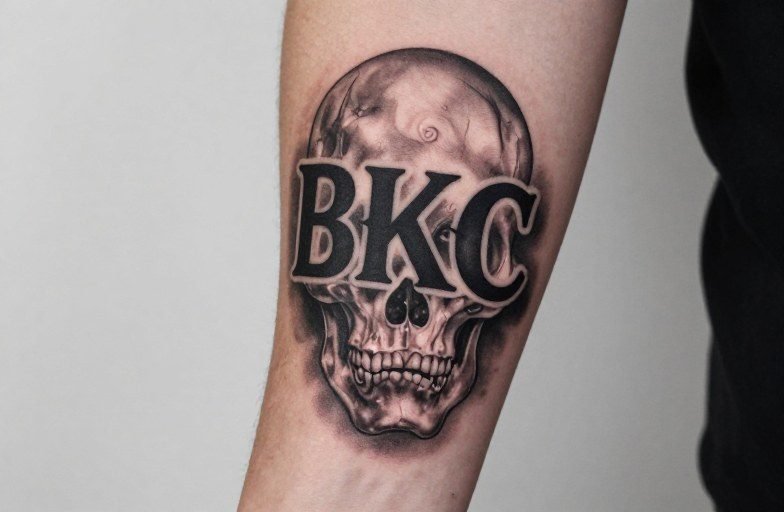
A BKC tattoo most commonly represents “Blood, Knowledge, and Cash” or “Brotherhood, Knowledge, Cash” depending on the wearer’s affiliation and intent. The three letters function as a compact code, recognizable to those inside certain circles, ambiguous to outsiders. Understanding its meaning requires looking at where it came from, who wears it, and how the design itself holds up over years on skin.
History & Cultural Roots
Street and Urban Origins
BKC emerged from late-20th-century American street culture, often linked to specific neighborhoods and regional groups rather than a single national organization. The acronym spread through hip-hop, prison culture, and local gang traditions where three-letter codes carry weight. Unlike more widely recognized symbols, BKC maintained a degree of regional specificity, strong in certain East Coast and Midwest cities, less common elsewhere. The letters might appear on their own, inside a crown, or paired with local imagery like area codes or street signs.
From Underground to Tattoo Parlor
By the early 2000s, BKC had migrated into mainstream tattoo shops, often worn by people with no direct gang affiliation but an appreciation for the aesthetic or a personal reinterpretation of the letters. This shift created tension: some artists refuse the tattoo outright, while others will execute it only after a conversation about placement and visibility. The design’s history means it carries social weight that purely decorative tattoos don’t.
How It Ages on Skin
Lettering Choices Matter Long-Term
BKC tattoos age based heavily on font selection and execution. Bold, simple block letters hold their edges for decades. Thin script or ornate Old English styles blur faster, especially on high-movement areas like the wrist, neck, or fingers. The letters B, K, and C all contain enclosed negative spaces, the loops in B, the diagonal of K, the curve of C, which are vulnerable to ink spread over time. A skilled artist compensates by keeping these spaces slightly larger than the final desired look, anticipating the natural settling that happens during the first two years.
- Inner bicep: excellent longevity, minimal sun exposure, low distortion from movement
- Forearm: moderate aging, requires touch-ups within 5-8 years if in bold black
- Neck/side of neck: high visibility, fastest fading due to constant friction and sun
- Hands/fingers: expect significant blur within 3-5 years regardless of artist skill
- Chest over pectoral: stable, though weight fluctuation can distort spacing
Color vs. Black and Grey
Most BKC tattoos execute in solid black. Adding red or blue for the “Blood” connotation accelerates fading, red pigment particles are larger and less stable, while blue often shifts toward greenish tones as it ages. If color is essential to the design, plan for periodic refresh sessions every 4-6 years.
Mythology & Folklore
No ancient mythology attaches directly to the BKC acronym itself, but the three concepts it encodes, blood, knowledge, and material success, appear across nearly every cultural tradition. Blood as sacrifice or kinship bond shows up in Norse oaths, Maori whakapapa, and countless military traditions. Knowledge as power, often guarded and transmitted selectively, echoes mystery schools from Pythagoreans to Freemasons. Cash, or its historical equivalents in land, cattle, and gold, consistently marks status and survival.
Some trace the specific BKC formulation to a synthesis of these older ideas through the lens of American urban experience: blood as loyalty test and family tie, knowledge as street smarts and survival information, cash as the measurable outcome of applying both. The acronym compresses this narrative into three letters, making it functionally similar to historical talismans that condensed protective or aspirational concepts into compact symbols.
Symbolism & Core Meaning
The Three Pillars
Each letter carries interpretive weight. Blood typically signifies loyalty, family (biological or chosen), and willingness to sacrifice. Knowledge encompasses street wisdom, formal education, or spiritual understanding depending on the wearer’s frame. Cash represents not merely money but security, success, and the tangible proof that the other two elements produce results. The ordering matters: blood and knowledge precede cash, suggesting that material gain without the first two foundations is hollow.
Placement as Message
Where the tattoo sits on the body changes its communicative function. Visible placements, neck, hands, face, signal that the meaning is public, worn as warning or declaration. Hidden placements, ribs, upper thigh, beneath clothing, suggest private commitment, personal reminder, or strategic concealment for professional contexts. The chest placement, over the heart, specifically emphasizes the “blood” component as central.
Personal & Modern Meanings
Contemporary wearers frequently divorce BKC from any organizational affiliation, redefining the letters for individual circumstances. “Blood” becomes family lineage or medical profession. “Knowledge” shifts to academic pursuit or specific expertise. “Cash” transforms into entrepreneurial ambition or financial independence goals. This personal reclamation mirrors how other loaded symbols, think nautical stars, spider webs, or certain numbers, gradually shed exclusive associations as they spread through broader tattoo culture.
Some wearers modify the acronym entirely: “Believe, Know, Create” or “Build, Keep, Conquer” among documented variations. These alternatives allow the visual format and cultural weight of the original while redirecting meaning. The risk lies in inescapable misrecognition, outsiders will read the original meaning first, and explanations become a lifelong accompaniment to the tattoo.
Design Tips & Pairings
Complementary Imagery
BKC letters pair effectively with specific visual elements that reinforce or complicate meaning. Stacks of cash, graduation caps, or family portraits literalize the three concepts. More abstract pairings, hourglasses, scales, compasses, add philosophical dimension. Crowns above the letters, often linked to specific regional traditions, amplify the status assertion while narrowing the design’s interpretive range.
- Roses or blood drops: emphasizes sacrifice and mortality, softens aggressive reading
- Books or scrolls: shifts knowledge component toward scholarship
- Dollar signs or coins: risks appearing crass, works better stylized or historical
- Clocks or dates: personalizes with specific moments of transformation
- Geometric frames: modernizes, distances from street origins
Technical Execution
For maximum longevity, request that the artist use a 7- or 9-round liner for the letterforms, with 11-mag for any fill. The K diagonal needs particular attention, too thin and it disappears; too heavy and it dominates the composition. Stipple shading around the letters adds depth without the blur risk of smooth gradients. Always view a stencil on your skin before needle touches flesh; letter spacing looks different flat on paper versus curved on a body.
Wrapping Up
BKC tattoos carry genuine historical weight from street and urban traditions, and that context doesn’t disappear regardless of personal intent. The design demands careful technical execution due to its letterform complexity, and it ages predictably based on placement and font choice. Modern wearers can reinterpret the acronym, but the original meaning remains culturally legible and may require ongoing explanation. If you’re considering this tattoo, the most important decision isn’t design, it’s if you’re ready to carry its full social history alongside your personal interpretation of it.
Frequently Asked Questions
Will people assume I’m in a gang if I get a BKC tattoo?
In many areas, yes, especially with visible placement. The acronym originated in street culture and retains that association regardless of personal intent. Consider placement carefully and be prepared to explain your specific meaning.
What’s the best font for a BKC tattoo that won’t blur?
Bold sans-serif or simple block letters age best. Avoid thin script or highly detailed Old English on high-movement areas. The enclosed spaces in B and C need extra room to accommodate natural ink spread over time.
Can I change the meaning to something personal like ‘Believe, Know, Create’?
You can, but the original meaning will still be read first by many viewers. Personal reinterpretations work best when paired with imagery that supports your alternative definition, not just the letters alone.
How much touch-up will a BKC tattoo need?
Black letterforms on stable placements like the inner bicep may need minimal touch-up for 10-15 years. Finger or neck placements often require refresh within 3-5 years. Color additions, especially red, fade faster and need more frequent maintenance.
Related Tattoo Meanings
- Blackberry Tattoo Meaning: Growth, Resilience Hidden Depth
- Blackbird Tattoo Meaning: Symbolism, Styles What to Know
- Blessing Thai Tattoo Meaning: Sacred Ink and Its Significance
- Explore more