
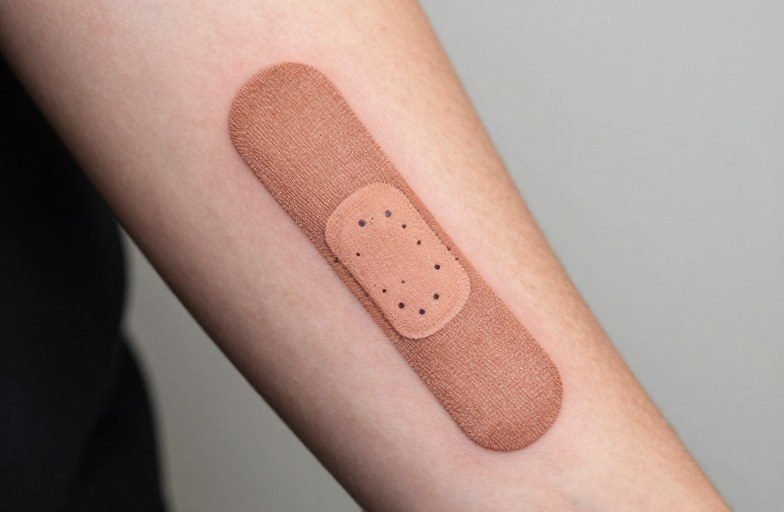
A band aid tattoo most commonly represents healing, physical, emotional, or psychological. Some people get it to mark surviving something difficult: addiction, grief, illness, a breakup. Others use it as dry humor, a way of saying “I’m fine” when they’re visibly not. The small size and everyday object make it approachable, but the meaning underneath runs from lighthearted to deeply serious depending on the person wearing it.
Symbolism & Core Meaning
The band aid is a universal symbol of temporary repair. Unlike a cure, it doesn’t fix the wound, it covers it, protects it, lets the body do the actual work. That distinction matters. A band aid tattoo acknowledges that healing is a process, not an event.
Covering What Hurts
Many who choose this design have something they want to acknowledge without displaying. The band aid sits over a scar, near a former injury site, or above the heart. Placement often carries the message: a band aid on the ribs guards something vulnerable; one on the forearm says “I’ve been hurt and I’m dealing with it openly.”
The “I’m Fine” Irony
There’s a specific dark humor to slapping a cartoon band aid on a serious problem. This resonates with people who use self-deprecating humor as a coping mechanism. The tattoo becomes a visual shrug, a way to name the struggle without making others uncomfortable. It can also mock the pressure to appear okay when you’re not.
Personal & Modern Meanings
Beyond the classic symbolism, people assign highly specific personal meanings to band aid tattoos. These rarely appear in generic tattoo meaning lists, but they show up constantly in consultations.
Mental Health & Neurodivergence
For some, the band aid marks a period of psychiatric treatment, a diagnosis, or ongoing management of conditions like depression, anxiety, or ADHD. It functions as a quiet signal to others who recognize it, and as self-recognition, proof that the work of staying functional counts as work. A small band aid behind the ear or on the inner wrist stays visible to the wearer more than to the world.
Relationship to the Body
People with chronic illness or pain sometimes get band aid tattoos near the site of symptoms they can’t control. The tattoo doesn’t claim victory over the condition; it names the ongoing negotiation. Others use it after surgery, marking where something was removed or repaired. In these cases, the band aid often pairs with dates, initials, or tiny text.
Design Tips & Pairings
The band aid’s simple shape makes it adaptable, but small details change the tone significantly. Line weight, whether the “pads” are filled or open, and the presence of a crinkle or tear all shift the reading from clinical to cute to melancholy.
Line Work vs. Shading
A clean single-needle outline reads as minimalist and modern. It ages well if kept large enough, below an inch, the central gap between pads can blur into a solid rectangle over time. Adding light grey wash to the pads creates depth but requires more frequent touch-ups; that grey fades faster than black line work. Some artists add a tiny drop of “blood” or a heart in the center pad. Keep any internal detail bold enough to hold at small sizes.
Common Pairings
- Over a scar: The tattoo literally covers or frames existing tissue, turning concealment into statement
- With text: “Ouch,” “This too shall pass,” or a date, keep lettering simple, no smaller than 10pt equivalent
- Multiple band aids: A cluster suggests repeated injury, or a family/group who’ve shared a loss
- Peeling corner: Shows the wound underneath, sometimes a heart, sometimes a word, sometimes nothing
Color vs Black and Grey
Color choices for band aid tattoos are surprisingly loaded. The classic beige “flesh tone” band aid carries its own cultural weight, whose flesh?, that some artists and clients deliberately subvert.
The Classic Beige Problem
Opting for the standard beige box color can read as nostalgic, clinical, or uncomfortably specific to light skin. Many artists now offer rainbow, neon, or patterned band aids that reference real products (the bright colors of children’s bandages, the dark fabric ones, the clear waterproof versions). These choices often signal something about the wearer’s relationship to care, who cared for them, what kind of care they needed.
Black and Grey Options
Stripped of color, the band aid becomes more abstract. Heavy black fill on the pads with negative-space “holes” creates a graphic, almost punk feel. Soft grey wash throughout feels more somber, more medical illustration. Black and grey also ages more predictably; colored band aids can look muddy as pigments separate and fade unevenly.
Who Chooses This Tattoo
There’s no single demographic. The band aid crosses age, gender, and style boundaries more than most motifs. However, certain patterns emerge in placement and context.
Younger clients often want the band aid as part of a larger collection of small, meaningful tattoos, part of a patchwork sleeve or scattered hand pieces. Older clients sometimes arrive with a specific event in mind, wanting one focused piece rather than accumulation. People in healthcare professions occasionally get band aid tattoos as dark occupational humor, a way to mark what they witness and absorb. Survivors of specific events, overdose, assault, suicide attempts, sometimes use the band aid as a milestone marker, often placed where they or others can see it during hard moments.
The tattoo’s small scale makes it accessible for first-timers, but that same small scale means it can be hidden easily. Some want it seen; some need the option of concealment. Both choices are meaningful.
Religious & Spiritual Angles
The band aid isn’t traditionally a religious symbol, but spiritual interpretations have developed around it, particularly in recovery communities and faith-based healing contexts.
Christian Readings
Some connect the band aid to the concept of being “washed and bandaged” in biblical healing narratives, or to the Good Samaritan story. The band aid becomes a stand-in for neighborly care, for being tended to when vulnerable. Crosses or ichthys symbols placed inside or near the band aid make this explicit. Others reject this, preferring the band aid stay secular, human care rather than divine intervention.
Broader Spiritual Frameworks
In Buddhist-informed practice, the band aid can represent the temporary nature of all fixes, the recognition that no external solution is permanent. In pagan or witchcraft communities, small protective symbols on the pad turn the band aid into a talisman. The act of tattooing itself, needle as wound, then healing, mirrors the band aid’s function, creating a meta-layer some find meaningful.
What to Remember
The band aid tattoo works because it’s ordinary. Everyone has used one; everyone knows the feeling of needing temporary relief. That shared reference lets the tattoo carry weight without heaviness, or humor without dismissal.
If you’re considering this design, think about placement in terms of who needs to see it, you, or others. Consider whether you want the classic shape or something that references a specific product, color, or memory. Talk to your artist about scale; too small, and the detail disappears into a blur. Too large, and the everyday quality that makes it resonate can feel lost.
Most importantly, know that the band aid doesn’t claim you’re fixed. It says you’re in process. That’s a different kind of strength, and for many people, a more honest one.
Frequently Asked Questions
Does a band aid tattoo over a scar actually cover it?
Tattooing over scar tissue is possible but requires an experienced artist and healed scars, typically at least a year old. The band aid design can draw attention to the area rather than away from it, so consider whether you want the scar integrated or framed.
How small can a band aid tattoo be before it blurs?
Below one inch, the gap between the center pad and border risks closing up over time. For longevity, aim for at least 1.5 inches in length, with line work bold enough to hold, think 3RL or heavier for the outline.
Why do some people get multiple band aid tattoos?
Clusters can represent repeated struggles, different people lost or survived, or simply an aesthetic choice. Each additional band aid changes the reading from singular event to ongoing pattern or collective experience.
Is the band aid tattoo only for people who’ve been through trauma?
Not at all. Some choose it purely for the visual humor, as a nursing tribute, or because they like the graphic simplicity. The meaning is determined by the wearer, not required by the image.
Related Tattoo Meanings
- Blackberry Tattoo Meaning: Growth, Resilience Hidden Depth
- Blessing Thai Tattoo Meaning: Sacred Ink and Its Significance
- Bow Back Thighs Tattoo Meaning: Symbolism Design Guide
- Explore more









