
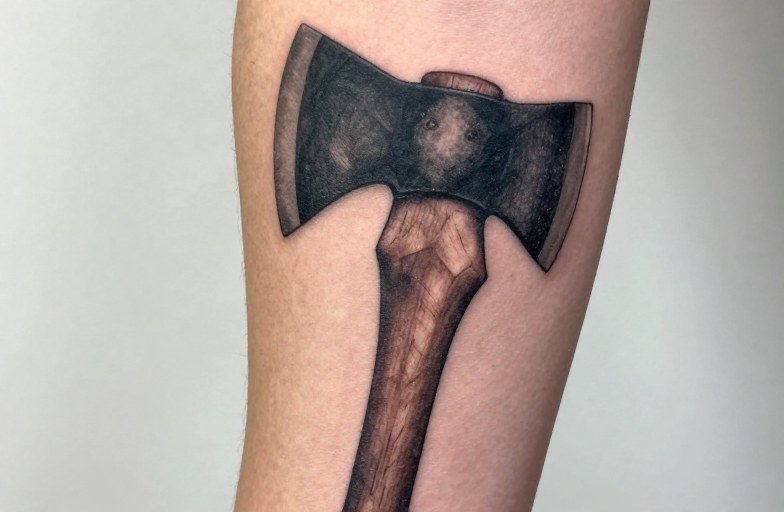
An axe tattoo most commonly signals personal power, decisive action, and the ability to sever ties with the past. Beyond the obvious warrior associations, the axe represents transformation, the tool that fells old growth to clear space for something new. Its meaning tightens or loosens depending on whether you choose a historical war axe, a woodsman’s felling axe, or something more stylized and abstract.
History & Cultural Roots
The axe predates the sword as a weapon and tool across nearly every human civilization, which makes its tattoo symbolism unusually broad. Understanding where your specific design originates helps ground the piece in something more specific than generic “strength.”
Norse & Viking Associations
The bearded axe of the Viking Age remains the most requested style in shops today. These weren’t uniform weapons, some were specialized for hooking shields, others for shipboard fighting where a sword swing could catch on rigging. The historical variety gives you real options: a broad, ornate Dane axe suggests martial prowess and status, while a simpler utility axe leans toward self-reliance and survival. Runes paired with these designs often reference specific sagas, though many clients choose them for aesthetic balance rather than literal translation.
Native American & Indigenous Symbolism
Tomahawks and pipe axes carry distinct cultural weight that shouldn’t be treated as interchangeable with European designs. The pipe tomahawk specifically, dual-purpose tool and ceremonial object, represents diplomacy and duality when rendered accurately. If you’re drawn to this imagery, the specific tribal origin and historical context matter enormously. Appropriation concerns aside, inaccurate designs simply age poorly; a tomahawk with obviously wrong proportions or anachronistic details looks amateurish within a few years.
Personal & Modern Meanings
Contemporary axe tattoos often divorce the image from warfare entirely, focusing instead on what the tool does: cutting, splitting, shaping raw material into something useful.
Recovery & Letting Go
Splitting wood is exhausting, repetitive, and ultimately productive, this metaphor resonates strongly with people who’ve cut toxic relationships, addictions, or dead-end situations out of their lives. The axe becomes a private marker of that labor, not the dramatic moment of severance but the ongoing work of clearing debris. Designs in this vein often show the axe mid-swing or embedded in a stump rather than displayed as a clean weapon.
Skilled Trades & Craft Identity
Carpenters, loggers, and wildland firefighters sometimes choose axe tattoos as professional emblems, similar to how sailors once collected specific nautical imagery. These pieces tend toward realistic rendering, visible grain in the handle, correct head geometry, maybe a specific manufacturer’s marks reproduced faithfully. The meaning here is membership and competence rather than aggression.
Design Tips & Pairings
The axe’s elongated shape creates specific composition challenges and opportunities that simpler symbols don’t present.
Line Work vs. Shading Approaches
Clean single-needle outlines suit smaller pieces and emphasize the axe as icon or symbol. Heavy blackwork or whip shading, by contrast, brings out material texture, weathered wood, forged steel, rust patina. The latter approach demands more skin real estate; a two-inch axe head with full shading turns muddy within five years as ink spreads. For anything under four inches, consider limiting shading to the head alone and leaving the handle as bold line work.
Common Pairings That Actually Work
- Wood and stumps: Grounds the axe in action rather than display; the split log or fresh chips add narrative context.
- Roses or botanical elements: The contrast between tool and organic growth works visually, but the combination risks cliché unless the plant choice is specific (thistle, regional wildflower, meaningful tree species).
- Skulls: Straightforward mortality reference; execution quality determines whether this reads as thoughtful or juvenile.
- Geometric frames: The axe’s straight lines complement hexagons, triangles, or compass-derived shapes without competing for attention.
Avoid pairing axes with unrelated fantasy elements, dragons, unrelated tribal patterns, or generic “tough” imagery like barbed wire. The axe already carries weight; overloading the composition dilutes it.
Best Placements
The axe’s vertical or diagonal orientation suits certain body areas far better than others.
Forearm & Calf
These cylindrical surfaces let the handle run with the bone, creating natural flow. The forearm’s visibility means detail remains readable, though sun exposure will fade lighter shading faster than on the calf. Either location accommodates medium-sized pieces (four to seven inches) without distortion from movement.
Ribcage & Thigh
Larger compositions fit here, especially axe-and-stump or axe-in-landscape scenes. The ribcage’s curve can distort straight handles if the design isn’t adapted to follow the body’s geometry; an experienced artist will tilt the axe slightly rather than forcing absolute vertical. Thighs offer the most forgiving canvas for learning how this tattoo will look at scale before committing to more visible placement.
Hands, Fingers, Neck
Small axe designs on fingers or hands suffer from rapid fading due to constant use and sun exposure. The image’s complexity doesn’t reduce well to sub-two-inch sizes, the head becomes a blob, the handle a line. Neck placement faces similar scale constraints and carries heavy employment consequences that few other placements share.
Who Chooses This Tattoo
There’s no single demographic, but patterns emerge in the specifics people request.
Men still request axe tattoos more frequently than women, though the gap has narrowed significantly in the last decade. Women choosing the design often gravitate toward smaller, more stylized versions or pair the axe with elements that complicate its purely aggressive reading, botanical wreaths, specific animal companions, or text that reframes the symbolism.
Age tends to correlate with style rather than subject: younger clients often want bold, graphic, sometimes cartoon-influenced axes with bright color or heavy black outlines. Clients over thirty-five more often request realistic or historically grounded pieces with muted palettes. Neither choice is superior, but the mismatch between age and style sometimes produces tattoos that feel borrowed rather than owned.
People in recovery communities, skilled trades, outdoor professions, and military or veteran populations all show up with axe concepts, but the reason within each group differs enough that the tattoo shouldn’t be treated as uniform.
Similar & Related Symbols
If you’re considering an axe but haven’t committed, related imagery might serve your specific meaning more precisely.
- Sword or dagger: More formal, more martial, less utilitarian; better for honor or oath-keeping symbolism.
- Hammer: Construction rather than destruction; creation and repair rather than severance. The hammer and axe together form a traditional blacksmith or labor pairing.
- Scythe: Time, harvest, inevitability; less active agency than the axe implies.
- Chainsaw: Modern logging equivalent, but reads as horror-movie reference or ironic commentary more often than genuine craft symbol.
- Broken or rusted axe: Exhaustion, obsolete tools, past labor; the opposite of the sharp, ready axe’s implication of ongoing capability.
The hatchet specifically, shorter handle, single-handed use, carries more intimate, personal connotation than the full axe. Camping, survival, close-quarters self-reliance. If your meaning is individual rather than collective, the hatchet may fit better.
Final Word
An axe tattoo succeeds when its specific style and placement match the specific reason you’re drawn to it. The generic “strength” reading is available but thin; better pieces come from knowing whether you mean the axe as weapon, tool, metaphor for cutting ties, or marker of craft identity. Bring reference images of actual historical axes, not tattoo interpretations of tattoo interpretations. The difference between a bearded Dane axe and a Michigan pattern felling axe is enormous in both form and implication, and that specificity is what separates a meaningful piece from mere decoration. A good artist will push you on this, what axe, what context, what action, because the answers determine everything about how the tattoo should look and where it should sit on your body.
Frequently Asked Questions
Do axe tattoos always have to look aggressive or violent?
Not at all. A utility axe embedded in a stump, a worn carpenter’s hatchet, or a stylized geometric interpretation can read as craftsmanship, transformation, or quiet capability rather than aggression. The surrounding elements and rendering style determine emotional tone more than the subject itself.
How well does fine detail in an axe head age over time?
Poorly if overdone. Intricate knotwork inside a small axe head, tiny runes, or photorealistic rust texture will blur within five to seven years as ink naturally spreads. For longevity, keep the head’s primary shapes bold and save fine detail for larger pieces where the spread won’t destroy readability.
Is it culturally appropriate for anyone to get a Viking-style axe tattoo?
The bearded axe as a general historical object isn’t closed to any group, but specific combinations, runes you haven’t researched, valknut or other sacred symbols paired without understanding, or imagery associated with modern hate movements, carry real problems. Do your homework on any symbolic additions beyond the axe itself.
What’s the typical price range for a quality axe tattoo?
A small, simple axe in linework might run $150-300 at a reputable shop. Detailed black-and-gray or color pieces at four to six inches typically fall in the $400-800 range, with full forearm or larger compositions extending higher. Historical accuracy and custom composition take more design time than flash pieces, which affects pricing.
Related Tattoo Meanings
- Deeper Meaning Tattoo: Symbolism, Aging, and Style Choices
- Fudog Tattoo Meaning: Guardian Lions, Protection Power
- Hercules Tattoo Meaning: Strength, Labor, and Redemption
- Explore more









