
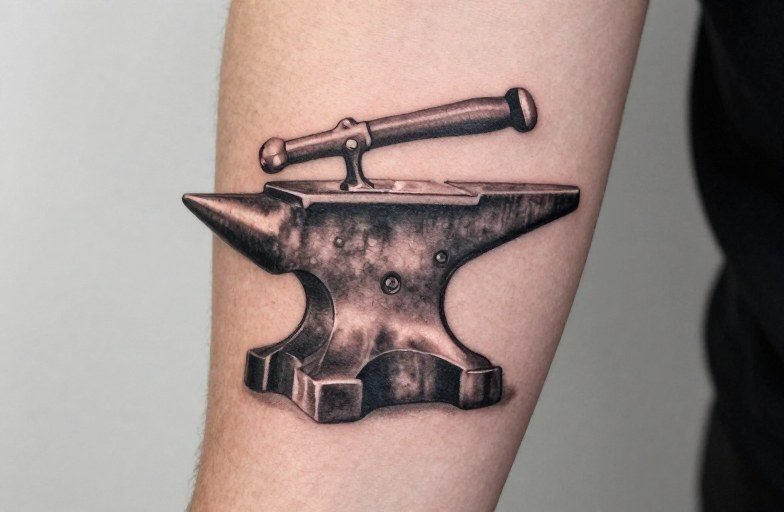
An anvil tattoo represents endurance under pressure, the dignity of skilled labor, and transformation through repeated strikes. For most people who choose it, the image carries weight literally and figuratively: it is the unmoving object that shapes everything else, the foundation that takes the blow so the work can happen.
Symbolism & Core Meaning
The Weight of Resilience
Unlike symbols of speed or aggression, the anvil speaks to staying power. It does not move; it withstands. That stillness carries its own kind of strength. In tattoo form, this often appeals to people who have endured prolonged hardship, recovery from injury, long-term caregiving, years of building something from nothing. The anvil does not celebrate the moment of victory; it honors the grinding process that precedes it.
Creation Through Destruction
Every hammer blow on an anvil is a small act of violence that produces something useful. The symbol captures that paradox: beauty and function emerging from force and friction. This duality makes it flexible. A blacksmith’s anvil carries different nuance than an anvil paired with a broken chain, or one sprouting flowers from its horn. The core remains, pressure creates, but the surrounding elements shift the emphasis.
History & Cultural Roots
Smithing Traditions
The anvil’s tattoo lineage is often linked to blacksmithing and metalworking cultures, though its symbolic use predates organized trade guilds. In Norse and Germanic traditions, dwarven smiths forged legendary weapons on anvils, tying the object to mastery and hidden knowledge. Some trace its tattoo popularity to maritime culture, where ships needed constant metal repair and smiths held respected, semi-magical status among crews. The image carried across to American traditional tattooing partly through sailor exposure to these working-class symbols.
Modern Working-Class Iconography
During the 20th century, the anvil became shorthand for honest labor in political and union imagery. Tattoo adoption followed, particularly among people in trades, manufacturing, and manual professions who wanted to mark their identity without corporate logos or military insignia. The symbol functioned as self-identification rather than organization membership.
Best Placements
Where the Weight Sits
Forearms and outer biceps dominate anvil placement because the image reads clearly at medium scale and benefits from the natural cylindrical shape of the limb. A vertical anvil on the outer forearm, horn pointing toward the elbow, follows the arm’s anatomy without distortion. Thighs and calves work well for larger pieces that incorporate surrounding elements, hammers, coals, sparks, or scrollwork.
Hands and fingers rarely suit an anvil; the detail collapses at small scale and the dense black shading required ages poorly in high-wear zones. Chest and back placements work for substantial compositions, particularly when the anvil anchors a larger scene of workshop or forge imagery. Ribs and stomach are less common due to the distortion from breathing and body movement, which can warp the anvil’s rigid geometry over time.
- Forearm: best for medium detail, easy to show or cover
- Outer bicep: classic, ages well with muscle definition
- Thigh: accommodates larger scale and surrounding elements
- Calf: stable skin, good for vertical compositions
- Chest/back: suited for narrative or multi-object pieces
Color vs Black and Grey
The Case for Black and Grey
Most anvil tattoos live in black and grey, and for practical reasons. The object’s surface is matte, non-reflective, and textured, color adds little visual information. Greywash can suggest the slight sheen of polished steel or the dust of a working forge without departing from the monochrome palette. Over time, black and grey holds sharper edges and clearer contrast than color, which matters because anvil tattoos rely on geometric precision for their impact.
When Color Works
Color becomes useful when the anvil serves as background or counterweight to a brighter subject. A glowing orange forge behind it, red-hot metal on its face, or a blue-hot steel piece being worked, these justify limited, purposeful color. Full-color anvils exist but tend toward illustrative or neo-traditional styles where the object is stylized rather than realistic. The risk is muddying the symbol’s starkness; the reward is narrative context.
Personal & Modern Meanings
Beyond literal metalworkers, the anvil has broadened to mark anyone who feels shaped by sustained pressure. Athletes recovering from career-threatening injuries, musicians who practiced through rejection, parents raising children alone, none touch an actual anvil, but the metaphor translates cleanly. The tattoo functions as private acknowledgment rather than public explanation. Some pair it with dates, coordinates, or small secondary images that specify the pressure being referenced, though many leave it unadorned to preserve ambiguity.
Contemporary variations include broken anvils (endurance pushed past limit), anvils with roots or vegetation (industry reclaimed by nature), and anvils dissolving into geometric shapes (traditional craft meeting digital precision). Each variation keeps the core symbol while pushing its meaning into new territory.
Who Chooses This Tattoo
Professions and Identities
Actual smiths, welders, and machinists choose anvil tattoos at notable rates, but so do people in physically demanding or precision-focused fields: carpenters, chefs, surgeons, military engineers. The common thread is work that requires both patience and physical engagement, where the mind and body solve problems together.
Life Stage and Timing
Anvil tattoos rarely appear as first tattoos. They tend to follow something: a completed apprenticeship, a survived crisis, a career change into hands-on work. The timing suggests the symbol’s weight feels earned rather than aspirational. Someone who has not yet been tested often gravitates toward more active, aggressive imagery; the anvil appeals after the testing has happened and the person recognizes what they withstood.
Final Thoughts
The anvil tattoo endures because its meaning is specific yet spacious. It does not demand explanation, but it rewards attention. In execution, it favors clean lines and solid black over flourish and color. In meaning, it honors the unglamorous middle of any difficult process: not the dramatic moment of breaking through, but the thousands of undramatic moments that built the capacity to break through. For people who have lived that middle, the symbol needs no translation.
Choose an artist who understands how to render weight in two dimensions, how to make flat black ink feel like mass sitting on bone. The difference between a generic anvil and a compelling one lies in subtle shadow work, in the slight irregularity of a hand-forged surface, in the patience to build density without losing edge. Like the object itself, the tattoo rewards the work put into it.
Frequently Asked Questions
Does an anvil tattoo always mean I’m a blacksmith?
No. While actual smiths do choose this design, most people wear it for the broader symbolism of endurance, pressure, and skilled labor. The meaning depends on your personal context, not your profession.
How well does an anvil tattoo age over time?
Black and grey anvil tattoos generally age well because they rely on solid black fill and strong outlines rather than fine detail. Avoid excessive small linework or subtle grey gradients that can blur within five to ten years.
Can an anvil tattoo be small and simple?
It can, but the symbol loses impact below three to four inches. The anvil’s visual weight comes from its density and geometry, which become muddy or cartoonish at very small scale. Medium to large works better.
What objects pair well with an anvil in a tattoo design?
Hammers, tongs, and forge fires are traditional pairings that reinforce the working context. Broken chains, growing plants, or text banners can shift the meaning toward liberation, growth, or personal motto.
Related Tattoo Meanings
- Ant Tattoo Meaning: Hard Work, Teamwork Quiet Strength
- Apostrophe Tattoo Meaning: Pause, Possession, and Purpose
- Astronaut Tattoo Meaning: Isolation, Courage, and the Unknown
- Explore more









