
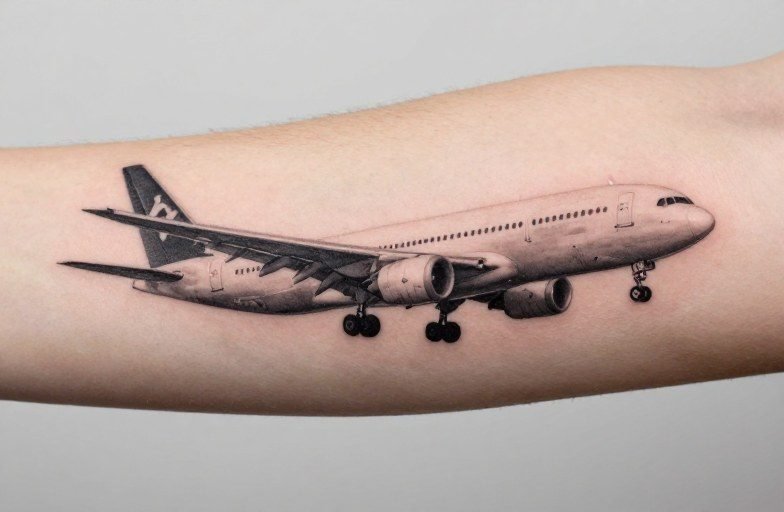
An aeroplane tattoo most commonly represents freedom, travel, and the deliberate choice to leave something behind. It can mark a literal journey, immigration, a life-changing trip, a career in aviation, or stand for ambition, escape, or the willingness to be uncomfortable in pursuit of something new. The meaning depends heavily on direction, style, and what accompanies the aircraft: a plane ascending suggests striving; one descending, arrival or return; a crashed or burning plane, survival or loss.
Design Tips & Pairings
Placement and Flow
Aeroplanes work best where their natural lines fit the body. A side-view silhouette stretches beautifully along the forearm, collarbone, or ribs. A top-down view, wings spread flat, sits well on the chest, back between shoulder blades, or the flat plane of a thigh. The trailing smoke or contrail is your friend; it creates motion and can connect to other elements or wrap around anatomy. Avoid cramming a detailed plane into a spot smaller than a palm; the wings, tail, and landing gear blur together when too small. For tiny tattoos, choose a simple outline or a single-engine propeller viewed head-on.
What to Pair With
Compasses and coordinates ground the travel theme in specificity, actual latitude and longitude of a meaningful place. Maps, whether folded or torn, add narrative texture. Paper planes paired with a real aircraft create a before-and-after: childhood dream versus adult execution. Clouds soften the edges and add depth; storm clouds versus fluffy cumulus completely shift the tone. Avoid overloading; the plane itself is already a busy shape. One strong secondary element beats a cluttered scene.
- Forearm or calf: ideal for side-profile planes with contrails
- Ribs or sternum: suits top-down views, but expect more pain and touch-ups
- Behind the ear or wrist: stick to minimal outlines, no shading
- Upper back/shoulder blades: room for dogfighting pairs or squadron formations
Similar & Related Symbols
The aeroplane sits in a family of transit and transformation imagery, each carrying slightly different weight. Ships and anchors share the travel theme but lean harder into nostalgia, permanence, or homecoming, sailors return; planes just land somewhere else. Hot air balloons suggest leisure and drift rather than purpose and speed. Rockets push toward futurism, ambition, even aggression. Birds are the obvious parallel, but they carry nature, spirit, and fragility where planes carry engineering and human will.
Paper planes specifically deserve mention. They bridge childhood and adulthood, imagination and limitation. A crumpled paper plane hits different than a crisp one. A paper plane transforming into a real jet is a common visual metaphor for dreams realized, though it walks close to cliché unless executed with restraint.
Mythology & Folklore
Flight in Human Imagination
Mechanical flight lacks the ancient mythological pedigree of wings, but it inherits that longing. Icarus, wings melted by hubris, often gets linked to aviation tattoos as a warning against overreach. Some trace the modern fascination to early 20th-century wonder at conquering gravity, a Promethean act that felt like stealing from the gods. The Wright brothers and early aviation pioneers were treated almost as mythic figures in their time; their machines appeared in art deco and futurist movements as symbols of human progress.
War and Memorial
Military aircraft carry heavy specific meaning, often linked to particular conflicts, squadrons, or family service. Spitfires, Mustangs, and B-17s are common memorial choices. A plane with nose art references a specific era and camaraderie. These designs usually avoid abstraction; accuracy matters, and artists research rivet patterns, insignia, and paint schemes. The meaning here is rarely about travel as pleasure. It is about duty, loss, survival, and belonging to something larger.
Color vs Black and Grey
When Color Works
Color makes sense for specific aircraft: the red of a baron, the olive drab of military planes, the silver and blue of commercial liveries. Sunset backdrops with orange and purple gradients are popular but age poorly; those soft color transitions blur and muddy within five to seven years. Solid blocks of color, flags, roundels, insignia, hold better. Watercolor-style splashes behind a plane can suggest motion and atmosphere, though they require an artist experienced in that specific technique.
Black and Grey Advantages
Most aeroplane tattoos benefit from black and grey. The subject is inherently structural: metal, rivets, glass, shadow. Greywash captures the cylindrical body, the underside darkness, the reflective canopy. Line work alone suits small pieces and maintains clarity as it ages. Black and grey also ages more predictably; color saturation in travel-exposed areas (forearms, calves) fades faster from sun. If you want a plane that still reads as a plane in fifteen years, restraint with color usually wins.
- Black and grey: better for detail, structure, longevity
- Limited color accents: roundels, tail markings, small flag elements
- Full color: best for specific aircraft identification or sunset/night sky scenes
- Line-only: ideal for small, high-movement placements
Who Chooses This Tattoo
The Literal Travelers
Pilots, flight attendants, and aviation mechanics often choose accurate depictions of their aircraft type. These are frequently placed where they can be shown or hidden, upper arm, ribs, back of calf. The meaning is identity and pride in craft. Frequent travelers sometimes mark a specific trip that changed them: a gap year, a move abroad, a solo journey. Coordinates or dates paired with the plane make it personal without requiring explanation.
The Metaphorical Fliers
People leaving difficult situations, addiction, abuse, dead towns, use the plane as departure made visible. This overlaps with the phoenix or bird imagery but feels more deliberate, less natural. A plane requires fuel, planning, a runway. It does not just rise; it is built to leave. Entrepreneurs and ambitious types sometimes choose planes for similar reasons: the willingness to go where others do not, the comfort with being airborne and alone.
Common Variations & Styles
Traditional American style planes, bold lines, limited color, banner scrolls, reference WWII nose art and travel posters. They read as vintage, nostalgic, patriotic. Neo-traditional allows more detail and softer color while keeping that illustrative quality. Realism demands a skilled artist; aircraft have complex perspective, and a slightly off wing angle ruins the whole piece. Photorealistic engines and spinning propellers are particularly hard to render in skin.
Minimalist and geometric versions strip the plane to triangles and lines. These work small and read instantly. Abstract contrails, just the white line across skin, are subtle to the point of obscurity; most viewers will not recognize the reference without context. Steampunk variations add gears and brass, though this trend has faded since its peak in the early 2010s. Biplanes and propeller aircraft carry vintage romance; jets and spacecraft lean modern or futuristic.
- Traditional/neo-traditional: bold, readable, ages well
- Realism: requires specialist, high maintenance for clarity
- Minimalist/geometric: small, versatile, risks being too abstract
- Blackwork/linework: strong contrast, good for long-term legibility
The Takeaway
An aeroplane tattoo works when it respects the subject’s inherent geometry and chooses its companions carefully. The meaning is not mysterious: departure, arrival, ambition, survival, or simple love of flight. What matters is specificity, your plane, your direction, your sky. A generic aircraft with generic clouds says generic things. One with your grandfather’s squadron markings, or the coordinates of the city you escaped, or the paper plane you threw as a child, carries actual weight. The best aviation tattoos understand that flight is not just movement through air but the decision to leave ground behind.
Frequently Asked Questions
Does an aeroplane tattoo always mean someone loves to travel?
Not necessarily. While travel is common, many people choose it for ambition, escape from difficult circumstances, military service, or aviation careers. Context like direction, accompanying elements, and style reveal more than the plane itself.
What direction should the plane face for the best meaning?
Ascending planes suggest striving and ambition; descending ones imply arrival or return. Side-to-side movement reads as journeying. There’s no wrong direction, but the choice should match your intent rather than defaulting to upward.
How well do detailed plane tattoos age over time?
Fine details like rivets, thin propeller blades, and small text tend to blur and spread. Simpler designs with stronger contrast age better. If you want heavy detail, plan for larger size and placement on stable skin with less movement.
Is it disrespectful to get a military aircraft tattoo without serving?
Specific squadron insignia, medals, or memorial designs can be sensitive. Generic aircraft types are generally fine. If you’re honoring a specific person, accuracy matters, research with care or consult someone with direct knowledge.
Related Tattoo Meanings
- Amor Fati Tattoo Meaning: Embracing What Comes
- Andreas Gustafsson Back Tattoo Meaning: Symbolism Style Guide
- Angel with Gun Tattoo Meaning: Duality, Protection Rebellion
- Explore more









