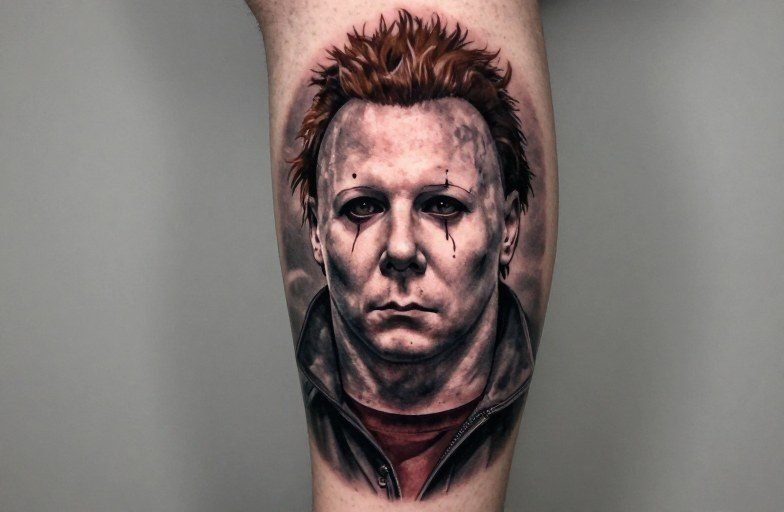
A realistic Michael Myers tattoo translates the Halloween slasher into skin through photorealistic portraiture, heavy on shadow work, mask texture, and the flat, dead quality of his eyes behind the white Captain Kirk-derived face. Done well, these pieces feel like a film still frozen in flesh, minus the safety net of a screen between you and the figure. The style demands technical precision: smooth gradients for the mask’s latex sheen, pinpoint detail in the eye holes, and usually a background that reinforces the mood without cluttering the composition.
Cost & Sessions
These pieces run expensive because of the sheer density of information packed into a small area. A palm-sized realistic portrait of the mask starts around $400-600 in most metro areas. A full forearm or thigh piece with background elements, fence posts, autumn leaves, the Haddonfield house, can hit $1,500 to $3,000 depending on the artist’s rate and geographic location.
Session Breakdown
Most realistic Myers tattoos need multiple sessions. A medium-sized piece (6-8 inches tall) typically takes two to three sessions of 3-4 hours each. The first session lays in the dark foundation and basic mask shape. The second builds the mid-tones and starts the fine detail in the eye holes and weathering on the mask surface. A third session, if needed, punches in the highest highlights and tightens edges that softened during healing.
- Small mask portrait (3-4 inches): 1 session, 3-5 hours
- Medium with simple background: 2-3 sessions
- Large sleeve or leg piece with complex environment: 4-6 sessions
- Touch-ups after healing: usually included in initial price, ask upfront
Artist Rate Reality
Horror realism specialists command premium rates. An artist known for cinematic portraits might charge $200-400 per hour versus a generalist at $150. The difference shows in how the mask reads, whether it looks like a flat white oval or has the subtle blue-gray undertones of actual latex under streetlight. Budget for quality here; a cheap realistic portrait ages into a blurry mess faster than almost any other style.
Linework & Technique
Realistic Myers tattoos rely almost entirely on needle grouping variation and machine speed, not bold outlines. The mask edge might get a whisper-thin “foundational line” that gets buried under shading, but traditional tattoo outlining would kill the illusion immediately.
Needle Selection
Artists typically use tight round liners (3RL, 5RL) for the eye holes and any hair detail, magnum shaders (7M1, 9M1) for the broad mask surfaces, and curved magnums for the soft gradients in background fog or skin tones if the piece includes a victim or reference to young Michael. The mask’s weathering, those subtle cracks and nicotine stains from the 1978 original, gets built through stippling and whip-shading, not lines.
Texture Building
The mask’s surface is the make-or-break element. Real latex has a slight sheen, micro-creases at the edges, and absorbs light differently than skin. Good artists replicate this through:
- Cool gray undertones beneath warm white highlights
- “Reflected light” along the mask’s edge facing away from the light source
- Pinpoint black dots for eye-hole depth, not solid black pools
- Soft, almost airbrushed transitions between the mask and any visible neck/jumpsuit
Color vs Black and Grey
Black and grey dominates realistic Myers tattoos for good reason. The original 1978 film was shot in autumnal daylight and blue-night tones that translate naturally to monochrome ink. A black and grey piece captures the flat, soulless quality of the character better than color in most cases.
When Color Works
Color enters realistically through specific references: the orange of jack-o’-lanterns, the brown of fence posts, the particular blue of 1978 film stock night scenes. Some artists do full-color pieces based on the Rob Zombie remake’s grittier palette, but that’s a different aesthetic, more saturated, more visceral, less ghostly. If you want color, commit to a specific film still as reference rather than asking the artist to invent a palette.
Color Aging Concerns
White ink, often used for mask highlights, yellows and fades within 2-5 years depending on sun exposure and skin type. Orange pumpkin tones can shift toward brown. Black and grey ages more predictably: blacks soften to charcoal, grays stay readable longer. For a piece meant to look like a frozen moment of dread, predictable aging usually wins.
Modern Variations
The basic mask portrait has splintered into several substyles as the horror tattoo scene matured. Each variation carries different technical demands.
Split-Face and Deconstruction
Some designs split the mask vertically, showing the burned or aged face beneath from later films, or juxtapose young Michael (the clown costume, the knife) with adult Myers. These require careful attention to scale and lighting consistency, two light sources that don’t match will break the realism. The split also creates a natural composition line that artists use to flow the piece around body contours.
Environmental Portraits
Instead of floating mask, the piece places Myers in a scene: the Haddonfield porch, the Doyle house stairs, the hedge-lined sidewalk. These read more like cinematic stills and demand background detail at the same resolution as the face. The tradeoff is scale, you need more skin real estate to keep the mask large enough for detail. Thighs and full backs work better than forearms for this approach.
- Minimalist mask-only: high impact, works anywhere, ages cleanly
- Split/composite: narrative density, harder to execute consistently
- Environmental: immersive, requires large placement, shows artist’s range
- Negative space/ghosted: mask emerging from black fog, dramatic but risks muddiness
Best Placements
The mask’s oval shape and vertical orientation suit certain body areas better than others. Placement also determines how much background context fits and how the piece ages with skin movement.
High-Detail Zones
The outer thigh offers flat, stable skin and enough room for a 6-8 inch mask with environmental elements. The upper arm/shoulder cap frames the portrait naturally and allows the mask to “look” outward. The calf works for vertical compositions but heals slightly rougher on the inner curve. The chest center over sternum can be striking but stretches with breathing and muscle movement, fine for a static mask, risky for detailed backgrounds.
Avoiding Problem Areas
Ribs and stomach shift too much with breathing and weight change; the mask distorts. Hands and fingers lack the space for realistic detail and blur rapidly. Neck placements exist but the constant movement and sun exposure degrades fine work fast. Side of the thigh near the knee joint also distorts the oval mask shape when sitting or bending.
How It Ages
Realistic portraits age through softening of fine detail and migration of dark areas into lighter ones. The Myers mask has advantages and vulnerabilities here.
What Holds
The large white/light gray areas of the mask remain visible even as they soften, there’s enough contrast with most skin tones. The basic oval shape and eye holes are graphic enough to stay readable at distance even when close-up detail blurs. Black jumpsuit or background elements hold their value but can “bleed” into adjacent lighter areas if packed too densely.
What Fades First
The subtle gray weathering on the mask surface disappears into a uniform mid-tone within 5-10 years. Eye-hole detail that relies on single-needle work becomes a soft blur. Any white highlights yellow or disappear entirely. The “deadness” of the eyes, that flat, lightless quality, requires crisp edge contrast that softens earliest.
- Year 1-2: crisp, near-photographic if healed well
- Year 5: weathering detail softens, edges slightly fuzzy
- Year 10+: reads as “stylized portrait” rather than “realistic,” still recognizable as Myers
- Touch-up strategy: rebuild eye detail and edge highlights, not full rework
What to Remember
A realistic Michael Myers tattoo succeeds or fails on the mask’s texture and the eyes’ emptiness. Choose an artist with proven horror portraiture in their portfolio, not just general realism, cinematic lighting and understanding of latex/mask material separates convincing from costume-party. Commit to black and grey unless you have a specific color reference and understand the aging tradeoffs. Plan for multiple sessions, budget for quality, and place it where skin stays stable. The character endures because he’s simple and inexorable; the tattoo should feel the same way. Clean, inevitable, still watching from the hedge line after the light changes.
Frequently Asked Questions
Should I bring a specific movie still as reference for my Myers tattoo?
Yes, and make it high-resolution. The 1978 original, 2018 sequel, and Rob Zombie remake each have distinct mask textures and lighting. A specific still gives your artist concrete information about weathering, eye-hole shape, and color temperature rather than vague direction.
Why do some realistic Myers tattoos look like a generic white mask?
The mask lacks expression, so artists must nail subtle material qualities, latex sheen, hairline cracks, how light dies in the eye holes, to make it read as Myers specifically. Without that texture work, you get a white oval with black eyes that could be any slasher.
Is it better to get the mask alone or with the knife and jumpsuit included?
The mask alone allows larger scale and sharper detail on the critical element. Adding the knife and jumpsuit creates narrative context but demands more skin space to avoid shrinking the face below the detail threshold. Forearm or smaller pieces favor mask-only; thigh or back can accommodate the full figure.
How do I find an artist who actually specializes in horror realism?
Search portfolios for finished horror portraits, not flash designs. Look for how they handle eyes in shadow, skin texture on aged faces, and whether their black and grey has depth or reads as flat gray wash. Instagram tags like #horrortattoo or #realistichorror help, but always verify healed results, not just fresh photos.
Related Style Guides
- Realistic Patch Tattoos: Complete Style Guide
- Realistic Pin Up Tattoo: A Complete Style Guide
- Realistic Skull Hand Tattoos: Complete Style Guide
- Explore more