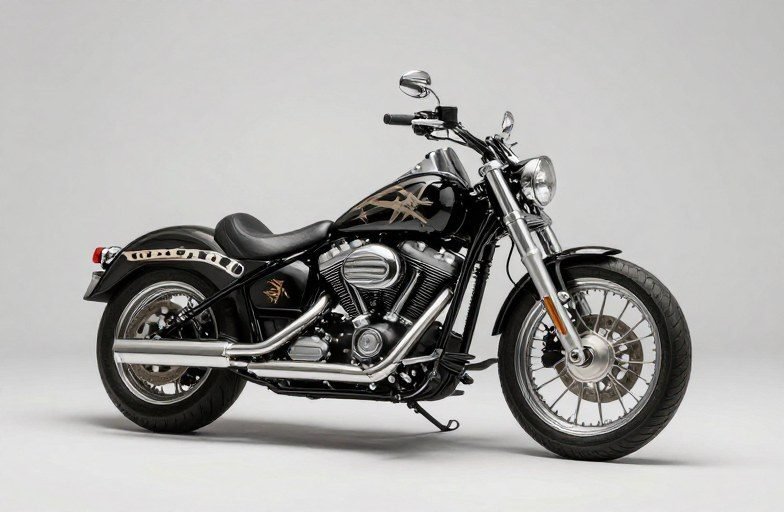
Harley Davidson tribal tattoos fuse the thick, flowing black lines of 1990s tribal style with unmistakable motorcycle iconography, flaming skulls, bar and shield logos, engine parts, and winged wheels. The result is aggressive, high-contrast ink that reads instantly from across a parking lot. Unlike the abstract Polynesian or Maori-inspired tribal of earlier decades, this hybrid style is specifically American biker culture rendered in black ink with occasional red accents. It prioritizes bold silhouette over fine detail, designed to hold up under sun, leather, and road miles.
Origins & History
From Club Patches to Skin
Biker tattooing grew directly from motorcycle club culture, where patches on vests signaled affiliation and mileage. Getting that imagery tattooed was the permanent step beyond club membership, skin as the ultimate commitment. The tribal wave that crashed through American shops in the 1990s offered a visual language that felt masculine, aggressive, and distinctly non-mainstream. Riders adapted it naturally, swapping generic tribal arm bands for designs incorporating Harley’s bar and shield, screaming eagle, or custom bike silhouettes.
The Hybrid Moment
By the late 1990s and early 2000s, this fusion peaked in popularity. Shops near rally destinations like Sturgis and Daytona Beach were doing steady business in black-heavy Harley tribals, often as walk-ins during event weeks. The style never fully disappeared, it simply became less trendy and more coded, still requested by dedicated riders who want ink that signals their community without explaining it.
- Early biker tattoos favored straightforward Americana: eagles, flags, pin-up girls
- The tribal infusion added motion and abstract energy to literal bike imagery
- Harley-Davidson’s own licensed merchandise reinforced the visual vocabulary riders drew from
- The style remains common in Midwest and Southern shops with strong riding cultures
Color vs Black and Grey
The Dominance of Black
Most Harley tribal work lives in pure black ink. The tribal foundation demands it, those heavy, interlocking lines and solid black negative space simply don’t function in greywash. Black also ages better on riders who spend serious time outdoors; UV exposure fades color faster than it degrades dense black. A solid black tribal sleeve or chest piece will still read clearly after years of highway sun.
Where Red Enters
Red shows up strategically: Harley’s signature orange-red in the bar and shield, flame tips, or blood drops on skull designs. Some artists work in limited red-and-black palettes that echo the company’s actual logo colors. Full color is rare in this style, when it appears, it usually signals a departure from pure tribal toward more illustrative biker art. If you’re considering color, understand it demands more touch-up maintenance than blackwork, especially on forearms and hands that take constant sun.
- Black-only heals faster and with fewer complications
- Red ink sits well in tribal compositions but requires a skilled hand to avoid looking like an afterthought
- Grey shading within tribal patterns tends to muddy the silhouette, avoid it unless the artist specifically designs for it
Who It Suits
This style carries specific cultural weight. The Harley tribal look signals membership in riding culture more than generic toughness. It works best for people who actually ride, or who have genuine history with the brand and community. Worn without that context, it risks reading as costume, aggressive imagery without the lived experience to back it.
Physically, the bold black suits medium to larger builds. The heavy lines need enough surface area to breathe; on very thin arms or small frames, the same design can feel overwhelming or compressed. Skin tone matters less than with fine-line work, since dense black shows clearly on most complexions. Age considerations are practical: this is not ink that fades quietly into the background. It remains visually loud for decades, which suits people comfortable with permanent visibility.
Choosing the Right Artist
Tribal Technique Is Specific
Not every blackwork specialist understands tribal flow. The best tribal artists think in terms of negative space and silhouette first, detail second. Ask to see healed photos, not just fresh work, tribal relies on consistent ink saturation, and blowout or uneven packing becomes obvious once swelling subsides. Look for artists with biker clientele in their portfolio; they’ll understand how designs sit under vests, how arm pieces work with riding gloves, how back pieces align when hunched over handlebars.
Consultation Red Flags
Be wary of artists who treat Harley tribal as “easy black fill.” The style requires precise line weight variation and intentional flow direction. Poor tribal looks like stickers applied to skin rather than integrated composition. A good artist will discuss how the design moves with your muscle structure, not just where it sits statically.
- Request healed photos from 2+ years prior
- Ask about needle grouping preferences, tribal often uses larger magnums for consistent saturation
- Confirm the artist has done motorcycle-specific imagery, not just generic tribal
- Discuss how the design will read at highway speed, not just in mirror selfies
Best Placements
Arms and Shoulders
The upper arm and shoulder cap remain the classic placement, visible in a tank top or vest, coverable with a jacket sleeve. Tribal sleeves that incorporate Harley elements work well because the arm’s natural taper suits the style’s flowing lines. Forearm placement is popular but consider sun exposure; black holds up, but constant UV without protection will grey any ink over time.
Back and Chest
Large back pieces allow full integration of bike imagery with tribal framing, think engine block centered with tribal wings extending to shoulder blades. Chest pieces work similarly but require careful design around sternum movement; rigid symmetrical tribal can distort oddly when skin flexes. Ribs are possible but painful and prone to inconsistent healing due to movement and friction from riding posture.
- Upper arm/shoulder: most forgiving for large, readable designs
- Forearm: high visibility, higher sun exposure
- Back: best for complex compositions with multiple elements
- Chest: requires design adaptation for movement and stretch
- Hands and neck: bold statement, significant professional and social implications
Key Characteristics & Motifs
Recognizable Harley tribal work combines specific recurring elements. The bar and shield logo often appears integrated into tribal knots rather than floating as separate imagery. Flames get the tribal treatment, thick, pointed, and stylized rather than realistic. Skulls are common, usually with angular jawlines and hollow eyes that merge into surrounding blackwork. Wings, engine pistons, and chain links appear as repeating pattern elements.
Line weight is crucial: the heaviest lines define the outer silhouette, medium weights build internal structure, and the finest lines (still relatively bold compared to other styles) add texture. True tribal never uses greywash for shading, contrast comes from solid black against skin, not tonal gradation. The best designs create optical movement, pulling the eye along curves that suggest speed and mechanical motion.
- Interlocking knots and points derived from 1990s tribal vocabulary
- Harley-specific imagery: bar and shield, screaming eagle, V-twin engines
- Flame motifs rendered as abstract black shapes rather than realistic fire
- Negative space used actively, skin becomes part of the design, not background
- Symmetrical compositions for chest and back, flowing asymmetry for arms
What to Remember
Harley Davidson tribal tattoos are a specific dialect of biker visual culture, not generic masculine decoration. They demand technical precision in blackwork, genuine connection to riding community, and acceptance of permanent high visibility. The style ages well if done properly, dense black, clean lines, smart placement, but poorly executed work turns muddy within years. Choose artists who understand both tribal construction and motorcycle imagery, not one or the other. Consider how the design functions in motion, in gear, under sun, across decades. This is ink built for the long road, not the moment of getting it.
Frequently Asked Questions
Do Harley tribal tattoos have to include the actual Harley-Davidson logo?
No. Many designs use generic motorcycle imagery, engines, wheels, wings, that signals riding culture without trademarked elements. Some riders prefer this to avoid corporate branding on their skin, or to honor custom bikes that aren’t factory Harley.
How well does heavy black tribal work hold up over years of riding?
Dense black generally ages better than color or fine detail, but sun exposure is the enemy. Unprotected forearm or hand ink will grey and blur faster. Quality sunscreen and occasional touch-ups keep the contrast sharp through decades of road miles.
Can a generic tribal tattoo be modified to add Harley elements later?
Sometimes, but it’s constrained by the original flow and negative space. Adding a logo into existing tribal usually requires redesigning surrounding blackwork to integrate it naturally. Covering old tribal entirely is often easier than modifying it piecemeal.
What’s the typical healing concern with large black fills?
Heavy saturation means more plasma and potential scabbing. The biggest risk is picking or letting clothing stick to the healing area, especially relevant for back pieces under riding gear. Follow aftercare precisely; compromised healing in large black areas shows as patchy, lighter spots permanently.
Related Style Guides
- Realistic Joker Tattoos: A Working Artist s Guide
- Memorial Tattoo Ideas That Stay Personal
- Horror Realism Tattoos: A Complete Style Guide
- Explore more