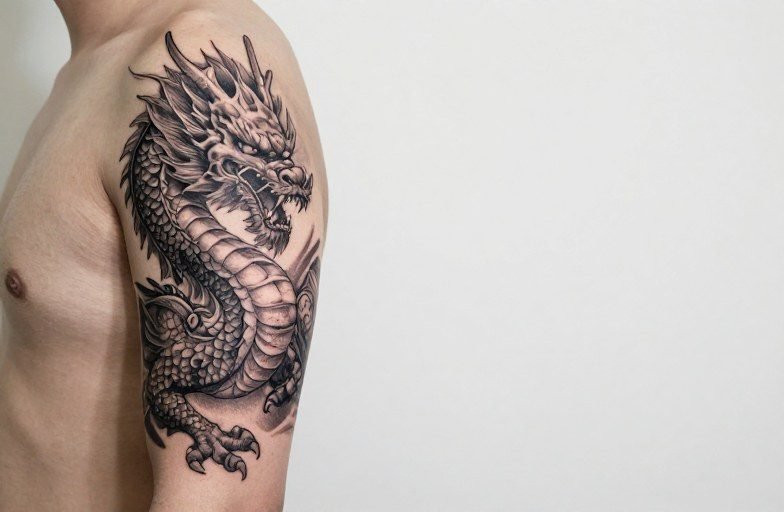
A dragon tattoo on a man typically signals dominance, protection, and untamed force. The creature carries weight across cultures as both guardian and destroyer, making the meaning hinge on which dragon you choose and where you place it. For most men, it lands somewhere between personal armor and a warning.
How It Ages on Skin
Dragons demand detail, and detail doesn’t always hold. The aging trajectory depends heavily on your initial choices.
Line Work vs. Heavy Shading
Clean, bold outlines age better than intricate scales drawn with single-needle precision. A dragon built from thick, confident lines stays readable at ten years. One packed with micro-detail turns to mush as skin shifts and ink particles migrate. Shading in the claws, horns, or fire breath holds up if the contrast is stark, deep blacks against negative space, not soft gray washes that fade to bruise-colored ambiguity. See also: Depressed Tattoo Meaning: Symbolism, Design & Aging.
- Japanese-style dragons with flowing bodies and sparse background age gracefully; the negative space works in your favor.
- Hyper-realistic European dragons with textured skin and individual scales require touch-ups within five to eight years.
- Red ink in flames or accents fades fastest; plan for saturation loss in warm colors.
Placement and Sun Exposure
Dragon tattoos wrapping the forearm or sitting on the outer bicep take direct UV punishment. The upper back and chest shield better under clothing. A full-back dragon ages like a mural, protected, large enough that minor blur doesn’t destroy the composition. Hand or neck dragons? Those blur fast and carry social weight you can’t undo.
History & Cultural Roots
The dragon’s footprint spans continents with sharply different temperaments. See also: Dogwood Flower Tattoo Meaning: Resilience, Faith & Renewal.
East Asian Traditions
In Chinese and Japanese contexts, dragons are often linked to water, rainfall, and imperial authority. The Chinese lung dragon coils through clouds and rivers, associated with wisdom and benevolent power. Japanese ryu dragons share this water connection but lean more heavily into protection of Buddhist temples and the balance of natural forces. A man wearing this imagery taps into centuries of authority, not aggression, though Western appropriation sometimes flattens that nuance.
European and Norse Depictions
European dragons skew darker. The Norse Nidhogg gnaws at the roots of the world tree. Medieval Christian imagery casts dragons as embodiments of sin or chaos to be conquered. Some trace the modern “rebellious” dragon tattoo to this tension, the creature as outlaw, not king. The Celtic dragon interlace carries yet another register: cyclical time, the ouroboros, the eternal return. See also: Dollar Sign Tattoo Meaning: Wealth, Hustle & Risk.
Common Variations & Styles
Not all dragons read the same. The style choice broadcasts intent before anyone asks.
- Traditional Japanese (Irezumi): Full-body serpentine dragons with tiger companions, cherry blossoms, or waves. Often covers large areas, back, sleeve, or leg. Reads as discipline, endurance, belonging to a tradition.
- Black and Gray Realism: European dragon portraits with dimensional shading. Emphasizes menace, texture, the creature as animal rather than symbol. Popular on upper arms and thighs.
- Neo-Traditional: Bold lines, limited but saturated color palette, stylized forms. Balances readability with personality. Works at medium scale.
- Tribal/Blackwork: Silhouette or geometric abstraction. The dragon becomes pattern rather than narrative. Often chosen for the graphic impact and faster healing.
- Minimalist/Single-Line: Emerging style, risky for longevity. The suggestion of dragon form in continuous line. Reads as subtlety, restraint, perhaps irony.
Mythology & Folklore
The stories embedded in dragon imagery give your tattoo conversational depth, or cultural weight you may not intend.
Guardians and Thresholds
Chinese lore places dragons at gates, bridges, and mountain passes. The tattoo as guardian isn’t metaphor; it’s direct reference. A man with a dragon coiled around his arm or across his chest invokes this threshold-keeping function, protection of self, of territory, of boundaries. The Korean yong dragon similarly guards treasure, though the treasure is sometimes wisdom rather than gold.
The Defeated and the Defiant
Saint George’s dragon lies pierced, subjugated. Beowulf’s dragon kills its slayer. The modern tattoo often sides with the dragon rather than the hero, identification with the monster, the outcast, the ungovernable. This inversion matters. A dragon rising from flames or breaking chains reads differently than a dragon coiled peacefully. The posture you choose: claws extended or folded, wings spread or furled, mouth open or closed, each shifts the meaning toward threat or watchfulness.
Best Placements
Dragon tattoos need room to move. The creature’s power comes from its length, its curves, its sense of motion arrested.
Large-Scale Canvas
The full back remains the classic placement for a reason. A dragon can span shoulder to hip, head at one blade, tail at the opposite hip, body winding across the spine. The natural curves of the back muscles animate the form when you move. The chest offers similar real estate, though the sternum’s flat plane can flatten a three-dimensional design unless your artist accounts for the bone structure.
Arm and Leg Solutions
Sleeves and leg pieces work when the dragon wraps rather than sits static. A forearm dragon with head at wrist and tail disappearing toward the elbow creates narrative flow. The thigh’s muscular canvas supports detailed work that stays protected from sun. Ankle-to-knee or knee-to-thigh designs follow the limb’s natural taper. Avoid cramming a full dragon onto a shoulder cap alone, the form gets compressed, the power diminishes.
- Hand and finger dragons: technically possible, practically problematic. Blur, professional consequences, and the difficulty of detail at that scale.
- Throat and face: same cautions, amplified. The dragon’s menace becomes your permanent expression.
Similar & Related Symbols
Men drawn to dragons often orbit related imagery. Understanding the distinctions helps you choose deliberately.
The phoenix pairs naturally with dragon in Chinese tradition, dragon as yang, phoenix as yin, the union of cosmic forces. Some men choose the pair for relationship or balance symbolism. The serpent, often confused with dragon, lacks the wings and legs and carries different registers: temptation, medicine, kundalini energy. The wyvern (two legs, wings) is a dragon variant but reads as lesser, more bestial, less noble.
Skulls crossed with dragons shift the meaning toward death and memento mori. Dragons clutching swords or orbs invoke specific medieval iconography, power held, power contained. The ouroboros, dragon or serpent eating its tail, compresses the dragon’s power into cyclical, self-contained form. Smaller, more philosophical, less aggressive.
Japanese dragon tattoos frequently incorporate specific companion elements: the tiger (strength through opposition), the koi (perseverance and transformation), cherry blossoms (the fleeting nature of power). Each addition complicates the dragon’s meaning rather than simply decorating it.
The Takeaway
A dragon tattoo on a man communicates force before you speak, but the specific force depends on your choices. The cultural tradition you draw from, the style’s visual language, the creature’s posture and companions, the placement’s visibility and scale, all of these refine the broad signal of “power” into something particular. Get the details right and the tattoo carries weight for decades. Treat it as generic fantasy imagery and it becomes exactly that: a picture that looked cool once, now blurred and contextless on aging skin.
Frequently Asked Questions
Does a dragon tattoo on a man mean he’s in a gang or criminal organization?
Not inherently. While some prison and gang cultures have used dragon imagery, the symbol is overwhelmingly mainstream across global tattooing. Context matters more than the image itself, placement, style, and accompanying symbols determine any organizational connection.
Should I get a Chinese dragon if I’m not Chinese?
Cultural appropriation concerns arise with religious or sacred imagery, but Chinese dragons occupy a complex space between cultural symbol and global tattoo vocabulary. Many artists recommend researching the specific tradition, avoiding crude mixes of unrelated Asian elements, and choosing an artist who understands the iconography rather than copying flash art.
How much should I expect to pay for a quality dragon tattoo?
Large-scale dragon work from an experienced artist typically runs into multiple sessions at several hundred dollars per session minimum. A full back piece in Japanese tradition can require 50+ hours. Budget constraints are real, but this is not a design category where shopping for the lowest price yields good results.
What’s the difference between a Japanese dragon and a Chinese dragon tattoo?
Japanese ryu dragons often appear with three claws, more serpentine bodies, and specific companion elements like waves or tigers. Chinese lung dragons traditionally have five claws (though four-claw versions exist), more prominent horns, and stronger imperial associations. The visual languages overlap but carry distinct cultural registers that knowledgeable artists respect.
Related Tattoo Meanings
- 1904 Tattoo Meaning: Year Dates, Baseball Personal Legacy
- Axe Tattoo Meaning: Symbolism, Design Placement Guide
- Fudog Tattoo Meaning: Guardian Lions, Protection Power
- Explore more