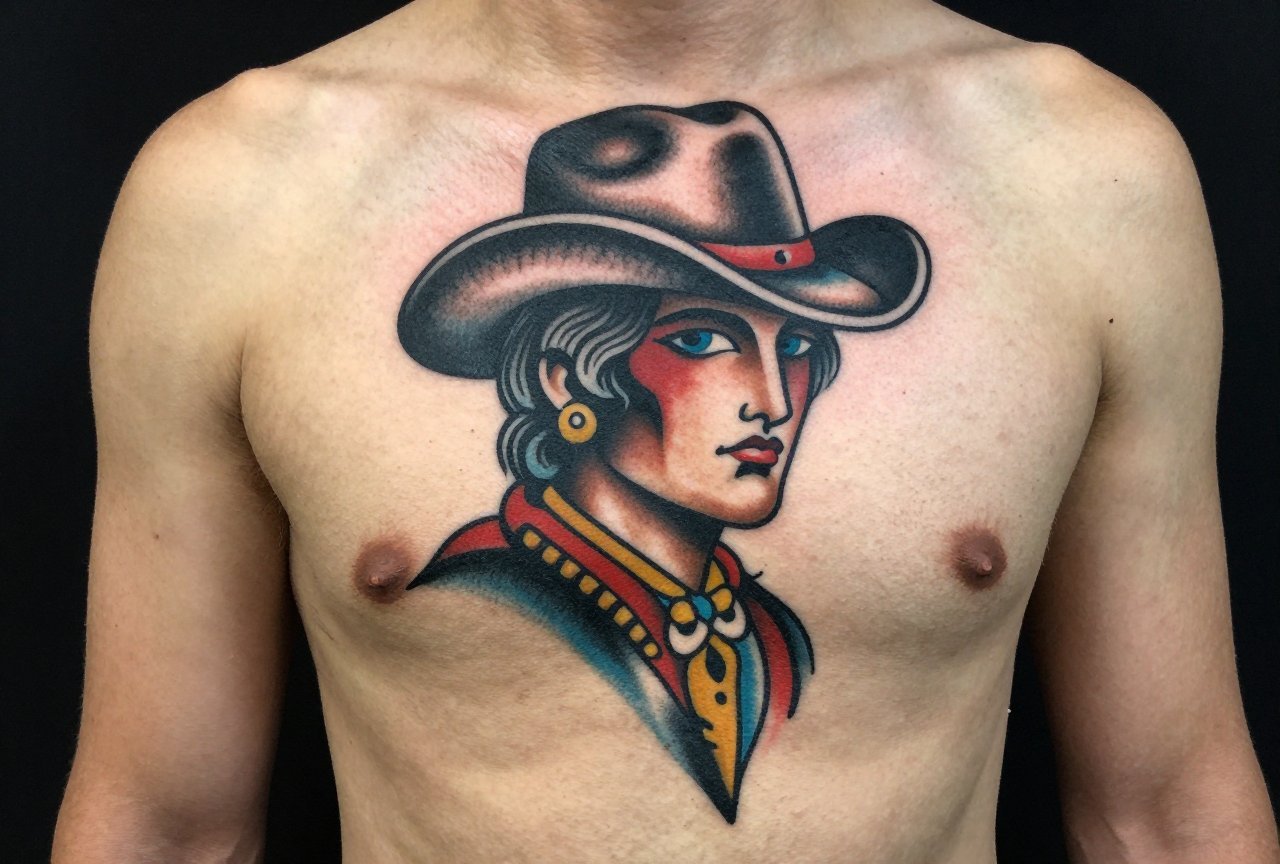
American Traditional Western tattoo is the bedrock of modern tattooing. When someone walks into my shop and says they want “something classic,” this is usually what they mean, bold black outlines, a restrained color palette, and imagery that reads clear as a bell from across the room. I’ve tattooed these designs for fifteen years, and I’ve watched them outlast trends that came and went like seasons. The style emerged from the tattoo parlors of port cities in the early 1900s, forged by sailors, soldiers, and the working class who needed art that would hold up through sun, salt, and decades of living. It’s not delicate. It’s not subtle. It’s built to last, and that’s the whole point.
Origins & History
The story starts on the waterfront. In the 1920s through the 1950s, tattooing in America was largely a sailor’s game. Shops clustered around Navy ports, San Diego, Norfolk, Honolulu. These guys wanted marks that meant something specific: protection, miles traveled, belonging. The designs had to be simple enough to execute quickly (liberty was short), bold enough to read through a uniform, and symbolic enough to carry weight.
The Sailor Jerry Legacy
Norman “Sailor Jerry” Collins is the name everyone knows, and for good reason. Working out of a shop on Hotel Street in Honolulu from the 1940s until his death in 1973, Jerry refined the visual language we still use. He pushed for better inks, sterilization, and needle configurations. I’ve studied his flash sheets until the pages went soft. What strikes me isn’t just the imagery, it’s the economy. Every line earns its place. No shading for shading’s sake. He’d tell clients straight up: this will hurt, this will last, this means you’re part of something.
From Counterculture to Mainstream
By the 1960s and 70s, tattooing had slid into outlaw territory, bikers, convicts, rock and rollers. The traditional style almost died out as black and grey Chicano work and Japanese irezumi gained ground. Then came the 1990s revival. Shops like Bert Grimm’s in Long Beach kept the flame, and a new generation of artists, Ed Hardy, Don Ed Hardy specifically, started treating these designs as American folk art rather than just skin decoration. I apprenticed in the early 2000s when this revival was in full swing. My mentor made me paint flash for six months before I touched skin. “Learn the rules,” he’d say, “then you can break them.”
Key Characteristics & Motifs
Walk into any shop with traditional flash on the walls and you’ll recognize the vocabulary immediately. These aren’t accidents, they’re solutions to technical problems that artists figured out decades ago.
- Bold outlines: Single-pass black lines, typically 7-14RL needles, that create a graphic border. I’ve seen traditional pieces hold for forty years where finer work blurred into soup.
- Limited color palette: Red, yellow, green, blue, black. That’s the classic set. Modern artists expand this, but the discipline of restriction is what gives the style its punch.
- Flat shading: No smooth gradients. Shading is done with parallel lines, whip shading, or sparse black fill that sits in distinct zones.
- Imagery that reads instantly: Eagles, snakes, roses, ships, anchors, pin-up girls, daggers, panthers, skulls, swallows. Each carries established meaning.
The swallow means 5,000 nautical miles. The anchor means stability or Navy service. The dagger through a rose? That’s love and pain, beauty and danger intertwined. I don’t lecture clients on this unless they ask, but I love when someone knows the language before they sit down.
Color vs Black and Grey
This debate comes up in my chair constantly. Traditional purists insist on color. The old timers I learned from would say black and grey traditional is like a cheeseburger without cheese, technically possible, missing the point.
When Color Works Best
Color traditional pops on lighter skin tones and holds remarkably well over time. The pigments have improved massively. I use the same core set my mentor did, Intenze, Eternal, Solid Ink, but the chemistry is cleaner now. Red and yellow still fade fastest, which is why they’re packed in solid. Green and blue settle in and stay. On a well-executed color traditional piece, that saturation should look almost velvety fresh, then soften into a lived-in vibrancy after healing.
The Black and Grey Argument
That said, I’ve done plenty of black and grey traditional. Some clients can’t do color, work restrictions, skin reactions, personal preference. The challenge is maintaining readability without the color contrast. You rely heavier on line weight variation and negative space. It can be stunning. It just hits different. I tell people: color traditional is a shout, black and grey is a growl. Both work, but know what you’re signing up for.
Best Placements
Traditional tattoos were designed for specific body real estate. The style’s graphic nature means it needs flat or gently curved surfaces to read properly. I’ve watched artists try to squeeze traditional onto fingers or the side of a neck and fight the anatomy the whole way.
- Arms: The classic. Outer bicep, forearm, full sleeves built from separate pieces. The cylinder of the arm lets those bold lines wrap cleanly.
- Chest: Center chest pieces, often symmetrical with eagles or ships spreading across the collarbones. The flat plane is ideal.
- Back: Big canvas for complex compositions. I’ve done full back pieces with multiple ships, sea monsters, lettering.
- Thighs and calves: Less common historically but perfect for the style’s scale. The muscle provides stable ground.
Hands, feet, and ribs are tough. The skin moves differently, heals harder, and the detail gets lost. I don’t refuse these spots, but I have the conversation. Sometimes “no” is the most honest thing I can say.
Who It Suits
American Traditional doesn’t care about your aesthetic. I’ve tattooed this style on punk kids, grandmothers, software engineers, and bikers. The common thread is wanting something that won’t embarrass you in ten years. The style’s limitations are its protection. You can’t get too trendy with a traditional rose. It was cool in 1950 and it’ll be cool in 2050.
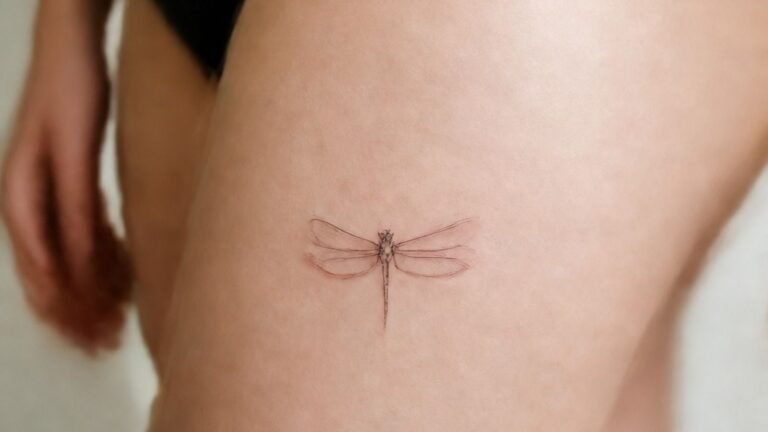
That said, it rewards commitment. These pieces are dense. They take space. A tiny traditional tattoo usually fails, the lines can’t breathe, the color can’t settle. I steer people toward at least palm-sized minimum. If you want delicate, we should talk about fine line or single needle. Different tools, different outcome.
Modern Variations
The style has splintered and evolved, which keeps it alive. I see this every day in shops across the country.
Neo-Traditional
This is the most prominent offshoot. Neo-traditional keeps the bold outlines but introduces more complex color gradients, softer shading, and expanded subject matter, animals, portraits, mythological scenes rendered with traditional structure. The line weight varies more. The color palette explodes. I do a lot of this work. It’s technically demanding and creatively freeing. But purists grumble, and I get it. There’s something about the restraint of true traditional that hits a nerve nothing else touches.
Contemporary Twists
Some artists are mixing traditional motifs with surrealism, geometric elements, or cultural imagery outside the canon. Japanese-inspired waves behind a traditional ship. Dotwork mandalas framing a classic eagle. These work when the artist understands both languages. I’ve seen disasters when they don’t, traditional lines fighting against delicate shading, the whole piece collapsing into visual noise. Respect the rules before you bend them.
Choosing an Artist
This matters more than anything. Not every tattooer who can do a clean line should do your traditional piece. Look for:
- Flash painting: Do they paint their own traditional flash? This shows they understand the style’s graphic fundamentals. A portfolio full of custom realism but no painted flash is a red flag.
- Healed photos: Everyone’s fresh work looks good. Ask to see pieces at one year, five years. I keep a binder in my shop of my own healed work. The lines should hold, the color should sit where it was put.
- Shop culture: Traditional shops have a specific feel. Flash on the walls, the buzz of coil machines, artists who know the history. Walk in and trust your gut. If it feels like a branding studio or a spa, keep looking.
I tell people to travel for the right artist. A traditional piece is for life. A few hours’ drive or a cheap flight is nothing compared to living with a botched eagle that looks like a seagull with arthritis.
Final Thoughts
American Traditional Western tattoo is stubborn. It refuses to die because it works. The limitations, bold lines, flat color, recognizable imagery, aren’t constraints. They’re the architecture that holds everything up. I’ve watched clients sit in my chair nervous about getting something “too common,” and I’ve watched them come back years later grateful for exactly that. A traditional rose doesn’t need to be unique. It needs to be good.
The style carries weight because it earned it. Sailor Jerry’s hand. Bert Grimm’s shop floor. The thousands of unnamed artists who pushed needles through skin in port cities and military towns, building a visual language that still speaks. When you choose this style, you’re not just getting a tattoo. You’re joining a lineage. Make sure your artist knows the history they’re working in. Make sure you respect it enough to let it be what it is, bold, direct, built to outlast you.
Frequently Asked Questions
How painful is an American Traditional tattoo compared to other styles?
The bold lines and solid color packing mean more needle passes in the same area, which can feel more intense than delicate styles. But sessions are often shorter because the design is graphic rather than detailed. I find clients handle it fine, the pain is honest and direct, like the style itself.
Will a traditional tattoo look good as I get older and my skin changes?
This is where traditional excels. The heavy black outlines act as fences that keep color from bleeding. I’ve seen forty-year-old traditional pieces that still read clearly. Fine lines blur; bold lines hold. The style was literally designed for aging skin.
Can I mix traditional tattoos with other styles on the same arm or body?
You can, but it takes planning. Traditional’s bold graphic quality can swallow more delicate work if placed too close. I usually recommend grouping traditional pieces together or using them as anchors in a larger composition. Your artist should map this out before any needle touches skin.
How much should I expect to pay for a quality traditional piece?
Good traditional work isn’t cheap and cheap traditional work isn’t good. You’re paying for years of apprenticeship, historical knowledge, and the technical skill to make those bold lines sing. In my shop, palm-sized pieces start around $300-400, with full sleeves running into the thousands. Flash designs are often priced flat; custom work is hourly.
Related Style Guides
- European Traditional Tattoo: A Working Artist s Guide
- Neo Trad Japanese Tattoos: A Working Artist s Guide
- Neo Traditional Tattoo Artists: A Working Guide
- Explore more