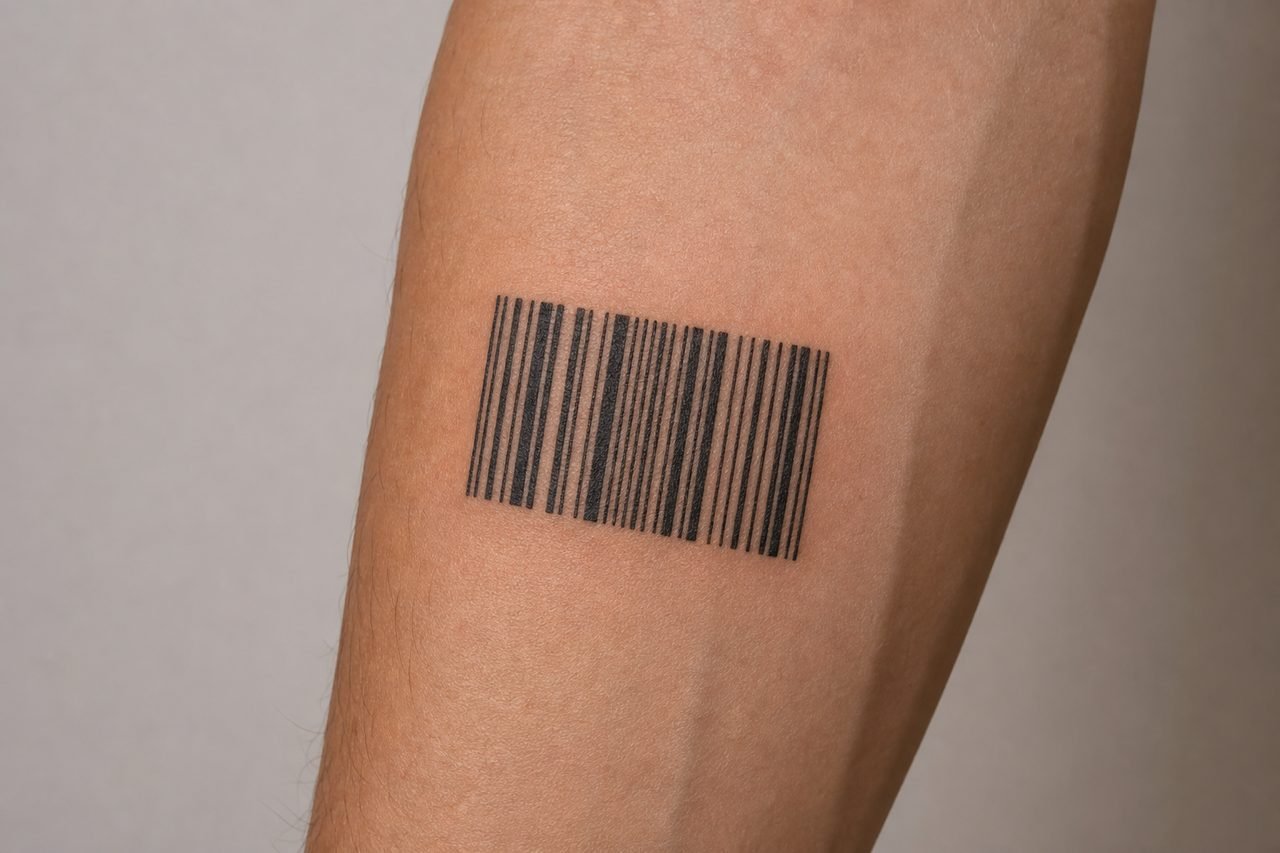
A bar code tattoo typically symbolizes themes of identity, dehumanization, consumerism, and individuality. For many wearers, it serves as a visual statement about feeling reduced to a number in modern society, while others use it to reclaim personal narrative by embedding meaningful dates, names, or messages within the vertical lines.
Symbolism & History
The bar code emerged in 1974 when a pack of Wrigley’s gum became the first scanned product in a Ohio supermarket. Originally a tool for inventory tracking, this black-and-white pattern quickly transcended retail to become a cultural icon of commodification. Tattoo artists began inking bar codes during the 1990s as punk and industrial subcultures gained visibility, borrowing the imagery to critique corporate control and mass production.
The symbolism operates on multiple levels:
- Anti-consumerism: A rejection of being treated as a product or disposable commodity
- Identity fragmentation: Commentary on surveillance states, data collection, and loss of privacy
- Reclamation: Personalizing the code with custom numbers that hold private significance
- Science fiction influence: References to dystopian films and literature where humans are catalogued
The visual starkness of bar codes, their mathematical precision, and their universal recognizability make them potent symbols that require no explanation across language barriers.
Common Variations & Styles
Bar code tattoos have evolved far beyond the standard UPC format found on grocery packaging. Artists and clients collaborate to create distinctive interpretations that balance authenticity with personal expression.
- Standard UPC-style: Maintains recognizable proportions with guard bars and number sequence beneath
- Distorted or glitching: Lines that warp, fragment, or dissolve into skin, suggesting system failure or breaking free
- Integrated imagery: Bar codes that transform into landscapes, portraits, or organic forms at one end
- Color variations: Red lines suggesting urgency or blood; faded grey for ghostly, erased identity
- Scannable authenticity: Some artists research actual encoding systems to create technically valid patterns
- Date and text integration: Birthdates, coordinates, or meaningful phrases substituted for standard product numbers
Blackwork and fine-line techniques dominate this style, though some collectors opt for heavy saturation or deliberate blowout effects to suggest age and wear.
Best Placements
The linear nature of bar codes influences where they sit most effectively on the body. Placement choices often reinforce the tattoo’s conceptual message.
- Forearm: Highly visible, mimicking product scanning; invites interaction and questioning
- Back of neck: References historical inventory tagging; vulnerable, exposed position
- Wrist: Suggests identification bands, hospital bracelets, or restraint
- Ribcage or sternum: Private, over the heart; personal codes hidden from casual observation
- Thigh or calf: Larger canvas for extended sequences or artistic distortion
- Along the spine: Vertical alignment follows natural body architecture; suggests core identity
Scale matters significantly. Too small, and the lines blur together over time; too large, and the delicate proportions appear awkward. Most successful bar code tattoos measure between three and eight inches in length.
Who Chooses This Tattoo / Personal Meanings
The bar code attracts a diverse collector base united by philosophical engagement rather than aesthetic tradition. Understanding who selects this design illuminates its continuing relevance.
- Activists and critics: Those protesting corporate influence, data mining, or surveillance capitalism
- Survivors: Individuals who have escaped controlling systems, including institutionalization or trafficking
- Tech workers: Ironically commenting on the industry they participate in; love-hate relationships with digital systems
- Military veterans: Referencing dog tags, serial numbers, and the dehumanizing aspects of service bureaucracy
- Memorial collectors: Encoding dates of loss or birth as permanent, scannable memory
- Minimalist enthusiasts: Drawn to the graphic simplicity and conceptual weight over decorative complexity
Personal meanings frequently contradict surface interpretation. A bar code may celebrate rather than critique being part of something larger, or it may function as a private joke between partners who share matching encoded messages.
Similar Symbols
Collectors drawn to bar code imagery often explore related visual languages that share themes of systematization, identity, and resistance.
- QR codes: More complex, digitally native; can link to actual websites or media
- Binary code: Raw data representation; appeals to programmers and digital natives
- Serial numbers: Simplified, text-based alternatives to graphical bar codes
- Prison or concentration camp numbers: Historically weighty; requires careful, respectful consideration
- RFID chip imagery: Critiques emerging tracking technologies and biohacking subcultures
- Corporate logos (modified or destroyed): Direct brand confrontation rather than abstract system critique
These alternatives offer varying degrees of legibility, historical baggage, and technical complexity depending on the wearer’s specific message.
Final Thoughts
The bar code tattoo endures because it functions as both mirror and mask. It reflects society’s obsession with categorization while allowing individuals to hide personal significance in plain sight. Whether worn as political statement, memorial device, or aesthetic choice, this design demands that viewers confront their own relationship to systems of control and identification. The best bar code tattoos reward close inspection, revealing that what appears to be mechanical uniformity often contains deeply human stories encoded within the lines.
Related Tattoo Meanings
- Rebel Flag Tattoo Meaning: Symbolism, History Styles
- Traditional Japanese Cloud Tattoo Meaning: Wind, Change Spirituality
- Ram Tattoo Meaning: Strength, Leadership Aries Symbolism
- Explore more
Frequently Asked Questions
Do barcode tattoos actually scan?
Most barcode tattoos are purely aesthetic and use distorted proportions or artistic styling that prevents actual scanning. However, some people have successfully created scannable versions, though skin elasticity and ink spread often degrade readability over time.
What does a barcode tattoo symbolize?
The barcode tattoo carries layered meanings: loss of individual identity in mass society, critique of consumer culture, or conversely, an ironic embrace of being a product. Many wearers also choose it to represent personal data, prison experiences, or membership in subcultures.
Is the barcode tattoo associated with criminals or gangs?
The design gained notoriety through its use in prisons and some extremist contexts, but today it is overwhelmingly a mainstream artistic choice. Context, placement, and accompanying imagery determine whether a specific tattoo carries negative connotations.
Where is the best placement for a barcode tattoo?
The forearm remains the most popular location because it mirrors actual product scanning positions and offers visibility for the statement. The wrist, back of the neck, and upper arm also work well for those wanting different levels of concealment or prominence.