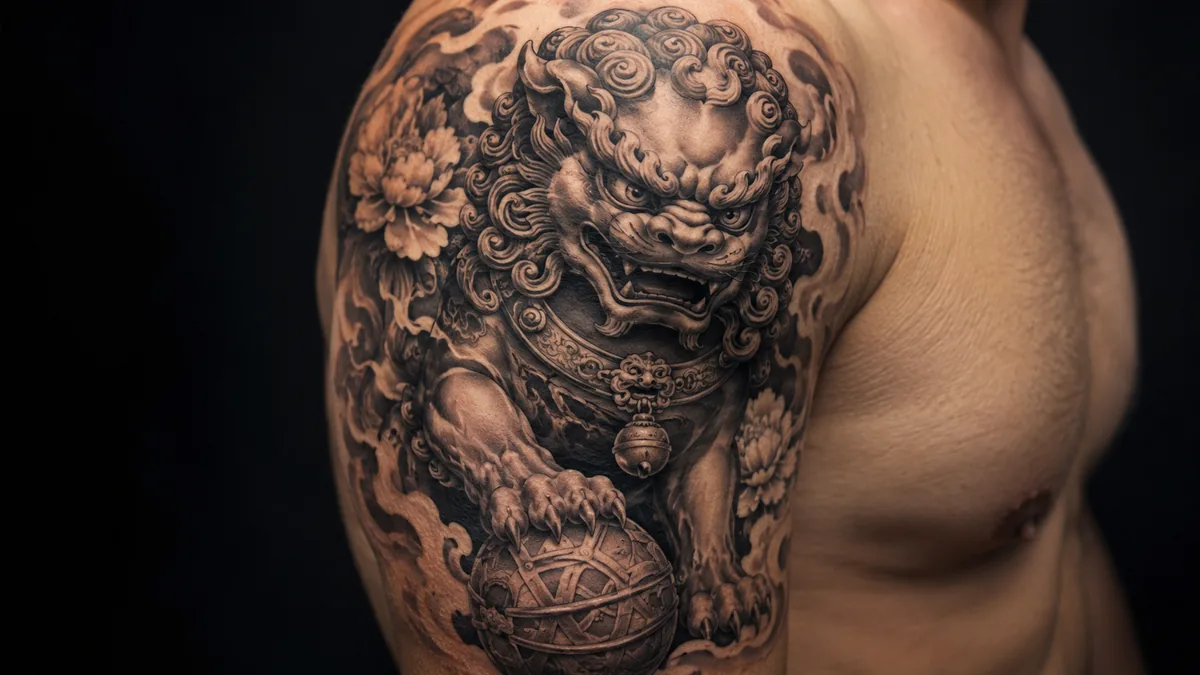
Foo dog tattoos are one of those designs people get because they look fierce, then find out the meaning is even better than expected. These mythical lion-dog guardians come from East Asian temple architecture and centuries of protective symbolism. The name “foo” likely comes from a romanization of “fo,” the Chinese word for Buddha, though the creatures themselves are more lion than dog.
People choose this tattoo because it hits on multiple levels. It’s a bold, dramatic image that reads from across the room, and it carries real weight behind it: protection, strength, duality, and warding off evil. That combination of visual power and genuine meaning is exactly what makes a tattoo worth committing to.
Core Symbolism: What a Foo Dog Tattoo Actually Means
Foo dogs represent protection and guardianship above everything else. In Chinese and broader East Asian tradition, they were carved in pairs and placed at the entrances of temples, imperial palaces, and important buildings to ward off evil spirits and negative energy. Getting one tattooed means you’re carrying that guardian energy on your body permanently.
Beyond raw protection, they symbolize strength, courage, and balance. The male foo dog typically holds a ball under his paw, representing control over the world or dominance over external forces. The female holds a cub, symbolizing protection of what’s closest to you. Together they represent duality: the protective force that both conquers and nurtures.
The Pair System: Male, Female, and What It Means for Your Tattoo
One foo dog is just a lion. Two foo dogs is a force field.
When people get matching foo dog tattoos, usually one on each side of the body, there’s an intentional split. The male figure, mouth open, is about projecting strength outward and keeping threats away. The female, mouth closed, is about protecting what’s already yours. Some clients get one or the other based on which meaning resonates more personally.
Open mouth and closed mouth also have a phonetic reading in some interpretations. Open represents the sound “ah” and closed represents “om,” forming the sacred syllable together. Most tattoo clients don’t dig that deep into it, but it’s a legitimate layer of meaning if you want your piece to carry that spiritual weight. It’s real symbolism, not invented lore.
Cultural and Historical Background Worth Knowing
The foo dog design traces back to Han Dynasty China, when actual lions were gifted to emperors as exotic animals. Since most Chinese artists had never seen a real lion, they sculpted something between a lion, a dog, and a dragon. The result became its own distinct creature with its own mythology. The statues spread through Buddhist culture across China, Japan, Korea, and Southeast Asia.
In Japan they’re called Komainu, or lion-dogs, and you’ll find them guarding Shinto shrines. In Okinawa, they’re called Shisa and sit on rooftops as household protectors. Each regional version has slight visual differences, but the guardian role stays consistent across all of them. Knowing where your specific design draws from helps you make intentional choices about what you’re putting on your body.
Design Styles: Traditional, Neo-Trad, Japanese, and Fine Line
Traditional American foo dogs lean into thick outlines, bold color fills, and a flat graphic quality. They look clean, saturated, and hold up for decades. Neo-traditional versions give you more detail in the face, more depth in the shading, and a slightly illustrative quality without losing that solid, readable silhouette. Both work well in most placements and age predictably.
Japanese-style foo dogs, built with flowing line work, heavy black fill in the mane, and negative space used intentionally, are probably the most tattooed version right now. They suit a full sleeve or back piece naturally because they integrate with waves, clouds, and peonies without fighting the composition. Fine line foo dogs are doable but risky. All that detail in the face and mane can blur over time, especially on softer skin.
Color vs Black and Grey: Choosing What Works for Your Skin
Color foo dogs go bold, usually red, gold, and green for the traditionally lucky palette, or all black with red accents for a more dramatic read. On lighter skin tones, fully saturated color lands beautifully and stays bold with proper aftercare and sun protection. On deeper skin tones, high-contrast work with solid black fills and selective color pops tends to read crisper long-term.
Black and grey foo dogs are a strong choice for almost anyone. A skilled artist using whip shading on the mane creates real depth and movement. The face details stay readable as the tattoo ages because the contrast is built in black rather than relying on color saturation that can shift. If you’re on the fence, black and grey ages more predictably and gives you flexibility to build around it later.
Placement, Pain, and How It Ages
Thigh, upper arm, back, and calf are the classic foo dog spots. These are lower-friction zones for longevity, meaning the skin there moves less dramatically and takes ink well. A full thigh foo dog has room to breathe, lets the artist get real detail into the face, and sits in a relatively low-pain zone. Upper arms are slightly spicier toward the inner bicep but manageable for most people.
Avoid squeezing a complex foo dog into a spot too small for it. The face is the focal point and it needs space to stay crispy. Hands, feet, and necks are high-friction zones and fine-line details will blowout or soften faster there. Ribs and the ditch of the elbow are spicy and also tricky for longevity. If you want it to still look sharp at year ten, pick a placement that respects the scale of the design.
Who Gets Foo Dog Tattoos and How to Make Yours Personal
Foo dog tattoos attract a wide range of clients: people with East Asian heritage honoring tradition, martial arts practitioners, anyone drawn to the protective symbolism, and plenty of people who simply connect with the imagery. None of those reasons is wrong. A tattoo doesn’t need to be ancestrally yours to be meaningful, but it helps to go in understanding what you’re carrying.
To personalize it, think about what you’re protecting or what you’ve overcome. Some clients add peonies for prosperity, flames for transformation, or incorporate a regional style tied to a place meaningful to them. Pair placement matters too: one over each shoulder blade reads differently than matching thighs. Talk to your artist about the story. A good artist uses that context to make design choices that give your piece real character instead of a generic flash copy.