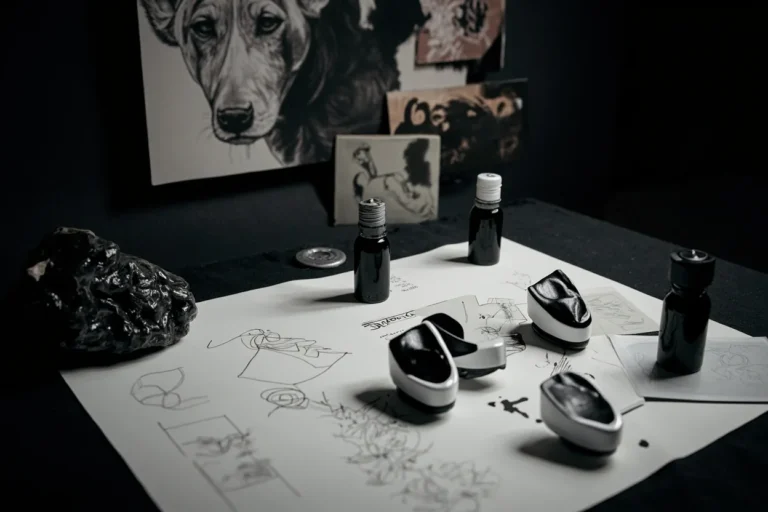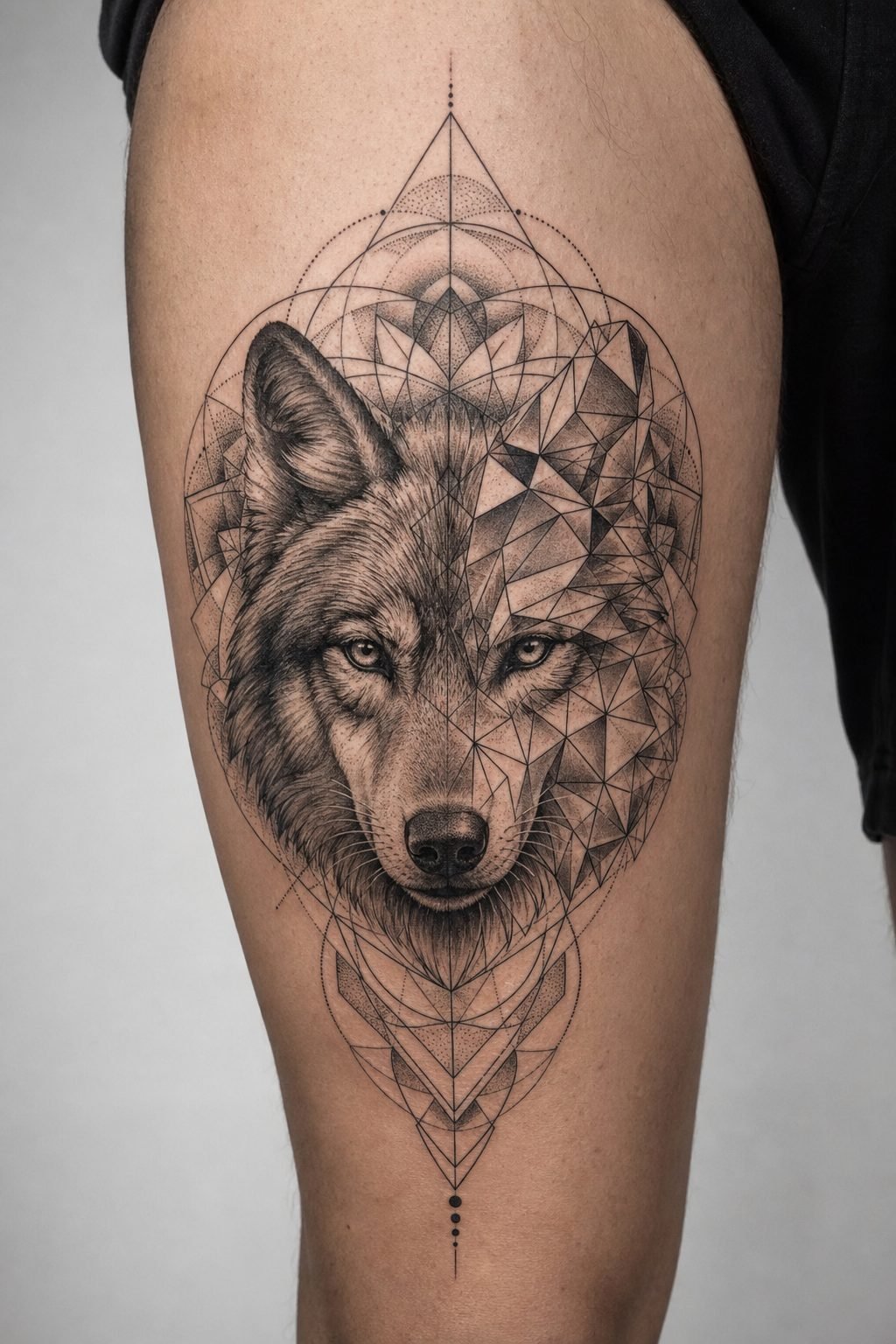
Geo realism tattoos combine two demanding disciplines: photorealistic rendering and precise geometric structure. The style typically presents a lifelike portrait, animal, or natural object, sometimes fragmented, sometimes whole, intersected with clean lines, polygons, mandala patterns, or abstract shapes. The contrast between organic detail and mathematical order creates visual tension that flat realism or pure geometry alone rarely achieves.
Origins & History
The style emerged from two separate tattoo traditions that began crossing paths in the early 2010s. Photorealism had already established itself through black-and-grey portraiture in Chicano and European scenes. Geometric tattooing, meanwhile, drew from ornamental traditions, dotwork mandalas, and the growing interest in sacred geometry among collectors seeking something beyond conventional Americana or Japanese imagery.
The fusion wasn’t inevitable. Early geometric work often stayed abstract; early realism avoided hard edges entirely. The combination required artists comfortable with both technical approaches, plus collectors willing to sit for sessions demanding extreme precision in two different registers.
European and American Development
German and Austrian studios often get credit for pushing the style toward its current form, frequently linked to artists who had backgrounds in technical illustration or architecture. The structural discipline of drafting translated naturally to skin. Some trace the specific “fractured portrait” look to collaborative work between realist and geometric specialists who began layering their respective strengths around 2012-2014.
Current Trajectory
Today the style has splintered. Some artists pursue hyper-minimal geometric frames around single realistic elements. Others push toward maximal complexity, with entire sleeves built from interlocking polygons each containing a different realistic micro-image. The throughline remains the same: the dialogue between organic truth and imposed structure.
Key Characteristics & Motifs
Recognizing quality geo realism requires understanding what separates it from related styles. A wolf with a triangle behind it isn’t geo realism. The geometry and realism must interact, interrupting, containing, or transforming each other.
- Fragmentation: Realistic elements broken along geometric planes, with different sections showing varied detail levels or color temperatures
- Containment: A realistic image fully enclosed within a polygon or polyhedron, often with deliberate distortion at the edges
- Interruption: Geometric lines passing through realistic subjects, creating the illusion of transparency or dimensional layering
- Dotwork transitions: Stippled gradients bridging geometric and realistic sections, softening the hard junctions
- Symmetrical frameworks: Mandala or mehndi-inspired structures with realistic elements placed at cardinal points or center
Common subjects include wildlife (wolves, owls, elephants, deer), human eyes or partial portraits, floral elements, and celestial bodies. The geometry tends toward polygons, triangles, hexagons, rhombuses, rather than curves, though circular mandala structures remain popular for containment pieces.
Color vs Black and Grey
This choice fundamentally changes the piece’s impact and longevity.
Black and Grey
The dominant approach. Greywash realism provides tonal range without competing with the stark contrast of black geometric lines. Healing tends to be more predictable; lines stay crisp, and the grey tones settle into stable values within six months. The limitation is visual temperature, everything reads as cool, which can flatten emotional impact in pieces meant to feel bold or alive.
Color
Color geo realism demands exceptional technical control. The geometry must be executed in pure black or near-black to maintain definition, while the realistic sections carry saturated hues. Risk: color realism requires more passes, more trauma to the skin, and the geometric lines can blow out or heal unevenly if overworked. Successful color pieces often separate sessions, geometry first, color realism second, allowing the structural work to heal before adding the organic layers.
Color saturation also shifts how the geometry reads. A bright, warm realistic subject against cool black lines creates pop; muted earth tones against the same lines can feel muddy if contrast values aren’t calculated precisely.
Best Placements
Geo realism has placement constraints that simpler styles avoid. The geometry requires flat, stable skin to maintain its precision; the realism needs enough space for detail to read.
- Upper arm to shoulder: The most common placement. Flat planes suit geometry; the deltoid curve frames circular or mandala structures naturally. Muscle movement here is moderate, preserving line integrity over time.
- Forearm: Excellent for elongated compositions, geometric frames running wrist to elbow with realistic elements at either end. The radius/ulna rotation means some angles will always distort the geometry slightly; design around the neutral hand position.
- Thigh: Large, flat canvas ideal for complex pieces. The adductor group provides stable skin with minimal distortion from walking or sitting. Pain levels allow longer sessions for detailed work.
- Chest: Sternum-centered geometry with realistic elements extending to pecs. The sternum’s flat bone support makes for crisp geometric lines, though the skin here is thin and can be temperamental during healing.
- Calf: Less common but effective for vertical compositions. The gastrocnemius curve suits certain mandala orientations; the muscle’s bulk protects the tattoo from the abrasion that degrades geometric precision on flatter surfaces.
Avoid areas with significant weight fluctuation or heavy sun exposure as primary placements. The geometric elements show distortion faster than organic realism when skin stretches or relaxes.
Who It Suits
Not every collector matches this style well. The commitment is substantial, sessions run long, and the visual effect depends on the geometry remaining precise. People with active lifestyles involving frequent sun exposure, contact sports, or occupations with high abrasion risk should consider placement carefully.
Skin type matters. Very dry or very oily skin can both challenge geometric line retention. Keloid-prone individuals face higher risk with the repeated needle passes that dense geometric work requires. Fitzpatrick types IV-VI need artists experienced in adapting greywash values for darker skin tones; pure black geometry translates well, but the realistic shading must be adjusted to avoid ashy healing.
The style also suits specific aesthetic temperaments. It reads as controlled, intellectual, occasionally cold. Collectors drawn to emotional warmth, organic flow, or traditional tattoo narrative often find geo realism too structured after the initial novelty fades.
Modern Variations
The style continues to mutate as artists specialize.
Minimal Geo Realism
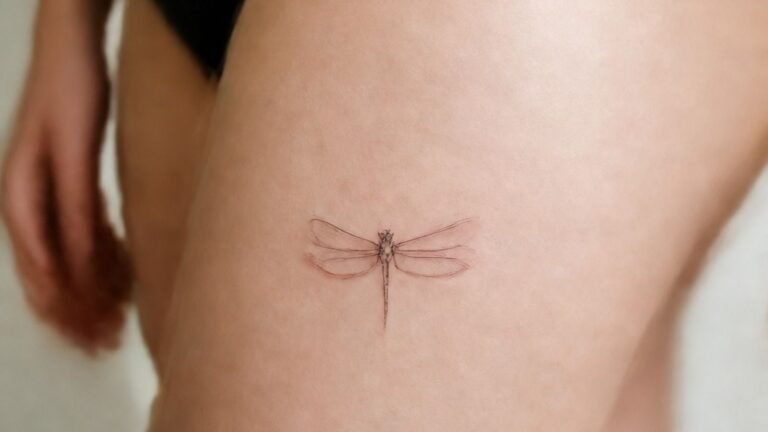
Single realistic elements, an eye, a flower, held in sparse geometric frameworks. Often small, sometimes single-needle. The geometry functions as negative space or thin contour rather than dominant structure. Heals faster, ages better, but loses the dramatic impact of larger compositions.
Biomechanical Geo Realism
Realistic mechanical or anatomical elements (gears, bones, musculature) combined with geometric structure. The geometry reads as engineered rather than ornamental. Often associated with a darker palette and heavier line weight.
Double Exposure Geo
Landscape or architectural photography rendered realistically within animal or human silhouettes, then cut with geometric planes. Requires exceptional design sense; the layered references can collapse into visual noise without careful value separation.
Choosing an Artist
This is not a style for generalists. The portfolio must show both strong realism and precise geometry, ideally in the same pieces, not separate categories. Red flags include geometric lines that waver, inconsistent dotwork density, or realistic elements that look photographic in photos but muddy in healed examples.
- Ask to see healed photos specifically; fresh geo realism always looks sharper than it settles
- Verify the artist designs the geometry to custom fit your anatomy, not applies templates
- Discuss session breakdown, geometry and realism in same session, or separated
- Confirm needle grouping preferences; fine geometry often requires tighter groupings than standard lining
- Request a stencil preview to check how the geometric framework maps to your contours
Travel is often necessary. The style’s top practitioners cluster in major European cities, Los Angeles, and New York, though quality has dispersed as the techniques standardize. Budget accordingly, geo realism commands premium rates for the design time alone, before the multi-session execution.
Final Thoughts
Geo realism tattoos occupy a specific niche: technically demanding, visually striking, and not universally flattering. The style rewards patience in both artist selection and sitting through lengthy sessions. What distinguishes successful pieces from failed experiments is the integration quality, whether the geometry and realism genuinely interact or simply coexist. The best work makes the structure feel inevitable, as if the realistic subject naturally crystallized into these planes and angles. The worst looks like two unrelated tattoos overlaid. Take time finding an artist who understands that difference, and the result can hold its precision for years.
Frequently Asked Questions
How long does a geo realism sleeve typically take?
A full forearm or upper arm piece usually requires 15-25 hours across multiple sessions, depending on complexity. The geometric framework alone might need 4-6 hours before any realism begins. Rushing the structural work guarantees blown lines and uneven healing.
Will the geometric lines blur over time?
All lines spread slightly, but well-executed geometric work in appropriate placements ages better than fine-line ornamental pieces. The key is consistent depth and adequate saturation during application. Black lines on flat skin with minimal movement hold their edge for years.
Can geo realism cover an existing tattoo?
Rarely without compromise. The geometry requires clean skin to read correctly, and the realism needs clear reference. Existing dark work usually forces the geometry into limited negative space or demands extensive laser fading first. Consult specifically about cover-up feasibility before committing to this style.
Why do some geo realism tattoos look grey instead of black after healing?
This usually indicates insufficient saturation during application, often from an artist working too fast or using incorrect needle groupings for the skin type. Grey-healed geometry reads as failed technical execution; the style depends on true black contrast. Healed photos in the artist’s portfolio reveal whether they solve this consistently.
Related Style Guides
- Geometric Cat Tattoos: Complete Style Guide
- Great Japanese Tattoos: A Complete Style Guide
- Realistic Anchor Tattoos: Complete Style Guide
- Explore more