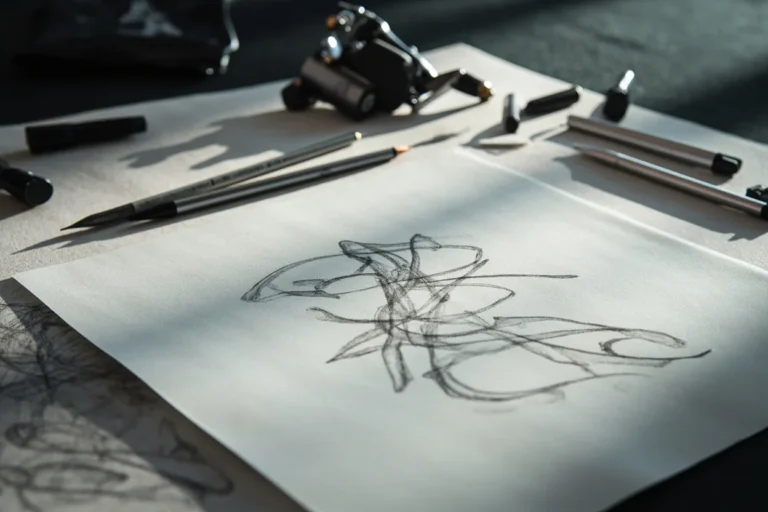
Prison tattoo guns are improvised devices built from available materials: mechanical pencils, guitar strings, paper clips, electric toothbrush motors, or cassette player motors. They function by moving a needle up and down to deposit ink beneath the skin. This guide explains the mechanics, risks, and why professional equipment exists for good reason.
The Direct Answer
Basic Components
A functional prison tattoo gun needs four things: a power source, a motor or vibration mechanism, a needle, and a barrel to hold it steady. The motor from an electric toothbrush or a small cassette player provides the reciprocating motion. A guitar string or sharpened paper clip serves as the needle. The barrel might be a hollowed-out pen casing or mechanical pencil tube. Ink comes from ballpoint pen ink, soot mixed with shampoo, or other improvised pigments.
How the Mechanism Functions
The motor’s spinning shaft connects to an offset cam or bent wire. This converts rotation into linear motion, up and down, like a sewing machine needle. The needle protrudes from the barrel by roughly 1-2 millimeters. Too shallow, and the ink falls out with the scab. Too deep, and the ink blows out, creating blurry lines and scar tissue. The power source is usually batteries taped together, sometimes charged from whatever electrical access exists in the unit.
What to Expect Step by Step
Assembly Process
Building one takes patience and some mechanical sense. The motor gets secured inside or against the barrel. The needle attaches to the moving arm with tape, thread, or melted plastic. The barrel must be rigid enough to prevent wobble, any side-to-side motion tears skin rather than depositing ink cleanly. Testing happens on fruit, styrofoam, or sometimes the builder’s own skin.
Actual Tattooing
Lines come from dragging the running needle across skin like a pen. Shading requires broader needle groupings and different hand speed, slower passes deposit more ink, creating darker tones. Because prison guns lack the precision tuning of professional machines, line weight variation is hard to control. Most prison tattoos default to bold outlines with minimal shading, since smooth gradients demand equipment that maintains consistent needle depth and speed.
Realistic Expectations
Quality Limitations
These devices cannot match professional rotary or coil machines for precision. Needle depth fluctuates with hand pressure and battery drain. Lines blow out. Ink saturation is unpredictable. The best prison tattoos look bold from a distance but reveal unevenness up close. Color work is especially rare and risky, improvised pigments often shift weirdly as they age, turning blues to greens or blacks to muddy grays.
Physical Risks
Infection is the immediate danger. Non-sterile needles, improvised ink, and unsanitary environments introduce bacteria. Bloodborne pathogens spread when needles get shared. Scar tissue forms more readily from traumatic needle action. Allergic reactions to non-standard inks can cause raised, itchy patches that last years. The skin damage is sometimes permanent, leaving keloids or discolored spots even after cover-up work.
Common Mistakes
Technical Errors
- Running the needle too deep, causing blowouts that blur lines within weeks
- Too-shallow work that heals out completely, leaving ghosted or patchy lines
- Using single needles for everything, when lining and shading need different configurations
- Neglecting to secure the needle properly, causing it to slip or snag mid-stroke
- Overworking the skin, causing excessive trauma and prolonged scabbing
Hygiene Failures
Reusing needles without sterilization is standard in prison, which is precisely why hepatitis C and staph infections are common outcomes. Homemade ink introduces contaminants that professional suppliers eliminate. Even “burning” a needle with a lighter doesn’t sterilize it properly, temperatures and duration vary too much. The absence of barrier methods like plastic wrap, new gloves, and single-use ink caps means cross-contamination happens easily.
How Ink Type Affects Long-Term Results
Soot-Based Ink
The oldest improvised ink is carbon soot suspended in a carrier, usually water, shampoo, or a small amount of oil. You collect the soot by burning materials that produce heavy carbon: melted styrofoam, rubber from shoe soles, or the residue scraped from a lighter flame held under a metal surface. The carbon particles are fine and relatively stable in skin over time. Many old prison tattoos done with soot ink retain reasonable darkness decades later, because carbon is chemically inert and the body struggles to break it down. The main problem is suspension quality. If the carrier ratio is off, particles clump unevenly, producing a grainy appearance even in areas that were supposed to be solid black.
Ballpoint Pen Ink
Ballpoint ink is the most commonly used improvised pigment because it’s accessible, but it performs poorly long-term. The dye compounds in ballpoint ink are not designed to stay stable under skin. Most fade significantly within two to five years, shifting from black or blue-black toward a washed-out gray-green tone. Some pigments in ballpoint formulations may also trigger mild inflammatory responses over time, producing raised texture in healed work. If you’ve seen older prison tattoos that look like faded stamps rather than intentional linework, ballpoint ink degradation is usually the reason.
Smuggled Commercial Ink
In facilities where contraband smuggling is sophisticated enough, occasionally actual tattoo ink gets in. The results are noticeably better: more consistent saturation, truer color retention, and less long-term migration. This is the exception, not the rule, and its availability depends entirely on the facility and whoever controls that particular economy. When commercial ink does show up, artists with even moderate skill can produce work that holds up for years rather than fading into muddy patches.
Design Styles That Work vs. Designs That Don’t
What Survives Poor Application
Bold, heavy linework is the prison gun’s natural territory. Thick outlines in the 3-5mm range hold their shape even when slight blowout occurs, because the line is wide enough that edge softening reads as stylistic rather than accidental. Traditional American tattoo designs, the kind with thick black outlines and simple blocked color, were popularized in part because that aesthetic is forgiving of equipment limitations. Simple text in block letters, bold geometric patterns, and high-contrast portraits with strong value separation all perform reasonably well on improvised equipment.
What Fails Badly
Fine line work is essentially impossible with a prison gun. Hairline details require sub-millimeter needle control and perfectly consistent depth, neither of which improvised machines provide. Watercolor-style tattoos, delicate script, and micro-realism all depend on precisely placed light passes that prison equipment cannot execute. Any design that relies on negative space and thin strokes will blow out into an unreadable smear within months. If you see someone attempting photorealistic portraits or geometric mandalas with complex fine lines using improvised equipment, the healed result will look nothing like the intention.
Prison Tattoo Traditions Around the World
Russian Criminal Tattoos
Russian prison tattooing developed one of the most documented symbolic systems in criminal history. In the Soviet-era criminal underworld, known as the vory v zakone or “thieves in law,” tattoos were not decorative choices. They were biographical records and status markers that other criminals could read. Stars on the knees meant you’d never kneel before authority. A cathedral with a specific number of domes indicated how many sentences had been served. Epaulettes on the shoulders signified rank within the criminal hierarchy. Wearing tattoos you hadn’t earned was considered a serious offense and could result in violent consequences. This system has been documented extensively by researchers and former inmates, and while the rigid code has eroded somewhat in the post-Soviet period, the tradition of symbolic, earned tattooing persists in Russian penal culture.
US Prison Tattoo Culture
American prison tattooing tends to be more personal and less codified than the Russian system, though gang affiliations introduce some shared symbolism. Number sequences, geographic markers, and specific imagery communicate allegiance or background within particular groups. Outside gang-affiliated work, American prison tattoos often mark time served, memorialize people lost, or carry personal religious imagery. The aesthetic leans toward bold, readable designs that hold up under rough application conditions.
Latin American Prison Tattoo Culture
In parts of Central America, heavily tattooed individuals have historically signaled membership in specific gang networks, most visibly in El Salvador, Honduras, and Guatemala. These tattoos carry significant social meaning both inside prisons and on the street, often covering large portions of the face and neck in ways that make affiliation immediately visible. The practice has complex and often tragic consequences for individuals who later attempt to leave gang life, since the visible tattooing creates permanent documentation of former membership that can follow a person across borders and decades.
The Jailhouse Aesthetic in Professional Shops
The raw, graphic quality of prison-style tattooing has found genuine appreciation in the professional tattoo world. Many artists now specialize in “jailhouse” or “stick and poke” inspired work done with proper equipment: bold black outlines, minimal shading, deliberate imperfection used as a stylistic choice rather than a technical failure. You can get this aesthetic without the infection risk, the inconsistent healing, or the permanent blowout damage.
Professional artists who work in this style use single-needle setups or hand-poke techniques with sterile, individually packaged needles and professional-grade black ink. The result captures the visual language of prison tattooing while maintaining the hygiene standards that protect your skin. If the rough, graphic look appeals to you, seek out an artist who works intentionally in that style rather than trying to replicate the conditions that produced it historically.
Aftercare Essentials
Fresh tattoos need airflow, gentle cleaning, and moisture balance. In prison, clean water and unscented soap may be scarce. The person must avoid picking scabs, which is harder when clothing rubs against the area or when sleeping on concrete or thin mattresses. Sun exposure through windows can fade healing ink. Ointments are rarely available, so some use whatever lotion they can trade for, fragranced products often irritate fresh work.
Healing takes longer with traumatic application. Two to four weeks is typical for surface healing, but the skin remains vulnerable for months. Thick scabbing indicates excessive damage during application. Touch-ups are difficult when the same equipment and conditions persist, so many prison tattoos remain unfinished or degrade visibly within the first year.
Cost Factors
Inside Prison
Payment runs on commissary goods, stamps, phone time, or favors. A simple name or symbol might cost a few packs of ramen. Larger pieces, full sleeves, portraits, extensive lettering, accumulate serious debt. The currency isn’t money, but the obligation created lasts longer than the tattoo. Some artists build reputation and consistent clientele; others work sporadically based on access to materials and housing unit restrictions.
Professional Correction Costs
Covering prison work in the free world costs significantly more than the original piece. Laser removal runs hundreds per session, often requiring ten or more sessions for dense black ink. Cover-up tattoos need larger, more complex designs to mask blowouts and scarring. What cost three ramen packs inside might require thousands of dollars and years of appointments to address properly.
Before You Decide
Professional tattoo equipment exists because decades of refinement produced machines that minimize skin trauma and maximize predictable results. Rotary machines run quietly with consistent needle depth. Coil machines offer the punch needed for bold lines. Autoclaves, single-use needles, and regulated inks eliminate most infection risks. The difference isn’t merely aesthetic, it’s physiological. Your skin is an organ that responds to damage with inflammation, scarring, and pigment migration.
If you’re researching this topic out of curiosity, the mechanics are genuinely interesting. If you’re considering building one, understand that the trade-offs are severe and permanent. The tattoo community has worked hard to shed its association with unsanitary, underground practice. Modern shops operate with health department oversight, ongoing education, and genuine craft pride. The gap between a prison gun and a professional setup represents more than equipment, it represents respect for the person wearing the work for life.
Frequently Asked Questions
Can prison tattoo guns be made safe with better materials?
Better materials help, but fundamental limitations remain. Without autoclave sterilization, single-use barriers, and regulated inks, infection and contamination risks stay high. The mechanical precision of professional machines also can’t be replicated with improvised parts.
Why do prison tattoos often look blurry or faded?
Inconsistent needle depth, non-standard inks, and limited aftercare supplies cause blowouts and poor retention. Professional machines maintain precise depth; prison guns fluctuate with hand pressure and battery strength.
How do people get tattoo supplies inside prisons?
Items come through visiting rooms, staff, smuggled packages, or improvised from available materials. Each facility has different security levels and screening, making access unpredictable and possession a disciplinary violation.
What happens to prison tattoos after release?
Many people seek professional cover-ups or laser removal. Dense black ink and scar tissue make both processes more difficult and expensive than work done with proper equipment. Some keep them as personal markers regardless of quality.
Related Tattoo Guides
- How to Make a Tattoo Gun Without a Motor: A Practical Guide
- How to Make a Permanent Tattoo at Home With a Pen
- How to Manage Tattoo Pain: A Practical Guide
- Explore more