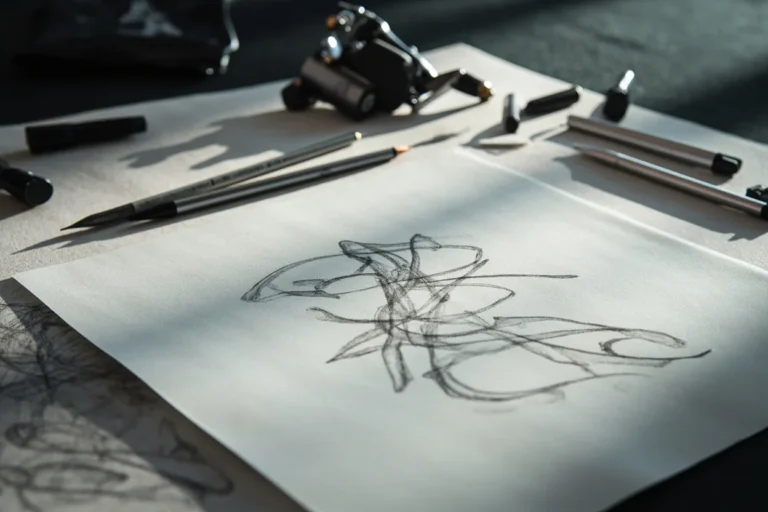
A jailhouse tattoo gun is typically built from a small motor (often from a Walkman or electric toothbrush), a bent paperclip or guitar string for the needle, and a modified pen casing to hold it together. Power comes from AA batteries taped or rubber-banded to the frame. The needle bar, sometimes just a straightened staple or single guitar string, moves up and down through a hollow tube, driven by the motor’s offset cam. It works enough to push ink into skin, but that’s about where the similarities to professional equipment end.
Tips From the Chair
What the Build Actually Looks Like
The classic “jail rig” uses a cassette player motor because it’s small, runs on low voltage, and has a shaft you can offset with a bit of melted toothbrush or a bead. That offset creates the reciprocating motion, needle up, needle down. The barrel is usually a hollowed-out ballpoint pen. The needle itself gets tricky: guitar string works because it’s already hard, thin, and has some spring. A single needle is most common, though some try to cluster them with thread or tape. Ink comes from melted chess pieces, boot polish, or pen ink mixed with water or shampoo. None of this is sterile. None of it is consistent. But the mechanical principle, linear oscillation driving a needle through a tube, does technically function.
Why the Geometry Matters
Professional rotary and coil machines control needle depth, angle, and speed with precision. A jailhouse build has none of that. The needle hangs loosely in the tube, so it wobbles side to side. Depth control is your thumb pressure and hope. The motor runs at whatever speed the dying batteries allow, slowing as they drain. What this means practically: lines blow out (ink spreads under the skin from too deep), or they don’t saturate at all (too shallow, falling out during healing). Shading is nearly impossible because there’s no way to control needle grouping or soft passes. The people who get decent results usually have hundreds of hours of practice on this specific equipment, not because the machine is good, but because they’ve learned to compensate for its failures.
- Offset cam material: melted toothbrush plastic, bead, eraser bit
- Common needle sources: guitar string (high E or B), straightened staple, sewing needle
- Power degradation: AA batteries drop voltage throughout the session, changing hit strength
- Tube alternatives: ballpoint pen casing, hollowed mechanical pencil, straw (worst option)
Common Mistakes
Needle and Tube Problems
The gap between needle and tube wall kills most jailhouse tattoos. Too loose, and the needle strikes the tube lip, blunting it and tearing skin. Too tight, and friction heats the needle, causing more trauma and slower healing. The needle tip itself rarely holds a sharp point for long, guitar string is round, not hollow like a proper tattoo needle, so it pushes ink rather than carrying it. Single needle work on black skin or dense body hair areas often fails to deposit visible pigment at all. Multiple passes to fix it just scar.
Ink and Contamination
Melted chess piece ink? That’s plastic soot suspended in liquid. It migrates over time, turning blue-black blobs into greenish smears. Pen ink contains solvents and pigments not meant for subcutaneous placement. The body walls it off, creating granulomas, hard, raised areas that can last years. Hepatitis C transmission through shared jailhouse tattoo equipment is well-documented. The same needle, same tube, same “ink cap” (usually a bottle cap or foil) gets used across multiple people. No autoclave, no ultrasonic, not even reliable bleach exposure. The risk isn’t theoretical.
- Needle wobble causes skin trauma that heals as raised scarring
- Non-sterile ink leads to bacterial infection, sometimes severe
- Shared equipment transmits bloodborne pathogens regardless of “wiping it down”
- Improper depth causes blowout (ink spread) or fallout (no retention)
Realistic Expectations
A tattoo from jailhouse equipment will likely be rough, blotchy, and age poorly. Lines that look acceptable in the first month often spread or fade unevenly within a year. Color is essentially impossible, colored inks require specific particle sizes and suspension mediums that improvised materials can’t replicate. Large pieces become patchwork nightmares because the machine fails mid-session, batteries die, or the single needle clogs with plasma and dried ink. Covering these later costs significantly more than a professional piece would have, because the artist must work around scar tissue, uneven saturation, and blown lines that limit design options.
Some people do collect these as “prison tributes” or personal markers. That’s a valid choice if informed. But the physical reality is that skin damaged by poor equipment heals differently, sometimes thicker, sometimes with hypopigmented patches where the immune response was too aggressive. You’re not just choosing a rough aesthetic; you’re choosing a specific kind of biological outcome.
Aftercare Essentials
What Healing Actually Looks Like
Skin tattooed with improvised equipment tends to swell more and weep longer. The trauma is greater, larger needle, rougher entry, more passes needed for saturation. Expect 3-5 days of heavy plasma and ink leakage, compared to 1-2 with professional work. Scabbing will be thicker and more prone to cracking if the skin dries out. The risk of infection is higher, so any signs spreading redness, heat, or pus require medical attention. Not as advice, but as reality: people do wait too long, and cellulitis from tattoo complications is common enough that emergency rooms recognize it.
Minimal Viable Aftercare
Keep it clean with mild soap and water. Pat dry, don’t rub. Thin layer of unscented lotion or plain petroleum jelly to prevent cracking scabs. No soaking, baths, pools, even long hot showers soften scabs and pull ink out. Sun exposure during the first month darkens scar tissue permanently. Don’t pick. The scabs on a rough jailhouse tattoo are often thicker and more tempting to remove; resisting matters more here because the ink retention is already marginal.
- Wash hands before touching the area
- Avoid tight clothing that rubs the fresh tattoo
- Don’t sleep directly on it for the first week if possible
- Expect longer peeling phase, sometimes 2-3 weeks versus 1 week professional
Pain & Comfort
Jailhouse tattooing hurts more. The single needle or crude cluster isn’t as sharp as professional needles, so it tears rather than slices. The lack of consistent speed means some areas get hammered too fast, others dragged too slow. There’s no numbing, no breaks built into professional timing, and the environment itself, stress, secrecy, poor positioning, amplifies pain perception. The most common spots (hands, neck, face) are also among the most sensitive and most difficult to heal properly. Rib work or sternum pieces with improvised equipment are brutal; the needle flexes against bone with no cushioning, and the vibration rattles through the chest cavity.
Endurance becomes the limiting factor. A professional session might run 4-5 hours with manageable pain because the equipment is efficient. Jailhouse work takes longer for less result, and the accumulated trauma exhausts the body’s pain coping mechanisms faster. Most people tap out early, leaving pieces unfinished that then become problems to solve later.
Cost Factors
Inside, It’s Trading
No cash changes hands in custody. The “cost” is commissary items, favors, or protection. A detailed piece might run two or three hundred dollars in store value, ramen, stamps, tobacco where permitted. The artist’s reputation inside determines rates. The problem is recourse: if it’s bad, you can’t get your soup back. There’s no portfolio to review, no health department to complain to. The power dynamic is also real. Indebtedness for tattoos creates obligations that can turn dangerous.
Outside, It’s Cover-Up Money
Fixing jailhouse work professionally starts around $200-400 for small pieces, scaling rapidly with size and complexity. Laser removal first? $500-1500 per session, multiple sessions needed. The economics are unambiguous: save the commissary money, wait, and pay a professional once. Or pay exponentially more in money, pain, and skin quality to fix what improvisation cost you.
Before You Decide
The knowledge of how these machines work isn’t encouragement, it’s context for a choice that people make under constraints most never face. If you’re reading this from outside, the path is obvious: professional equipment, sterile environment, trained hands. If you’re inside or facing that possibility, understanding the mechanical failures and biological risks lets you assess what you’re actually trading. Skin is the only canvas you can’t replace. The tattoo you live with includes not just the image but the method of its making, written in scar tissue and ink migration that decades won’t erase.
There’s no romanticism in rough work. Some wear it as survival marking, identity under duress. That’s human and real. But go in knowing: the machine built from a Walkman and a guitar string will damage you more than a professional tool, and the damage lasts longer than the time you served.
Frequently Asked Questions
Can a jailhouse tattoo gun actually work well enough for detailed designs?
No. The wobble, inconsistent power, and single-needle limitation make fine detail nearly impossible. What looks detailed fresh usually blurs within months. Large designs become patchy because equipment fails mid-session.
What’s the most common infection risk from prison tattooing?
Hepatitis C transmission through shared needles and ink caps is the most documented risk. Bacterial infections from non-sterile equipment and ink are also common, sometimes progressing to serious soft tissue infections.
Why do jailhouse tattoos often turn green or blue over time?
Improvised inks, melted plastic, pen ink, boot polish, contain pigments and bases not formulated for skin. The body breaks them down unpredictably, and some pigments migrate or change color as they degrade.
Is it true that hand and neck tattoos done with jailhouse equipment are harder to remove?
Yes, generally. These areas often require more sessions for laser removal because the ink is deposited unevenly and sometimes deeper than professional work. Scar tissue also complicates both removal and cover-ups.
Related Tattoo Guides
- How Prison Tattoo Guns Work: A Realistic Guide
- How to Make a Tattoo Gun Without a Motor: A Practical Guide
- How to Make a Permanent Tattoo at Home With a Pen
- Explore more