
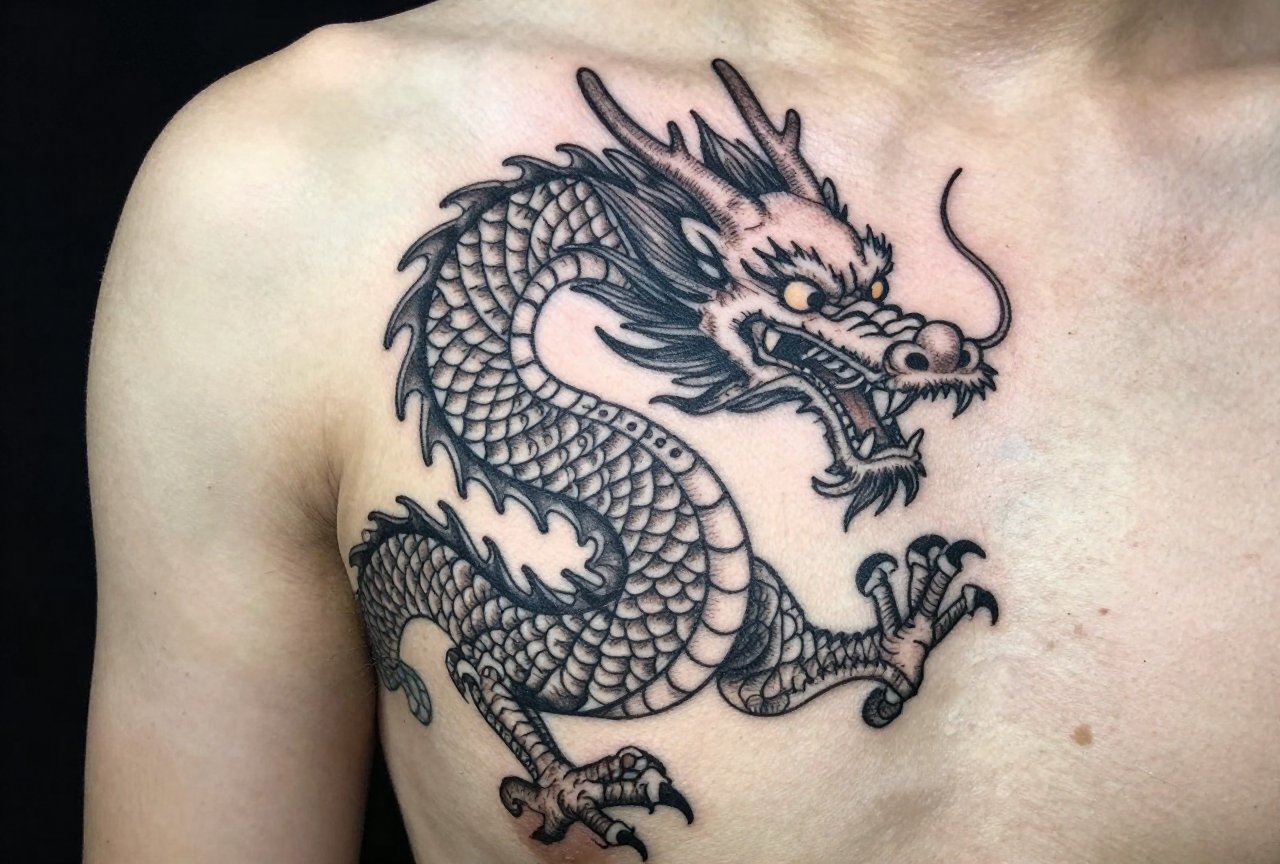
A Japanese dragon tattoo means power, wisdom, and protection rooted in centuries of folklore. Unlike Western dragons that guard treasure and breathe destruction, the Japanese dragon (ryū or tatsu) controls water, brings rain, and acts as a benevolent guardian. I’ve tattooed dozens of these over the years, and clients always bring something personal to the imagery, strength they’ve found, storms they’ve survived, or protection they want to carry.
Symbolism & History
Water, Not Fire
This is the first thing I explain to clients who walk in wanting a dragon but only know the Game of Thrones version. Japanese dragons are creatures of water, rivers, seas, clouds, rain. They have three claws instead of the Chinese five, and they don’t have wings. They fly through willpower and spiritual energy alone. That distinction matters because it changes the entire feeling of the piece. Water dragons suggest flow, adaptability, life-giving force. Fire-breathing Western dragons read as aggression, conquest, hoarding. When someone sits in my chair and says they want a Japanese dragon, I always ask: do you know why? The ones who do tend to have the most meaningful pieces years later.
Guardian Energy
In Japanese folklore, dragons protect temples, guard sacred pearls of wisdom, and serve as messengers between worlds. The legendary dragon king Ryūjin lives in an undersea palace and controls tides with his jewel. Sailors once tattooed dragons for safe passage. Warriors wore them for courage in battle. That guardian aspect still resonates, I’ve had parents get dragons after children are born, people recovering from illness, folks who’ve finally escaped something. The dragon doesn’t just represent strength; it represents using strength to protect what matters.
Common Variations & Styles
Irezumi vs. Modern Interpretations
Traditional Japanese tattooing, irezumi, follows specific rules that developed over centuries. Dragons coil through waves, wind bars, or clouds in very particular ways. The scales get laid in patterns that flow with the body’s musculature. Cherry blossoms might fall around the dragon to symbolize life’s fragility against its power. Peonies represent wealth and honor. I’ve done full back pieces that took forty hours, the dragon emerging from turbulent water, every scale hand-poked or machine-lined depending on the client’s pain tolerance and budget.
Modern interpretations loosen these rules. Some clients want a single dragon on a forearm, no background, clean lines and limited color. Others want watercolor splashes, geometric elements, or blackwork shading that references Japanese aesthetics without following tradition strictly. Both approaches work if the artist understands why the imagery matters. The worst dragon tattoos I’ve seen came from artists who copied a Pinterest design without knowing which direction the dragon should face or why the claws matter.
- Traditional ryū: Three claws, no wings, serpentine body, associated with specific elements
- Dragon with pearl: Chasing or holding the tama (sacred jewel), representing wisdom or spiritual pursuit
- Dragon and tiger: Classic pairing representing balance of power (dragon) and strength (tiger)
- Dragon and koi: The koi’s transformation, perseverance rewarded with ascension
Color Choices and What They Signal
Black and grey dragons age beautifully. The heavy saturation holds, the contrast stays readable. I’ve seen blackwork dragons from fifteen years ago that still look fierce. Color changes the meaning subtly, gold suggests imperial power or spiritual attainment. Green connects to nature, vegetation, spring. Blue reinforces the water association. Red can mean passion, danger, or protection against evil depending on context. We see this a lot in the shop: someone wants a red dragon because it “pops,” and we have to talk about whether that choice serves the meaning they actually want.
Best Placements
Japanese dragons demand flow. The body curves, the tail extends, the head turns. This isn’t a static image you can drop anywhere. Traditional placement follows the body’s lines, full back, full sleeve, wrapping the thigh, chest panel connecting to half-sleeve. I’ve tattooed dragons that start at the shoulder, coil down the outer arm, and have the tail curling toward the wrist. The elbow becomes a joint in the body, the shoulder the emergence point from clouds.
Smaller dragons work but require compromise. A forearm piece might show just the head and upper body emerging from stylized waves. The ribs can hold a coiled dragon if the client has enough real estate and pain tolerance. Fingers and hands? I’ve done them, but I warn clients: line detail blurs, color falls out, and the meaning gets compressed into something more decorative than symbolic. The dragon wants room to move.
- Full back: The classic canvas, allows complete dragon with all elements
- Full sleeve: Narrative flow, dragon can interact with other symbols
- Thigh/leg: Excellent for coiling compositions, less painful than ribs
- Chest to half-sleeve: Hikae style, traditional and striking
Who Chooses This Tattoo / Personal Meanings
What Clients Actually Say
In my chair, the stories vary. A construction worker got his after beating a years-long drinking problem, the dragon as reclaiming power, controlling the water instead of drowning in it. A woman in her sixties chose a small dragon on her shoulder after her divorce, the first tattoo she’d ever allowed herself. She wanted something that said she’d been through fire and come out with wisdom. A younger client, twenty-two, brought his grandfather’s WWII journal. The grandfather had a dragon tattoo from his time in occupied Japan. He wanted to honor that connection without copying the exact piece.
Not everyone has a story that clean. Some just think dragons look cool, and that’s fine too. But the ones who connect the symbol to something lived tend to sit better during long sessions. They understand the discomfort as part of the transformation. The dragon becomes theirs through the process, not just the finished image.
Cultural Respect vs. Appreciation
This comes up in every shop that does Japanese work. I’m not Japanese. Most of my clients aren’t. The question is whether getting a Japanese dragon constitutes appropriation. My take, after years of doing this: intention and education matter. If you’re choosing this imagery, learn what it means. Don’t mix unrelated symbols because they look cool. Don’t claim a cultural connection you don’t have. Appreciate the art form, respect its origins, and work with artists who understand the tradition. I’ve turned down clients who wanted “something Asian” without caring what, and I’ve spent hours consulting with others who genuinely wanted to understand before committing.
Similar Symbols
Clients often compare dragons to other Japanese tattoo motifs. The phoenix (hō-ō) represents rebirth and renewal, similar powerful energy but more focused on cyclical return than ongoing guardianship. The koi represents perseverance and ambition, the dragon its realized form. Snakes suggest cunning and regeneration but lack the benevolent protector aspect. Oni (demons) can be guardians too, but they’re more chaotic, more about raw force than refined power.
Western dragons, as mentioned, invert almost every quality. Fire vs. water. Destruction vs. protection. Hoarding vs. generosity. I’ve had clients who started wanting a Western dragon and switched after learning the difference. The Japanese version simply fits more people’s lived experience better, surviving difficulty, gaining wisdom, protecting others.
Final Thoughts
A Japanese dragon tattoo carries weight beyond its visual impact. The meaning lives in the water association, the guardian role, the specific visual language developed over centuries of art and story. I’ve watched these tattoos age on skin, watched clients grow into them or grow past them. The best ones were chosen with understanding, placed with respect for the body’s movement, and executed by artists who know why the claws are three and the dragon has no wings.
If you’re considering this imagery, sit with the question of what you’re protecting, what wisdom you’ve earned, what storms you’ve learned to ride rather than fear. The dragon doesn’t just represent power. It represents power that’s been tempered, directed, made useful. That’s the difference between a cool tattoo and one that stays meaningful when you look at it thirty years from now.
Frequently Asked Questions
Do I need to be Japanese to get a Japanese dragon tattoo?
No, but approach it with respect and education. Learn the symbolism, work with artists who understand the tradition, and avoid treating it as mere decoration. Cultural appreciation means engaging seriously with what the imagery represents.
How much does a traditional Japanese dragon sleeve typically cost?
Quality work from an experienced artist runs thousands of dollars and takes multiple sessions over months. This isn’t a budget tattoo. Rushing for cheap work means compromised design, poor aging, and often regrettable results. Save and wait for the right artist.
Will a Japanese dragon tattoo fade or blur over time?
All tattoos age, but bold lines and proper saturation hold best. Black and grey dragons typically age better than fine-line color pieces. Sun protection matters enormously, UV exposure destroys tattoo pigment. Expect touch-ups after ten to fifteen years.
Can I combine a dragon with non-Japanese elements like roses or clocks?
You can, but be thoughtful. Mixing traditions without understanding either tends to look disjointed. If you want Japanese dragon imagery, commit to that visual language. If you want eclectic symbolism, work with an artist who can unify disparate elements coherently.
Related Tattoo Meanings
- Katana Tattoo Meaning: Honor, Discipline the Warrior Spirit
- Catrina Tattoo Meaning: Life, Death Mexican Heritage
- Llorona Tattoo Meaning: Grief, Warning, and Mexican Folklore
- Explore more









