
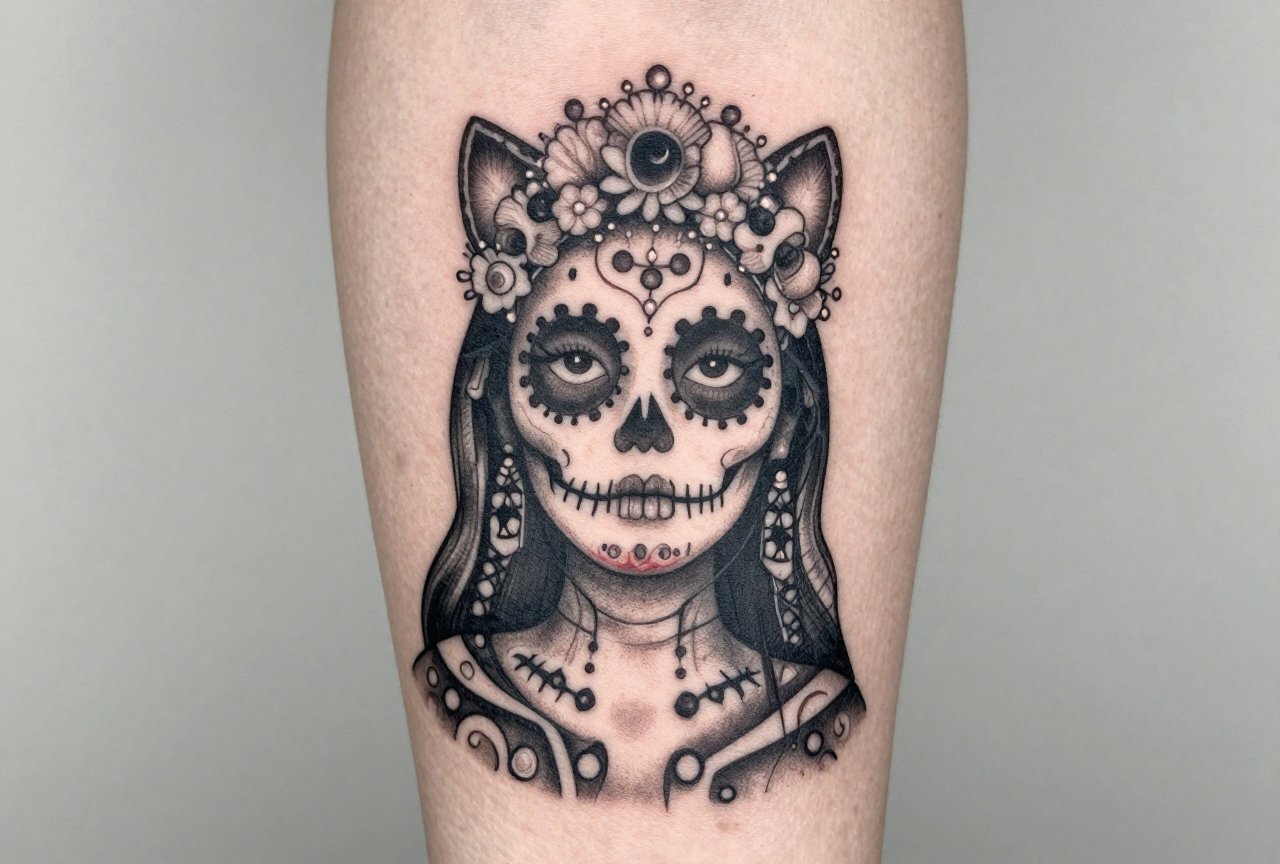
The Catrina tattoo carries deep Mexican roots, blending beauty with mortality in a way that celebrates life rather than mourning death. She’s the elegant skeleton woman you see in Día de los Muertos imagery, originally sketched by José Guadalupe Posada in 1910 as political satire, later reclaimed as a cultural icon. When someone sits in my chair for a Catrina, they’re usually carrying stories about family altars, lost loved ones, or a connection to heritage that runs bone-deep.
Symbolism & History
Posada’s original “La Calavera Catrina” was a zinger at Mexico’s upper class, a skeleton dolled up in French finery to mock those who rejected their own culture. Over a century later, she’s become something far more layered. I’ve tattooed Catrinas on abuelas who want their mother’s face remembered, on Chicano clients reconnecting with roots, and on people who simply found her image during a hard season and felt seen.
The core symbols stay consistent: the skull itself is memento mori, a reminder that death comes for everyone. But the Catrina specifically adds joy to that reckoning. The flowers, the elaborate dress, the painted face, she’s having a party at the edge of the grave. That’s the Día de los Muertos philosophy in ink form. Death isn’t the end of relationship; it’s a different kind of conversation.
Color vs. Black and Grey
Color Catrinas pop with marigold oranges, rose reds, and the electric pinks of traditional sugar skull makeup. They photograph beautifully and carry that festival energy. Black and grey versions, though, hit different, they age cleaner on most skin tones and carry a more somber, timeless weight. I’ve had clients cry in the mirror looking at a greywash Catrina because the stripped-down palette felt more like honest grief. Neither choice is wrong; they just speak different emotional languages.
Common Variations & Styles
Walk into any shop from LA to Houston and you’ll see Catrinas interpreted through distinct regional lenses. Here are the main approaches I work with:
- Traditional Mexican folk style: Bold lines, flat color fields, direct reference to Posada’s broadsheet aesthetic. Think thick black outlines, limited but saturated palette, decorative borders.
- Realistic portrait Catrina: The face rendered in soft shading, almost living, with skull elements emerging through makeup or transitioning at the jaw. These take serious technical skill to keep from looking muddy as they age.
- Neo-traditional: My personal favorite to execute. Keeps the bold line weight but adds dimensional shading, jewel tones, and ornamental details like filigree or candles.
- Chicano black and grey: Soft, smoky gradients, often paired with religious iconography, prison-style lettering, or payasa imagery. Deep roots in Southern California shop culture.
- Minimalist/line work: Just the essential silhouette, hat, face, maybe a single flower. Clean, fast, but you lose some of the symbolic density.
Clients often bring me photos of their grandmother’s ofrenda, the specific flowers she used, the color of her favorite rebozo. Those details get woven in. I’ve added hummingbirds for a client whose mother believed they carried souls. Another brought her tía’s actual lipstick shade to match the lip color. That’s the stuff that separates a generic Catrina from a real memorial.
Best Placements
Catrinas need room to breathe. The face detail, the headdress, the ornamental elements, squash them too small and in five years you’ve got a blurry smudge with eye sockets.
High-Impact Large Placements
Thighs and upper arms are the classic real estate. A Catrina on a thigh gives you vertical space for the full hat and flowing dress, and the skin there stays relatively stable over time. Upper arms, especially outer bicep, let you wrap the headdress around the curve of the muscle. I’ve done full back pieces that incorporated multiple generations of family faces into the Catrina’s dress pattern, those are all-day sessions, but the storytelling payoff is massive.
Smaller & Subtle Options
Forearms work if you keep the composition tight, maybe just the face with minimal headdress. Ribs are popular but brutal; that skin moves constantly with breathing, and the healing is rough. I always warn clients that rib Catrinas often need touch-ups. Hands and neck? I talk people out of those for first tattoos. The Catrina deserves better than to be crammed into a spot where she’ll blow out in two years.
One thing I tell clients straight: the face is the focal point. Wherever you place it, make sure the eyes can be sized large enough to hold detail. Micro-Catrinas are a technical lie that Instagram filters sell and real skin punishes.
Who Chooses This Tattoo / Personal Meanings
After fifteen years in shops, I can tell you there’s no single Catrina client. The meaning splinters across experiences:
- Heritage reclamation: Second or third-generation Mexican-Americans who grew up with the imagery at family gatherings but want to claim it as their own adult identity.
- Grief work: Someone processing a death, often a parent or sibling, who wants a permanent ofrenda on their body. The Catrina becomes a companion through mourning.
- Survivorship: I’ve tattooed Catrinas on people who’ve beaten illness, faced their own mortality, and want to wear the skull as triumph rather than fear.
- Aesthetic draw: Honestly? Some people just think she’s beautiful. The symmetry, the flowers, the contrast of horror and elegance. That’s valid too, though I always ask what personal connection they feel, because that guides the design choices.
There’s tension sometimes. I’ve had white clients ask for Catrinas, and I have the conversation about cultural context. Not to gatekeep, but to make sure they’re entering the imagery with respect. The best outcomes happen when someone has done even a little homework on what Día de los Muertos actually means to living communities.
Similar Symbols
Clients often waver between the Catrina and related imagery. Here’s how I break it down in consultations:
- Sugar skull (calavera): More decorative, less narrative. Often simpler, smaller, good for first tattoos or less personal commitment. The Catrina is specifically female, specifically elegant, specifically human-scale.
- Grim Reaper: Western death as threat, as ending. Totally different emotional register. I’ve had bikers get reapers and granddaughters get Catrinas; the vibe couldn’t be more separate.
- Santa Muerte: This one’s complicated. She’s a folk saint, often associated with protection in marginalized communities, sometimes criminalized by association. The Catrina is cultural celebration; Santa Muerte is devotional practice. I don’t mix them up in design, and I ask questions if a client seems confused.
- Japanese yūrei or oni: Another culture’s death imagery, equally rich, equally not interchangeable. I’ve seen mashup attempts that feel disrespectful to both traditions.
The Catrina stands apart because she’s laughing. She’s at the party. That specific energy is hard to find in other death iconography.
Final Thoughts
A Catrina tattoo done well should feel like a conversation with your own mortality that you can actually stand to have. The best ones I’ve put on skin carry specific stories, abuela’s roses, the year someone died, the color of the sky on Día de los Muertos morning. The worst ones I’ve seen are generic flash copied fifty times with no personal anchor, fading into blurry regret.
If you’re considering this piece, spend time with the imagery before you spend money. Visit a real ofrenda if you can. Talk to living people who celebrate the holiday. Bring your artist something beyond a Pinterest screenshot. The Catrina deserves your story, not just your skin.
Frequently Asked Questions
Does a Catrina tattoo have to be colorful to be authentic?
Not at all. Black and grey Catrinas are deeply rooted in Chicano tattoo tradition and carry their own emotional weight. Color celebrates; greyscale mourns. Both are valid expressions of the symbol’s meaning.
Is it disrespectful to get a Catrina if I’m not Mexican?
It depends on your relationship to the imagery. Appreciation with understanding and respect differs from casual appropriation. I always encourage clients to learn the history of Día de los Muertos and consider whether they’re honoring the culture or just consuming aesthetics.
How well do Catrina face details age over time?
Fine lines in the eyes, nose shading, and delicate flower work will soften. I design with bolder features in the face and save the finest detail for larger elements that can blur gracefully. Expect a touch-up in 5-10 years if you want it crisp.
Can I combine a Catrina with a portrait of my deceased loved one?
Absolutely, and it’s one of the most meaningful approaches. I often blend a loved one’s features into the Catrina face or incorporate their personal items into the headdress. It transforms the symbol from general cultural reference into specific family memorial.
Related Tattoo Meanings
- Llorona Tattoo Meaning: Grief, Warning, and Mexican Folklore
- Lemon Tattoo Meaning: Symbolism, Styles Placement Guide
- Line Chin Tattoo Meaning: Symbolism, Style Why People Get It
- Explore more









