Clean line work strips Star Wars imagery down to its essential geometry. A single-needle Death Star outline. A three-line X-wing viewed head-on. These designs trade cinematic detail for instant recognition, and they work because the source material is already burned into popular memory. You don’t need shading to know a TIE fighter silhouette. The question is which icons survive translation to skin, and how to place them so they still read in ten years.
Popular Styles
Single-Needle Outlines
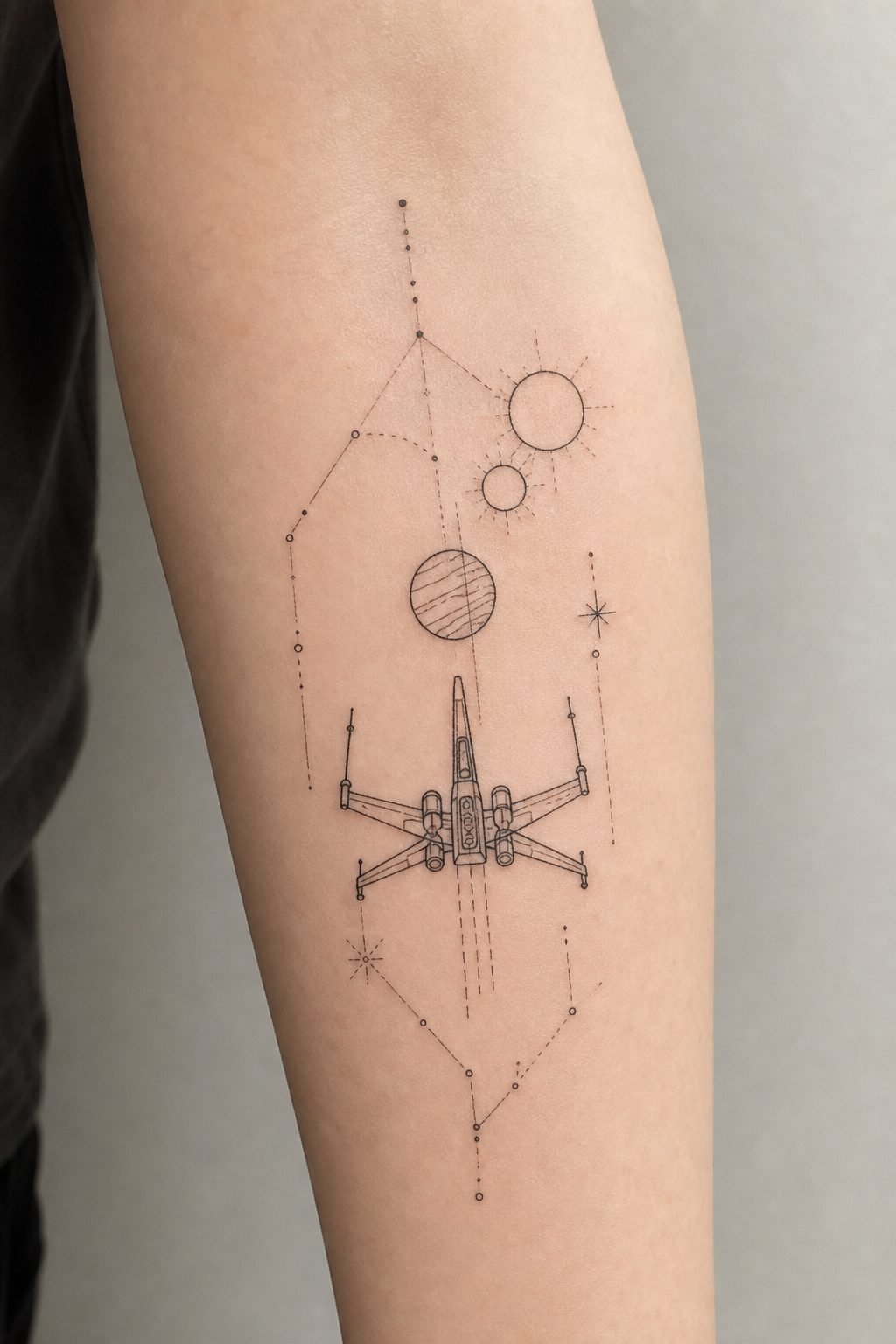
Single-needle work uses one round liner to deposit hair-thin marks. For Star Wars subject matter, this excels at helmets, droids, and ship profiles. Vader’s dome reduces to a few confident curves. BB-8 becomes two circles and a horizontal panel line. The risk is blowout, ink spreading under the skin over time. Thin lines blur faster than bold ones, so single-needle pieces need strategic placement away from high-friction areas and sun exposure.
Continuous Line Drawings
One unbroken line traces the entire subject without lifting from the skin. Yoda’s ears, robe folds, and cane merge into a single flowing path. The style looks delicate on paper but requires substantial skin real estate to avoid muddling where lines cross. Continuous line works best at palm-sized or larger. On fingers or wrists, the overlaps turn to noise.
Negative Space Designs
The Rebel starbird or Imperial cog rendered as empty skin surrounded by stippled or solid black. The image exists by absence. This demands either surrounding blackout work or placement where natural skin tone contrasts sharply with the inked field. Heals with a slight softening at the edges, which actually helps, the halo effect mimics a glow.
Design Ideas
Not every iconic image survives simplification. Complex characters like Jabba or General Grievous collapse into unrecognizable lumps without their texture. These hold up under line reduction:
- Helmets: Vader, Mandalorian, Captain Phasma. The silhouette alone carries weight. A side-profile Vader dome needs only five or six lines to read instantly.
- Droids: R2-D2’s cylindrical body and dome translate cleanly. C-3PO’s humanoid form requires more detail and ages poorly; stick to his head or a single golden arm.
- Ships in profile: Star Destroyer wedge, TIE fighter hex panels, X-wing with S-foils locked. Viewed from directly above or below, ships flatten to graphic shapes perfect for line work.
- Symbols: Rebel insignia, Imperial cog, Jedi Order crest, Mandalorian skull. These were designed as logos, already optimized for single-color reproduction.
- Minimalist characters: A single Leia bun silhouette. Three lines suggesting Yoda’s ears. The child in a hovering pram, reduced to dome and ears.
Avoid lightsabers unless you commit to color. A line-drawing blade reads as a stick. If you must, the hilt alone works, Vader’s or Rey’s have distinctive grips that identify without the blade.
Best Placements
Where Line Work Stays Crisp
Upper outer arm, outer forearm, calf, and upper back age most predictably for fine lines. These areas experience less stretching and friction than inner arms, wrists, or ribs. The skin is relatively stable, and you can control sun exposure with clothing.
Placement by Design
- Helmet profiles: Outer forearm, running vertically. The natural curve of the muscle follows the dome shape.
- Ship silhouettes: Flat planes, inner bicep, side of calf, flat of shoulder. Any curve distorts the perspective.
- Symbols: Chest center, upper back between shoulders, or flat of the thigh. Symmetrical designs need symmetrical placement.
- Small single icons: Behind the ear, ankle, or inner wrist. Accept that these will soften faster and plan for a touch-up in three to five years.
Finger and hand placement is possible but requires accepting significant fade. The constant regeneration of palmar skin and exposure to elements means even bold lines blur within a couple years. Single-needle work on hands is essentially temporary.
Color Choices
Strict line drawing typically means black ink only. But selective color can anchor a Star Wars reference without abandoning minimalism:
- Red: A single red line for Vader’s lightsaber hilt detail. The Rebel starbird filled with flat red while the outline stays black. Red ages well and stays visible on most skin tones.
- Blue or green: Small accent for Jedi-related imagery. A green line tracing Yoda’s walking stick. These cooler tones can fade to grey faster on lighter skin without proper saturation.
- White ink: Highlights on droids, or the Death Star’s superlaser focus lens. White heals to a subtle raised scar-like tone on most people, plan for it to be quieter than it appears fresh.
- Skin tone as color: Leaving the Death Star’s planet-killer aperture as bare skin inside a black circle. No ink, just absence.
Full color in a line-drawing style usually fails. The point is restraint. One accent color maximum, applied flat without shading.
Tips for Choosing
Reference Discipline
Bring your artist specific film stills or production art, not other people’s tattoos. Line drawing requires understanding the original form to reduce it accurately. A second-generation tattoo reference already lost information. Primary sources let the artist find the essential geometry themselves.
Scale Honesty
Complex designs need space. A Star Destroyer with visible bridge and shield generators requires at least four inches to read. At two inches, it becomes a spiky triangle. Test by drawing your design at actual size on paper, taping it to your intended placement, and living with it for a week.
Artist Selection
Look for portfolios showing healed fine-line work, not just fresh photos. Clean lines day-one mean nothing if they blur by month six. Ask to see pieces from a year prior. The style requires needle control and consistent depth, too shallow and ink falls out; too deep and blowout destroys the precision.
Long-term Maintenance
- SPF 30+ on the area whenever exposed. UV radiation is the primary enemy of fine black lines.
- Moisturize regularly; dry skin cracks and ink settles unevenly.
- Plan for a touch-up at 2-3 years. Single-needle work is not permanent in the same way bold traditional work is. That’s not a flaw, it’s the trade for subtlety.
Final Thoughts
Line drawing Star Wars tattoos work because the franchise’s visual language was already designed for instant recognition. Lucasfilm spent millions ensuring a TIE fighter silhouette reads at thumbnail size. Your tattoo benefits from that cultural groundwork. The task is selecting which image survives the reduction to skin, placing it where your body won’t distort it, and finding an artist who understands that minimalism is harder, not easier, than detail. The best pieces feel inevitable, the moment you see them, you can’t imagine the lines arranged any other way.
Frequently Asked Questions
Do simple line Star Wars tattoos cost less than detailed ones?
Not necessarily. Single-needle work takes longer and demands more precision than bold traditional work. You’re paying for technical control, not just time. A small clean Vader helmet might take the same session as a larger shaded piece.
Will a minimalist Death Star tattoo still look like a moon in ten years?
Without the surrounding superlaser trench and equatorial detail, a plain circle risks becoming ambiguous. Keep the trench line or the concave dish indentation, even simplified, those specific marks identify it as the Death Star, not a generic sphere.
Can line drawing tattoos be covered up later if I change my mind?
Fine black lines are actually easier to cover than dense blackwork or color, but the design’s simplicity means it must be something you genuinely want. A bold cover-up requires going bigger and darker. Plan for the original to stand on its own.
How do I know if my skin takes fine line work well?
Oily skin and darker skin tones both present challenges, oil can spread ink during healing, and very fine lines may not contrast enough on deep skin. An experienced artist assesses this during consultation and adjusts needle grouping or suggests slightly bolder lines.
More Tattoo Ideas
- Minimalist Spongebob Tattoo Ideas
- Pic Tattoo Designs: Camera Photography Ink Ideas
- Picture Designs Tattoo Ideas
- Explore more