
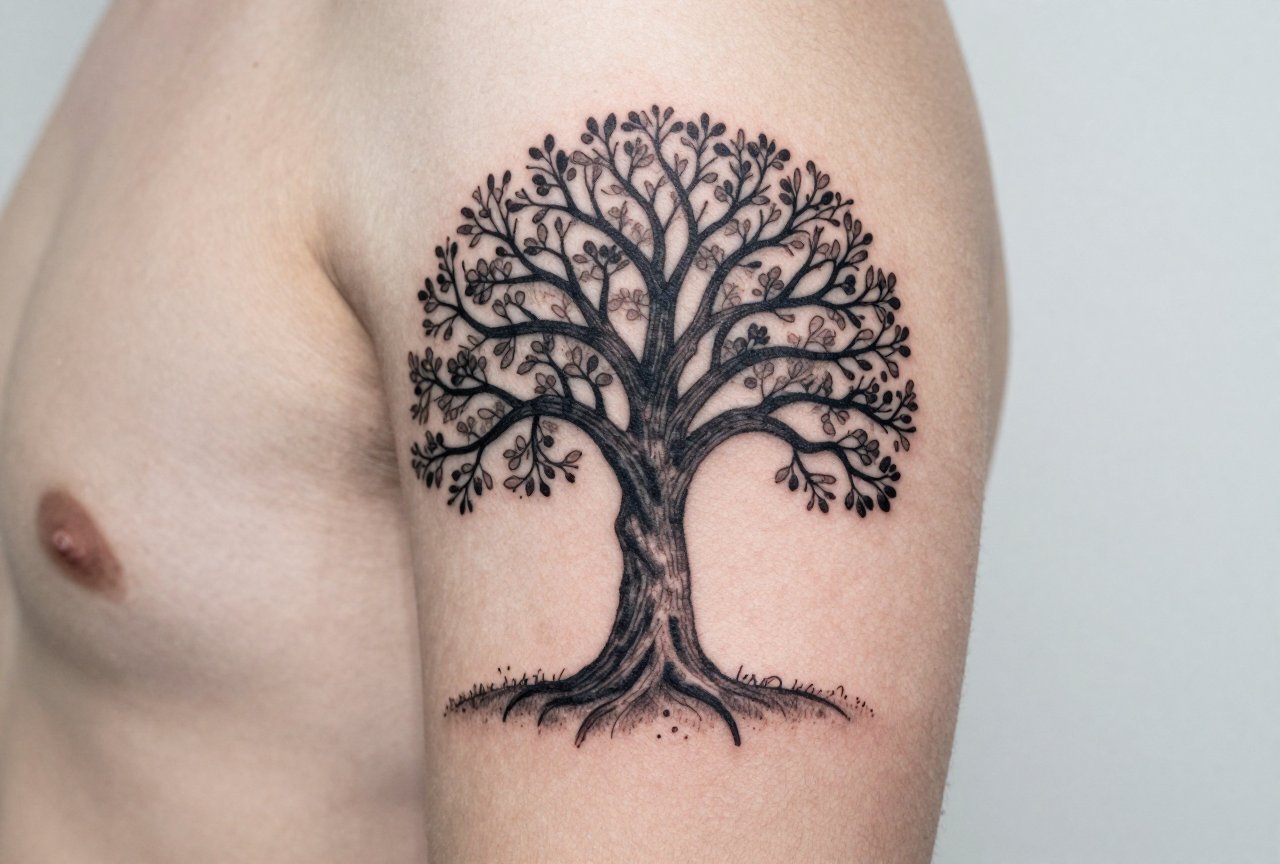
The tree of life tattoo for men carries layered meaning: rooted strength, family lineage, personal growth through hardship, and the cycle of death and rebirth. I’ve tattooed this design on fathers honoring their children, guys who’ve survived addiction, and soldiers processing what they saw overseas. The meaning shifts with the man wearing it, but the core stays constant, resilience, connection, and the passage of time marked on living skin.
Symbolism & History
This symbol predates every tattoo shop on the strip. The tree of life appears in Norse mythology as Yggdrasil, the ash tree connecting nine worlds. Celtic druids worshipped sacred groves. In Kabbalah, it’s the diagram of divine emanation. I’ve had clients bring me research printouts, family crests, even hand-drawn sketches from their grandmothers.
What draws men specifically? The metaphor works. Roots below, trunk solid, branches reaching. You don’t need to explain it to anyone. I’ve sat with guys who tear up describing their father’s workshop, their own kids’ names worked into the roots. The symbol holds weight without being preachy.
Roots and Grounding
Men often want the root system emphasized, thick, gnarled, spreading deep. I tell clients: roots age better than fine branches. On a forearm or calf, those dark lines stay readable for decades. The visual says I come from somewhere. Family, place, history. One client had me bury his hometown coordinates in the root knots, invisible unless you knew to look.
The Cycle: Growth, Death, Rebirth
Seasonal variation matters. Some guys want bare winter branches, stark against skin. Others need full summer canopy. I’ve done both on the same man, chest piece showing the transition, spring buds to fallen leaves. The unspoken message: I’ve been through seasons. I’ll see more. This resonates hard with men who’ve lost jobs, marriages, brothers. The tree doesn’t fight winter; it endures it.
Common Variations & Styles
Shop culture shapes what walks in the door. Five years ago, every tree of life was blackwork Celtic knotwork. Now I’m doing more illustrative, more fine-line, more color. Here’s what actually shows up in my chair:
- Blackwork/Celtic: Heavy knotwork in trunk and branches, thick lines, holds up on calves and upper arms. Classic for a reason.
- Illustrative/Realistic: Actual oak or maple species, bark texture, individual leaves. Takes longer, costs more, stunning when healed.
- Geometric: Circles framing the tree, sacred geometry roots. Popular with engineers and architects. Clean lines, precise placement crucial.
- Minimalist/Fine Line: Single needle, delicate branches. I warn every guy: this fades faster, especially on high-movement spots like wrists. Beautiful but high-maintenance.
- Color integration: Autumn reds, winter blues, green spring growth. Watercolor backgrounds bleeding behind solid tree structure. The contrast makes it pop.
Style choice changes meaning subtly. Geometric feels intellectual, controlled. Realistic oak says grounded, traditional. Watercolor hints at emotional openness some men aren’t ready to voice directly.
Best Placements
Where you put it changes how you see it, how others see it, how it ages. I’ve watched these settle over years of touch-ups.
High-Visibility: Arms and Forearms
Forearm tree of life tattoos dominate. You see it while working, typing, holding your kid’s hand. The cylindrical shape wraps well, roots inner forearm, branches outer. One downside: sun exposure fades ink faster. I remind guys to use sunscreen, watch them nod, know half won’t.
Upper arm/shoulder gives more real estate for detailed canopy. Bicep flexes add dimension to the trunk. I’ve had clients specifically request this, make it look like it’s growing when I curl.
Torso: Chest and Back
Full chest pieces hit different. Symmetrical, framed by pectorals, the tree becomes architectural. Back pieces allow landscape integration, roots following spine, branches spreading to shoulders. These sessions hurt more, cost more, heal slower. Guys who commit to chest or back usually have the deepest personal connection to the symbol.
Legs and Ribs
Calf muscle provides flat canvas for clean geometry. Thighs hide bigger work. Ribs? I call it the vulnerability spot. The pain is real, the placement private. Men who choose ribs usually aren’t showing this off casually. The tree of life here is personal armor, not public statement.
Who Chooses This Tattoo / Personal Meanings
After fifteen years, patterns emerge. Not stereotypes, archetypes. The men drawn to this design share something, even when they don’t share demographics.
New fathers want roots incorporating children’s names, birth dates, tiny footprints. The tree becomes family tree literally. Men in recovery choose bare branches, new growth, sometimes dates of sobriety worked into rings. Veterans often add dog tags, unit insignia, fallen brothers’ initials in the roots. Guys who’ve lost fathers mirror the image, dad’s tree, now theirs.
The common thread: transition. Some passage marked, some role assumed, some loss survived. The tree of life tattoo announces I’ve changed and I’m still here without requiring explanation at the bar or the gym.
I’ve also tattooed this on men who simply love the aesthetic, no deep story. That’s valid too. Not every tattoo needs therapy language attached. Sometimes a powerful symbol is enough.
Similar Symbols
Clients sometimes waver between the tree of life and related imagery. I sketch options, talk through differences.
- Single tree (not “of life”): More personal, less universal. A specific oak from childhood, a pine from a mountain climbed. Less symbolic baggage, more autobiographical.
- Bonsai: Patience, discipline, controlled growth. Appeals to martial artists, meditators. Smaller scale usually.
- Dead tree/snag: Stark, western, sometimes morbid. I’ve done these for men processing terminal diagnoses. Not the same energy as living tree of life.
- Tree of life + wolf, raven, or other animal: Adds spirit animal layer. Celtic wolf packs in roots are common requests. Each animal shifts meaning, raven for memory, wolf for pack loyalty.
- Ash tree specifically: Norse clients, gamers, mythology readers. Yggdrasil carries apocalyptic weight Ragnarök, world-burning, world-rebuilding.
We see this a lot: guys start with tree of life, end up with hybrid personal mythology. The symbol is a doorway, not a destination.
Final Thoughts
The male tree of life tattoo endures because it adapts. Same symbol, infinite variation. I’ve watched it heal on fresh skin and fade into lived-in bodies. The meaning you bring matters more than any website’s interpretation. Bring your story, your specific tree, your particular season. A good artist listens, sketches, translates feeling into line and shade.
What stays constant: the tree grows in both directions. Down into darkness, up toward light. Most men I tattoo have known both. The design honors that balance without requiring them to name it out loud. That’s the real power. Not the symbol itself, but what it lets you carry quietly, permanently, on your own skin.
Frequently Asked Questions
Will a tree of life tattoo look too feminine for a guy?
Not with the right execution. I emphasize thicker roots, heavier bark texture, and bolder line weight for masculine energy. Style matters more than subject, geometric framing, blackwork density, or integrated armor elements shift the feel completely. We’ve tattooed this on construction workers and corporate lawyers alike.
How much detail can I get in the branches before it blurs over time?
Fine branches under two millimeters spread and soften within five to ten years. I recommend keeping main branches bold, using negative space for smaller twigs, or planning a touch-up schedule. The root system actually ages better, those thick, dark lines hold crisp for decades.
Can I add family members’ names later without ruining the design?
Absolutely. I build negative space into root systems specifically for this. Names, dates, even small portraits fit naturally into root knots or carved into bark texture. Plan ahead with your artist, easier to预留 space than to force additions into a completed piece.
Does it matter what species of tree I choose?
For realistic styles, yes. Oak reads strong and enduring, willow more melancholy and flexible, pine evergreen and memory-focused. In stylized or geometric versions, species becomes less important than overall form. I ask clients: what tree would survive where you grew up? That answer usually reveals the right choice.
Related Tattoo Meanings
- Rock of Ages Tattoo Meaning: Faith, Strength Timeless Ink
- Teddy Bear Tattoo Meaning: Comfort, Memory, and Childhood Inked
- Valkyrie Tattoo Meaning: Strength, Honor Divine Guidance
- Explore more









