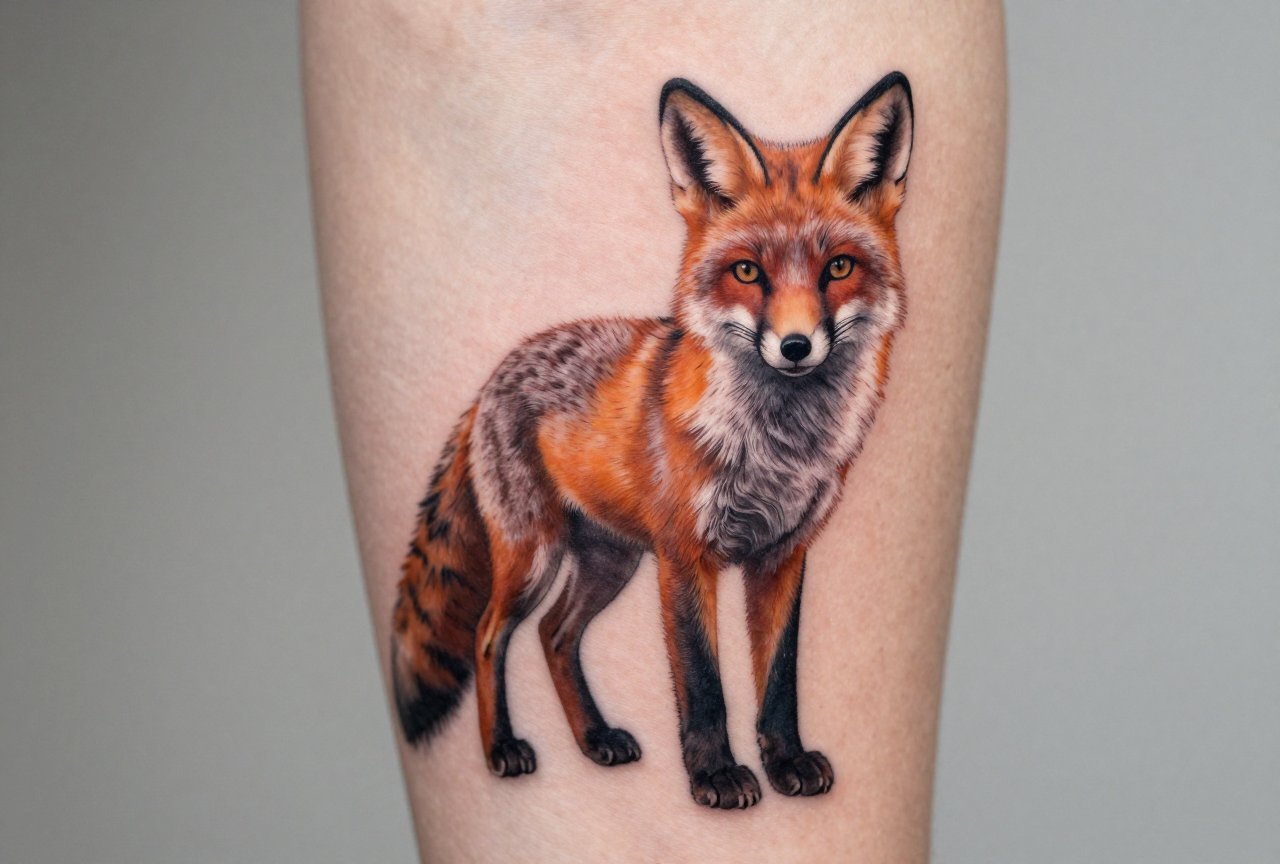
A realistic fox tattoo is one of those designs that walks into the shop and immediately tells me what kind of client I’m working with. Usually someone who’s done their homework, who’s scrolled through hours of wildlife photography, and who wants that specific moment, the catchlight in the eye, the ruff of fur catching winter light, the burnt orange shifting into cream and charcoal. Not cartoon. Not tribal. Living animal on skin. I’ve tattooed dozens of these over the years, and the good ones require a particular set of skills that not every artist possesses. Let me break down what actually matters.
Origins & History
From Wildlife Art to Skin
The realistic fox tattoo descends from a long tradition of wildlife illustration, think Audubon prints, European hunting lodge paintings, the hyper-detailed work of Carl Brenders and Robert Bateman. That tradition migrated into tattooing through the black and grey realism movement of the 1990s and early 2000s, when artists like Jack Rudy and Freddy Negrete proved that photorealistic portraiture could survive on skin. Foxes specifically gained traction as clients moved away from the aggressive imagery of traditional tattooing, skulls, daggers, panthers, and toward nature-based symbolism that felt personal without being aggressive. I’ve had clients tell me the fox represents adaptability, intelligence, or simply a childhood memory of seeing one in the woods behind their grandmother’s house. The meaning is often quieter than the execution.
Why Foxes Specifically
Foxes offer the tattoo artist something technically perfect: varied fur texture, expressive eyes, dramatic color gradients, and a body shape that reads clearly even at smaller sizes. Unlike wolves, which can look generic or overdone, foxes carry less cultural baggage. They’re also challenging enough to separate skilled artists from those still learning. In my chair, when someone asks for a realistic fox, I know I’m going to be spending serious time on reference gathering and stencil placement.
Key Characteristics & Motifs
The successful realistic fox tattoo lives or dies in a few specific details. Here’s what I focus on when designing one:
- Eye detail: The golden-amber iris with that vertical pupil slit, the wet reflection that suggests life. I use white ink sparingly here, too much and it looks like a cartoon highlight, too little and the eye goes flat.
- Fur directionality: Fox fur doesn’t all flow one way. The cheek ruff fans outward, the neck fur lies flat, the tail has that distinctive fullness. Line work has to follow these patterns or the whole piece looks like a photograph printed wrong.
- Color transition: That burnt orange isn’t flat. It shifts through rust, copper, cream, and near-white at the throat. In black and grey, this becomes a challenge of value contrast, getting enough range without the piece looking muddy.
- The nose and muzzle: Wet leather texture, subtle. I’ve seen artists overwork this area and it heals into a dark blob. Less is more.
- Background context: Some clients want the fox isolated, floating on skin. Others want fallen leaves, snow, forest floor. Each choice changes how the animal reads.
What separates a decent fox from a great one is usually the ear fur, that fine, almost transparent hair at the tips. Getting that wispy quality without it disappearing after healing takes a light hand and the right needle grouping, usually a tight three-liner or single needle for the finest details.
Color vs Black and Grey
The Case for Color
Color fox tattoos are what most people picture: that iconic red-orange coat, white chest, black stockings on the legs. When done well, they’re stunning. I use a split of warm orange tones, usually a base of dark red-orange, layered with lighter cadmium and peach tones, then cooled down with brown and black in the shadows. The white areas aren’t actually white ink; they’re negative space, skin tone left open, sometimes with the lightest wash of pale yellow to suggest warmth. Color realistic foxes age better than you’d think if the saturation is there from day one. Faded color looks like a mistake. Bold color looks intentional even after ten years.
The Power of Black and Grey
Black and grey fox tattoos are underrated. Without color, the focus shifts entirely to texture and form. The fur becomes a study in contrast. I love doing these with a whip-shading technique for the softer areas and tight stippling for the dense undercoat. The healed result has a graphite-drawing quality that photographs beautifully and ages with dignity. For clients worried about color longevity or professional constraints, this is my recommendation. One thing I tell clients: black and grey foxes can read more serious, more contemplative. The color version feels more alive, more immediate.
Best Placements
I’ve tattooed realistic foxes on almost every part of the body. Some work better than others.
- Thigh: My favorite for medium to large pieces. The flat plane lets the fox sit in a natural pose, and there’s room for environmental detail. Healing is straightforward. Clients can hide or show easily.
- Forearm: Popular, but limited. The cylindrical shape distorts the face if you’re not careful. I usually design these with the fox in profile or three-quarter view, never straight-on.
- Ribcage: Painful, but the large canvas rewards the client. I’ve done full fox portraits here with surrounding forest scenes. The stretch of the skin during breathing actually helps the tattoo settle naturally over time.
- Upper arm/shoulder: Classic placement. The deltoid curve can frame a fox’s head beautifully, like a cameo. I did one where the fox appeared to peer over the shoulder, which the client loved.
- Calf: Underrated. Good flat area, easy healing, and the fox’s vertical orientation matches the leg’s natural line.
- Hand or neck: I try to talk clients out of these for realistic animal work. The detail required doesn’t hold up well on such mobile, high-wear skin. If they insist, we simplify dramatically.
One thing we see a lot in the shop: clients wanting a small realistic fox, like three inches. I explain that realism needs room to breathe. Below a certain size, the eye becomes a dot, the fur texture becomes a blur. Five inches minimum for a head portrait, eight to ten for full body.
Who It Suits
Not everyone should get a realistic fox. Here’s my honest take after years of consultation.
The realistic fox tattoo suits people who want their ink to feel like art first, symbol second. It’s for the client who’ll spend money on quality reference photography, who understands that this will take multiple sessions if it’s large, who won’t rush the process. I’ve found it appeals heavily to women in their late twenties to forties, though that’s shifting, more men are asking for them now, often incorporated into larger nature sleeves. It suits professionals who need concealable work (thigh, upper arm) and outdoor enthusiasts who want to carry their connection to wild places visibly.
It does not suit the impulse tattooer. Realism requires patience in execution and in healing. The fine detail means longer sessions. The color saturation means careful aftercare. I’ve had clients who wanted a realistic fox in the morning and a traditional rose by afternoon, those personalities clash with this style.
Modern Variations
Double Exposure and Geometric Fusion
The most interesting evolution I’ve seen is the realistic fox combined with other visual languages. Double exposure foxes, where the animal’s silhouette contains a forest scene, starfield, or mountain range, are technically demanding but visually striking. I did one where the fox’s body dissolved into autumn leaves, each leaf individually rendered. Took twelve hours. The client sat like a stone.
Neo-Traditional Hybrids
Some artists are blending realistic fox faces with neo-traditional decorative elements, ornate frames, jewel-toned backgrounds, stylized florals. This bridges the gap between collectors who want technical realism and those who love the boldness of traditional tattooing. I appreciate these when the artist commits fully to both languages rather than doing neither well.
Choosing an Artist
This is where I get serious with potential clients. Not every artist who can tattoo a realistic portrait can do a fox. Animals have specific anatomy that portrait artists sometimes miss, the way the zygomatic arch flares, the exact set of the ears, the proportions of the muzzle to the cranium.
- Check their animal portfolio specifically: Human portraits and animal portraits use different skills. Look for healed photos, not just fresh work.
- Ask about their reference process: A serious artist will want multiple angles, lighting conditions, and will discuss if you’re open to composite references.
- Discuss needle preferences: I use magnum shaders for the fur body, tight liners for whiskers and eye detail, and sometimes a curved magnum for the soft transitions. An artist who can’t explain their tool choices for this specific subject may not have done many.
- Budget realistically: A quality realistic fox, palm-sized or larger, runs $800-2500 depending on location, artist reputation, and complexity. Anyone quoting significantly less is cutting corners somewhere.
- Travel if needed: For this style, the right artist matters more than convenience. I’ve had clients fly in from three states away for a specific piece.
Final Thoughts
A realistic fox tattoo, done well, is one of the most satisfying pieces to execute and to wear. It demands technical precision, thoughtful design, and a client who understands the investment. I’ve watched these age beautifully on returning clients, the color settling into the skin, the fur texture softening slightly but remaining readable, the eye still catching light years later. I’ve also seen cheap ones blur into unrecognizable orange smears. The difference is always the artist and the client’s willingness to prioritize quality over convenience.
If you’re considering one, spend time with reference images. Not tattoo references, photographs of living foxes. Notice the individual variation. Some have more black in their coats. Some have almost white faces. Some carry scars, asymmetries, personality. The best realistic fox tattoos capture that specificity, not a generic idea of what a fox looks like. Bring that vision to the right artist, sit through the sessions, care for it properly while healing, and you’ll carry something that genuinely resembles the wild.
Frequently Asked Questions
How long does a realistic fox tattoo take to complete?
A palm-sized realistic fox usually takes 4-6 hours in one session, while larger pieces with background detail can require 10-15 hours split across multiple appointments. I always book longer than I think I’ll need rather than rushing the fine details.
Will the orange color fade quickly on my fox tattoo?
Orange and red pigments have a reputation for fading, but modern inks hold much better than they used to. The key is proper saturation during application and diligent sun protection afterward. I tell clients their tattoo’s worst enemy isn’t time, it’s UV exposure without sunscreen.
Can I get a realistic fox tattoo if I only have black and grey tattoos?
Absolutely. A black and grey fox can integrate beautifully into an existing monochrome collection. I actually prefer mixing styles this way, it keeps the eye moving across different pieces rather than everything competing for attention.
What’s the most common mistake people make when planning a fox tattoo?
Sizing it too small is the biggest issue I see. Clients want delicate, but realism needs room for the detail that makes it convincing. I always print the stencil at multiple sizes so they can see how much gets lost when you shrink below five inches.
Related Style Guides
- Realistic Moon Tattoos: Complete Style Guide
- Realistic Skull Tattoos: A Working Artist s Guide
- Tribal Tattoo Artists: Finding the Right One
- Explore more