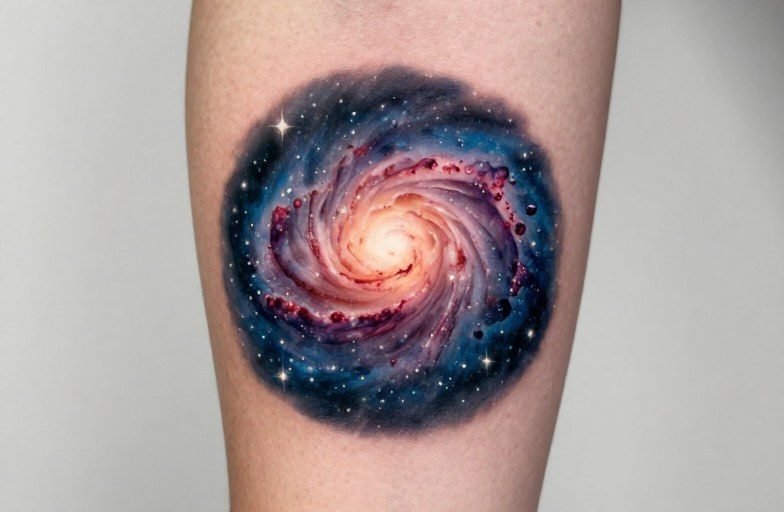
A realistic galaxy tattoo translates photographs of nebulae, star clusters, and deep-space phenomena into skin. The style requires saturated purples, blues, and magentas that read as luminous against solid black background, plus pinpoint white dots for stars that actually hold long-term. Done well, the skin appears to open into actual space; done poorly, it becomes a bruised smear within two years.
Key Characteristics & Motifs
Color Behavior in Space Scenes
Galaxy tattoos rely on colors that fight against skin’s natural warmth. Deep violet and true cyan are the workhorses; without them, the piece shifts toward brown within months. The Orion Nebula’s salmon-pink gas clouds translate poorly to most skin tones unless the artist cools the mix with blue undertones. Successful pieces layer: a black base, then blue-purple midtones, then brighter magentas and teals in sparse highlights. The black never truly “recedes” as background, it’s active, shaped, with soft edges where gas clouds meet void.
Star Rendering Techniques
Stars separate galaxy tattoos from generic space backgrounds. Single-needle white dots create the pinprick effect, but white ink is notorious for fading to yellow or dropping out entirely. Experienced artists vary star size: larger dots (3-5 needle grouping) for foreground brightness, scattered single-needle points for depth. Some bury tiny black dots inside larger white ones to create the “diffraction spike” look of bright stars. The worst approach is uniform white dots across the piece, reads as chicken pox, not cosmos.
- Black hole accents: pure black circles with subtle accretion disk gradients, extremely difficult to keep balanced
- Planetary silhouettes: Saturn’s rings or lunar edges provide structural anchors in otherwise chaotic composition
- Color bleeding between nebula sections: intentional, but controlled through needle angle and speed
- Negative space stars: skin left untouched, surrounded by dense black, reads brighter than white ink over time
Linework & Technique
Needle Groupings and Saturation
There’s almost no traditional linework in a realistic galaxy piece. Instead, artists use magnum shaders (11-15 curved) for broad color fields, switching to round shaders for tight nebula details. The “linework” is really edge control: where a gas cloud stops and void begins. This requires consistent hand speed, too slow and the black over-saturates into gray; too fast and the color patches read as stripes.
Color packing demands multiple passes. First pass lays the foundation; second pass deepens saturation; third pass adds the bright accents. Skin trauma accumulates fast with this approach. Artists working large galaxy pieces often split sessions by region, letting one quadrant heal before adjacent saturation. The alternative is a single marathon session with compromised results as skin swells and rejects additional pigment.
White Ink Strategy
White highlights go in last, after the skin has taken all the color it can hold. Some artists wait until a second session entirely, letting the piece settle and reveal where white will actually pop. Fresh white on saturated skin often looks brilliant; healed, it can disappear into surrounding color. Strategic placement, along edges facing the implied light source, at dense star clusters, outperforms scattered random application.
How It Ages
The Color Shift Timeline
Year one: the piece looks its best, though white stars may already yellow slightly. Blues hold best; magentas often redden. Year three: the piece softens significantly. Black backgrounds lighten to charcoal in areas of heavy sun exposure. The nebula edges that read as soft gradients fresh become muddy boundaries. Year five-plus: without touch-ups, many galaxy tattoos resemble watercolor abstracts more than space photography. The black holds structure longer than the color, which can create a skeletal ghost of the original composition.
Placement dramatically affects this timeline. Inner bicep galaxies, protected from sun and stretching, age gracefully for years. Forearm or calf pieces with regular UV exposure fade faster than almost any other color style. The chest, despite protection, often distorts as pectoral muscle changes shape, galaxy symmetry requires stable canvas.
Touch-Up Reality
Galaxy tattoos need more touch-up sessions than most other styles. The original saturation levels are essentially unachievable in healed skin, so artists aim for “good enough” density knowing they’ll reinforce at 6-12 months. This isn’t failure, it’s the technique. Clients who refuse touch-ups should expect a significantly muted piece. Some artists build this into initial pricing; others charge separately. Clarify before booking.
Origins & History
Space imagery in tattooing traces to the 1990s boom in Hubble Telescope photography, when nebula prints became dorm-room fixtures. Early tattoo translations were largely New School, cartoonish, with bold outlines and simplified color blocks. The realistic approach developed as color realism matured in the 2000s, often linked to artists in Southern California experimenting with photographic reference techniques borrowed from portrait work.
The style’s popularity surged around 2014-2015 with social media sharing of large back pieces and sleeve work. Some trace the specific “galaxy sleeve” format to Japanese-style background adaptations, replacing traditional wind and water patterns with cosmic imagery. The technique continues evolving: recent approaches incorporate UV-reactive ink for blacklight-visible star fields, though this remains controversial among traditionalists and complicates touch-up matching.
Common Mistakes to Avoid
Composition Errors
Wrapping a galaxy around a limb without accounting for curvature destroys the illusion. Nebulae stretched across an elbow bend read as distorted smears when the arm straightens. Circular compositions (galaxy spirals) placed on convex surfaces like shoulders flatten unnaturally. Better: treat the body part as a window frame, with the galaxy receding behind it, not wrapping around it.
Scale confusion kills otherwise technical work. A piece mixing a full spiral galaxy with detailed planetary surfaces implies impossible proximity. Choose your depth: distant nebula fields with point stars, or closer planetary systems with resolved detail. Crossing these registers without transition reads as collage, not coherent space.
Technical Pitfalls
- Overworking the black: multiple passes on black background create scar tissue that shines, destroying the matte void effect
- White ink overuse: too many stars compete for attention, creating visual noise without focal point
- Ignoring skin undertone: cool purples turn muddy on warm olive skin; warm magentas sicken on very fair, pink-based skin
- Insufficient contrast: afraid of heavy black, artists create gray “space” that reads as fog, not infinite depth
Aftercare Notes
Critical First Two Weeks
Galaxy tattoos weep plasma heavily in days 1-3 due to saturation density. This isn’t infection, it’s the body responding to extensive trauma. However, plasma pooling under Saniderm or plastic wrap can lift color. More frequent dressing changes than simpler pieces, or switching to open-air drying after day two, prevents this. The heavy black areas scab differently than color sections: thicker, darker, sometimes alarming in appearance. Don’t pick; the black is particularly vulnerable to patchy fallout.
Sleep position matters enormously. Fresh galaxy back pieces require stomach sleeping or specialized arrangements for weeks. Rolling onto healing work smears the fine white dots and can push color beyond intended boundaries. For arm placements, loose long sleeves protect from bedding friction better than exposed healing.
Long-Term Protection
SPF is non-negotiable for color longevity, but particularly critical for galaxy work where the contrast between black void and colored nebula is the entire effect. A faded magenta against lightened gray loses the luminous quality that defines the style. Reapplication every two hours during sun exposure, plus protective clothing, extends viable color life by years. White ink stars are the first casualties of UV exposure, often yellowing before other colors fade significantly.
What to Remember
Realistic galaxy tattoos demand artists with specific color-packing experience, not just general “color work” portfolios. Ask to see healed photos at minimum one year old, fresh galaxy work is misleadingly forgiving. Budget for touch-ups as continuation, not correction. The style’s beauty is its depth illusion, which requires maintenance to sustain. Choose placement for stability and protection; this isn’t a style that rewards impulse placement. Finally, trust the black: heavy, solid void space is what makes the color luminous. Artists hesitant to commit deep black will deliver a piece that ages into murky abstraction rather than enduring cosmos.
Frequently Asked Questions
How long does a realistic galaxy sleeve typically take?
A full sleeve runs 15-25 hours across multiple sessions, often 4-6 visits spaced 3-4 weeks apart. The saturation density requires working in sections to prevent excessive skin trauma in one sitting.
Will white ink stars completely disappear over time?
White ink often yellows or fades faster than surrounding colors, but strategic placement and proper aftercare extend viability. Many artists now mix negative-space stars with limited white ink for longevity.
Can galaxy tattoos work on darker skin tones?
Absolutely, but the approach shifts. Deep blacks become even more crucial for contrast, and color choices favor deeper, more saturated magentas and teals over lighter pastels that can read ashy. Artist selection matters significantly.
Why does my healed galaxy look duller than when fresh?
All tattoos heal 20-30% lighter, but galaxy pieces show this dramatically due to their reliance on saturation. The initial session is essentially an underpainting; the touch-up session brings the final vibrancy that lasts.
Related Style Guides
- Realistic Goat Tattoos: Complete Style Guide
- Realistic Graveyard Tattoos: Complete Style Guide
- Realistic Michael Myers Tattoos: Complete Style Guide
- Explore more