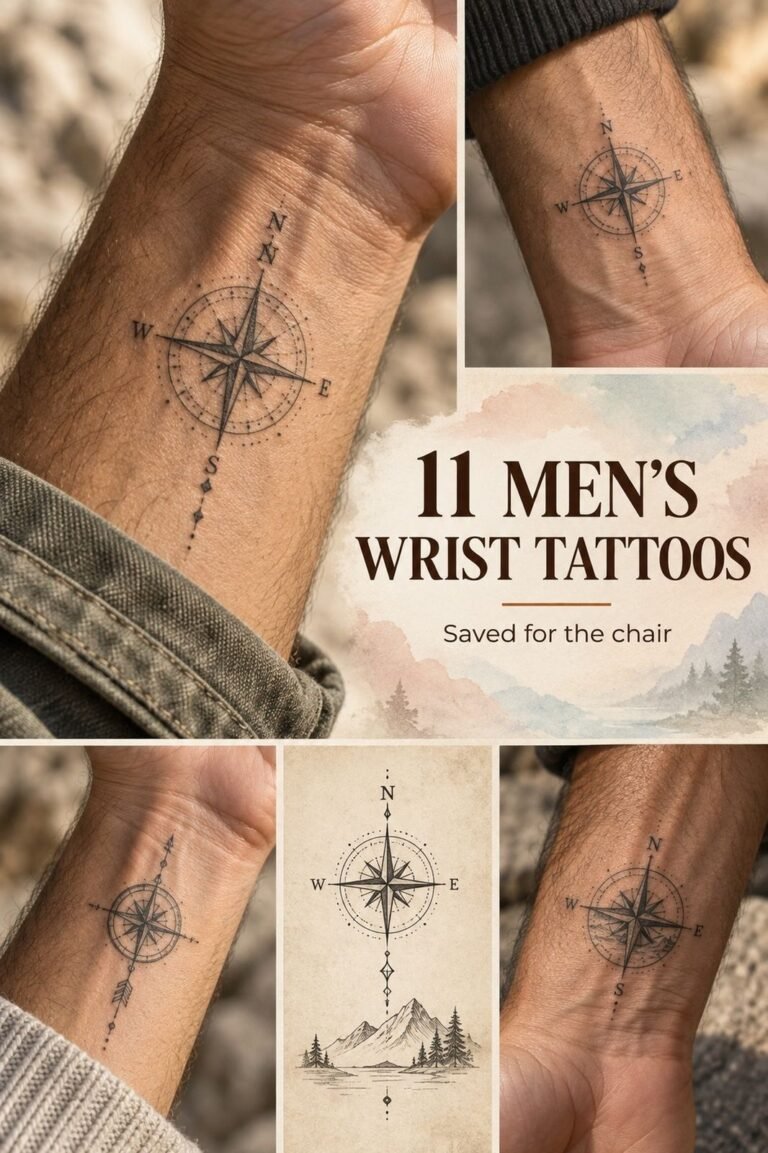
Tattoo ideas for men often get flattened into lions, clocks, compasses, skulls, and sleeves. Those can work, but only when the design has real composition and the right artist.
Quick answer: Strong tattoo ideas for men include American traditional motifs, Japanese sleeves, blackwork, geometric pieces, realism animals, meaningful symbols, patchwork sleeves, forearm designs, chest pieces, and back tattoos sized for long-term readability.
Tattoo ideas for men by style
Start with style before picking the final subject.
| Direction | Best fit | What to watch |
|---|---|---|
| Traditional | Bold classic tattoos | Avoid weak outlines |
| Japanese | Large sleeves and back pieces | Needs cultural context |
| Blackwork | Graphic masculine pieces | Saturation matters |
| Realism | Animals or portraits | Needs size and specialist artist |
| Patchwork | Collected sleeve over time | Spacing needs planning |
Black and grey realism, Japanese traditional, neo-trad, blackwork, fine line, and geometric are the six styles you’ll hear most in a serious shop. Each one behaves differently on skin. Fine line looks stunning fresh but needs tight needle groupings and a light hand, otherwise it spreads in the dermis and heals muddy. Japanese traditional uses bold outlines and flat saturated color, which is why a 20-year-old Sailor Jerry still reads from across the room. Blackwork with heavy fill ages like concrete, solid and unforgiving in the best way.
Placement matters as much as style. A delicate fine-line script on a forearm gets sun, friction, and flexion every single day, so expect fading inside two years without touchups. Put that same script on a rib or upper arm and it holds longer. Neo-trad on a thigh or upper back gives the artist real estate to stack color and layered linework without crowding. Match your style choice to the body part, not just to what looks good in a reference photo.
Think beyond one tattoo
The right placement on the wrong body reads loud; the right body with no plan reads lost.
Many men start with a forearm tattoo and later want a sleeve. That is easier if the first tattoo leaves room, uses compatible style, and does not block the best future placement.
If you want one standalone tattoo, make it strong enough to hold the body part by itself. A tiny symbol on a large forearm can look unfinished unless that is the point.
Most guys come in for one tattoo and leave planning a sleeve or a chest panel by the second session. Before you book that first piece, think about how it might connect to future work. A standalone bicep tattoo placed dead-center can box you into a weird layout if you later want a half sleeve. Leave breathing room. Talk to your artist about negative space and how the design can anchor a larger composition down the road without a full redesign.
Collecting tattoos over time also means staggering your healing. Fresh skin needs 3 to 4 weeks before you can tattoo adjacent areas, and a full sleeve realistically takes 6 to 18 months depending on session length and your budget. Big back pieces can run 15 to 40 hours of work split across multiple visits. Plan your sessions so healed pieces aren’t getting bumped and irritated by wrapping on neighboring skin.
Artist fit
Different masculine tattoo styles need different portfolios.
- Ask for healed work in the exact style.
- Ask how the piece could connect to a sleeve.
- Ask if the design needs more size.
- Ask what makes the idea less generic.
Not every artist does every style well. A guy who whip shades black and grey portraits all day isn’t necessarily your person if you want crispy traditional lines and flat color fills. Look at healed work, not just fresh tattoos. Fresh ink pops under studio lights. Healed photos show you whether the color stayed saturated, whether the lines stayed tight, and whether the shading still has depth after the skin settled. Ask to see healed photos specifically, any artist worth booking will have them.
Artist fit is also about communication. If you walk in with a reference and the artist immediately starts changing the concept without asking questions, that’s a flag. A good artist asks where it’s going on your body, whether you have existing work nearby, and what your pain tolerance is for certain zones. The inner bicep, ditch, and ribs are spicy spots that affect session length. Your artist should factor that into the design complexity and sitting time before you ever sit in the chair.
Generic tattoo traps
The issue is not lions or clocks. The issue is copying the same lion-clock-compass layout without a reason.
If the symbol matters, simplify the story and let the tattoo composition do the heavy lifting.
The most common trap is picking a design off Pinterest without thinking about how it translates to skin. Hyper-detailed micro tattoos with thin gray linework look incredible in the reference photo, which was probably taken fresh and filtered. On skin, those lines are fractions of a millimeter apart. Over 5 to 10 years they blur together, especially on high-wear zones like hands, fingers, and forearms. A reputable artist will tell you straight up that the design needs to be simplified or scaled up to hold.
Another trap is chasing the cheapest price. Tattoos are permanent. A $150 piece from an unlicensed scratcher can cost you $600 or more in laser sessions or cover-up work later. Established shops in major US cities typically run $150 to $250 per hour for solid mid-level artists, more for well-known names. That’s not a markup, that’s sterilization equipment, quality ink, proper needles, and someone who’s done this thousands of times. Blowout from an inexperienced hand isn’t fixable without significant additional work.