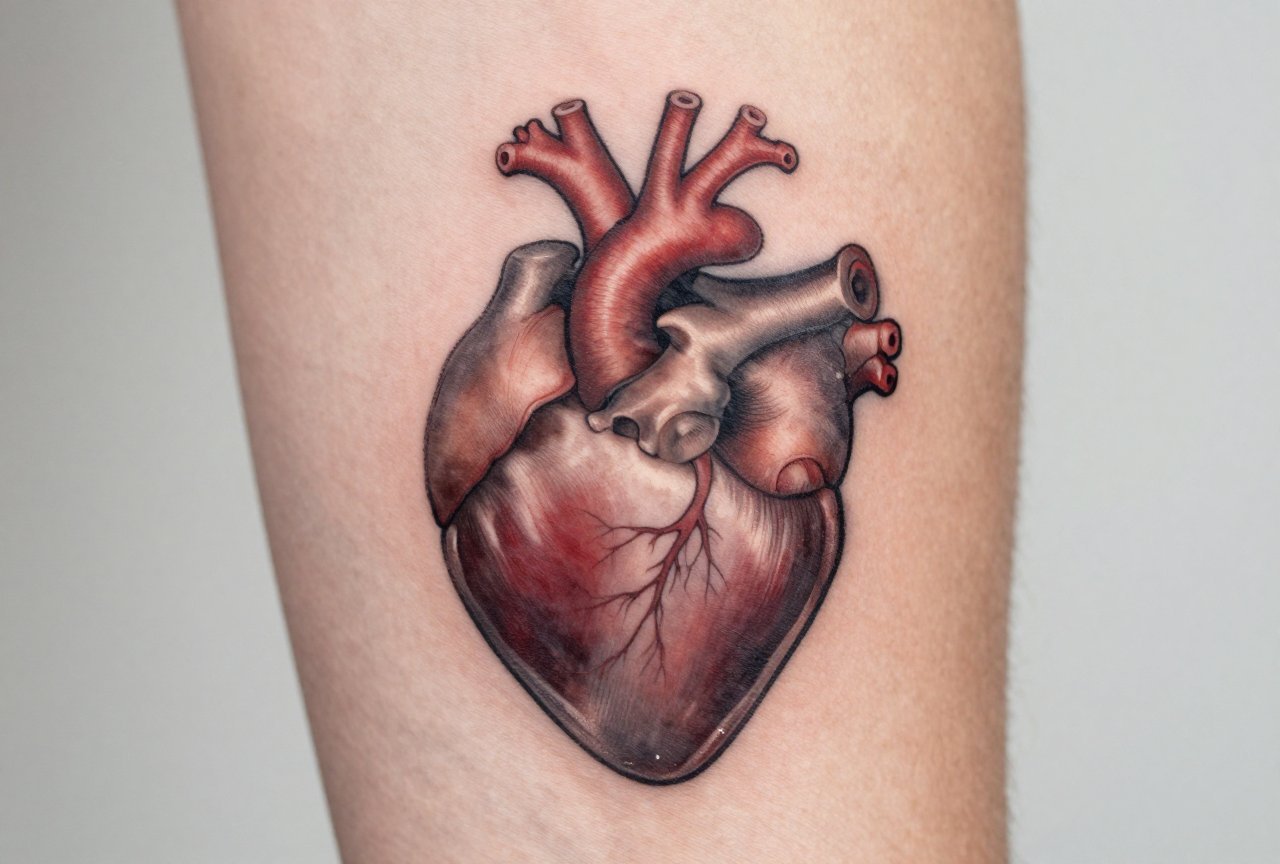
Realistic heart tattoos aren’t the Valentine’s candy version. We’re talking full anatomical accuracy, ventricles, aortas, the twisted crown of arteries, sometimes draped in tissue, sometimes beating raw. Done right, they hit harder than any romantic symbol because they show the actual engine, not the metaphor. Done wrong, they look like a chewed-up strawberry. This guide breaks down what separates the stunning from the sloppy, where these pieces live longest on skin, and what your artist needs to prove before you let them near your ribs with a 7-round liner.
Origins & History
Anatomical heart imagery predates tattoos by centuries. Medical illustrators in the 16th century spent their lives mapping what Da Vinci sketched in secret, this weird, fist-sized muscle that somehow keeps everything running. Sailors and soldiers started wearing heart tattoos as mementos in the 1800s, but those were the classic “mom” hearts with banners. The true anatomical realistic style didn’t catch fire until the 1990s, when photorealism in tattooing finally had the needles, pigments, and healed portfolio evidence to back it up.
From Medical Text to Skin
The jump from textbook illustration to tattooable art wasn’t smooth. Early attempts by non-specialists often collapsed into muddy red blobs within a year. The breakthrough came when artists started treating the heart like any other portrait subject, studying light source, depth, the way blood vessels catch highlights. Now you see pieces that could hang in a gallery, except they’re walking around on someone’s forearm.
Symbolism That Actually Means Something
People get these for reasons that run deeper than “love.” Survivors of cardiac surgery. Medical professionals who’ve held actual hearts. Grief work, someone’s real heart stopped, and this is the memorial. The anatomical accuracy matters because the symbol is the thing itself. No shorthand. No cute replacement. Just the organ, honest and unflinching.
Key Characteristics & Motifs
A realistic heart tattoo lives or dies on structural accuracy. The left ventricle wall should be thicker. The aorta needs to arch correctly, not look like a random pipe. Veins and arteries have different wall textures, coronaries are finer, more branching. Artists who nail this have spent hours with reference photos, not just copied from Google Images but studied how light falls on a three-dimensional form.
- Chamber definition: Deep shadows between ventricles create depth; without them, the whole thing flattens
- Vascular detail: Fine lines for surface veins, heavier saturation for major arteries, contrast is everything
- Tissue texture: The myocardium has a fibrous, almost striated quality; smooth shading reads as fake
- Negative space: Some of the best pieces let skin tone read as highlight, especially on lighter complexions
Common additions include thorns, barbed wire, or surgical tools, these need to integrate with the heart’s actual anatomy, not float on top like stickers. A scalpel slicing through the pericardium only works if the membrane tension looks real.
Color vs Black and Grey
This is where opinions split hard in shops. Color realism on hearts can be breathtaking, oxygenated arterial blood that deep scarlet, deoxygenated veins toward blue-purple, the yellow fat deposits around the base. But color also ages faster, especially reds. I’ve seen five-year-old pieces where the scarlet turned salmon, where the blue veins blurred into grey smudges.
When Color Works
Go color if your artist has a proven healed portfolio of red-dominant work. Ask to see photos at one year, three years. Not fresh. Fresh color always pops. The best color hearts use limited palettes, maybe three reds, a violet, a touch of white for specular highlights. Restraint keeps it readable long-term.
Why Black and Grey Dominates
Black and grey ages like a stone monument. The values stay, the structure holds. You lose the visceral blood shock, but gain longevity and a certain clinical elegance. Many medical professionals prefer this route, it matches the aesthetic of the anatomy atlases they studied. A skilled artist can still suggest warmth through temperature shifts in the grey wash, cooler shadows and warmer mid-tones.
Best Placements
Hearts are organic shapes with no straight edges, which makes them forgiving for curved body areas. But size matters. Too small and the vascular detail becomes a red blur. Too large on a high-movement area and the stretching distorts the anatomy.
- Chest/upper pectoral: The obvious choice. Skin is relatively stable, the symbolism lands literally over the actual heart. Best for medium to large pieces
- Outer forearm: Great visibility, flat enough for detail, but expect some fade from sun exposure, use SPF religiously
- Upper arm/outer bicep: Classic canvas. Muscle movement adds subtle life to the piece, almost like a pulse
- Thigh: Large, flat when standing, tolerates long sessions. Heals well if you can avoid thigh-rubbing during recovery
- Ribs: Brutal sit. Skin stretches with every breath. Artists charge more because it’s technically harder, and you’ll feel every second. But the placement is intimate, hidden, personal
Hands and feet? I’d talk you out of it. The detail required for a convincing anatomical heart just doesn’t hold at small sizes on those high-wear areas. You’d be touching up every two years.
Who It Suits
Not everyone wants their interior made exterior. These tattoos attract a specific crowd: people comfortable with intensity, with images that don’t soften themselves for viewers. Medical workers. People who’ve faced mortality directly. Artists and musicians who respond to the raw biological reality beneath all our performances.
That said, the style scales. A small single-needle heart behind the ear can whisper where a chest piece shouts. The commitment level is yours to choose. What doesn’t work is half-commitment, getting anatomical accuracy but then adding cartoon eyes or a smile. Pick a lane. The heart is dramatic enough without irony.
Modern Variations
The core style keeps evolving. Biomechanical hearts, half-organ, half-machine, remain popular, though the trend peaked in the early 2000s. More current: hearts with botanical elements, vines threading through the aorta, roses growing from the ventricles. The contrast between organic decay and organic life works visually and conceptually.
Neo-Traditional Fusion
Some artists are bridging the gap, keeping anatomical structure but adding bold outlines or limited color blocks. It’s not pure realism anymore, but it solves the aging problem, those outlines hold the form even as internal shading softens. Think of it as realism with training wheels, or realism that admits it’s a tattoo, not a photograph.
3D and Biometric Effects
Hyper-realistic pieces with extreme depth, hearts that seem to beat under translucent skin, or held in an actual hand with proper proportion. These require enormous skill and enormous trust. One wrong value shift and the illusion collapses into a muddy mess. Worth it when executed by specialists who do little else.
Choosing an Artist
This is where I get emphatic. Not every realism specialist can do a heart. Portraits of people and portraits of organs use different knowledge bases. You want someone who understands cardiovascular structure, who gets excited about reference material, who won’t wing the aortic arch because “it looks close enough.”
- Ask about medical reference: Do they study anatomy texts, or just copy other tattoos? The best ones do both
- Check healed work specifically: Fresh hearts look amazing on Instagram. Ask for six-month minimum, ideally two-year photos
- Discuss their red pigment choices: Some reds fade faster; experienced artists know which brands hold in their climate and on your skin tone
- Trust the consultation: If they rush the design process, if they don’t ask why you want this specific image, keep looking
Budget realistically. A solid palm-sized realistic heart takes four to six hours. Larger pieces run multiple sessions. This isn’t flash art territory. You’re commissioning a biological portrait.
Final Thoughts
Realistic heart tattoos carry weight because they refuse to romanticize. The organ itself is ugly-beautiful, all function and relentless rhythm. Translating that to skin requires technical discipline most artists develop over years, not months. If you’re drawn to this style, respect the complexity. Do your research. Sit with the image before you commit. And when you find the right artist, give them the trust and the skin real estate they need to make something that lasts, not just as ink, but as an honest representation of what keeps you here.
Related Style Guides
- Traditional Ship Tattoos: A Complete Guide
- Traditional Tattoo Stencils: Complete Guide
- Warrior Tattoo Ideas That Mean Something
- Explore more
Frequently Asked Questions
How much does a realistic heart tattoo typically cost?
A realistic heart tattoo usually ranges from $200 to $800 depending on size, detail level, and artist expertise. Larger chest pieces or highly detailed anatomical designs by renowned artists can exceed $1,500.
What is the best placement for a realistic heart tattoo?
The chest directly over the actual heart remains the most popular and meaningful placement for realistic heart tattoos. Other common spots include the upper arm, forearm, and thigh where the curved surface allows for dynamic three dimensional rendering.
How long does a realistic heart tattoo take to complete?
A small to medium realistic heart tattoo typically requires 2 to 4 hours in a single session. Larger or highly intricate pieces with veins, arteries, and shading may need multiple sessions totaling 6 to 10 hours.
Do realistic heart tattoos fade faster than other styles?
Realistic heart tattoos with heavy black and gray shading actually tend to age well compared to color realism. However, fine details like thin vein lines may blur over time, so choosing an experienced artist who understands proper saturation and line weight is crucial for longevity.