
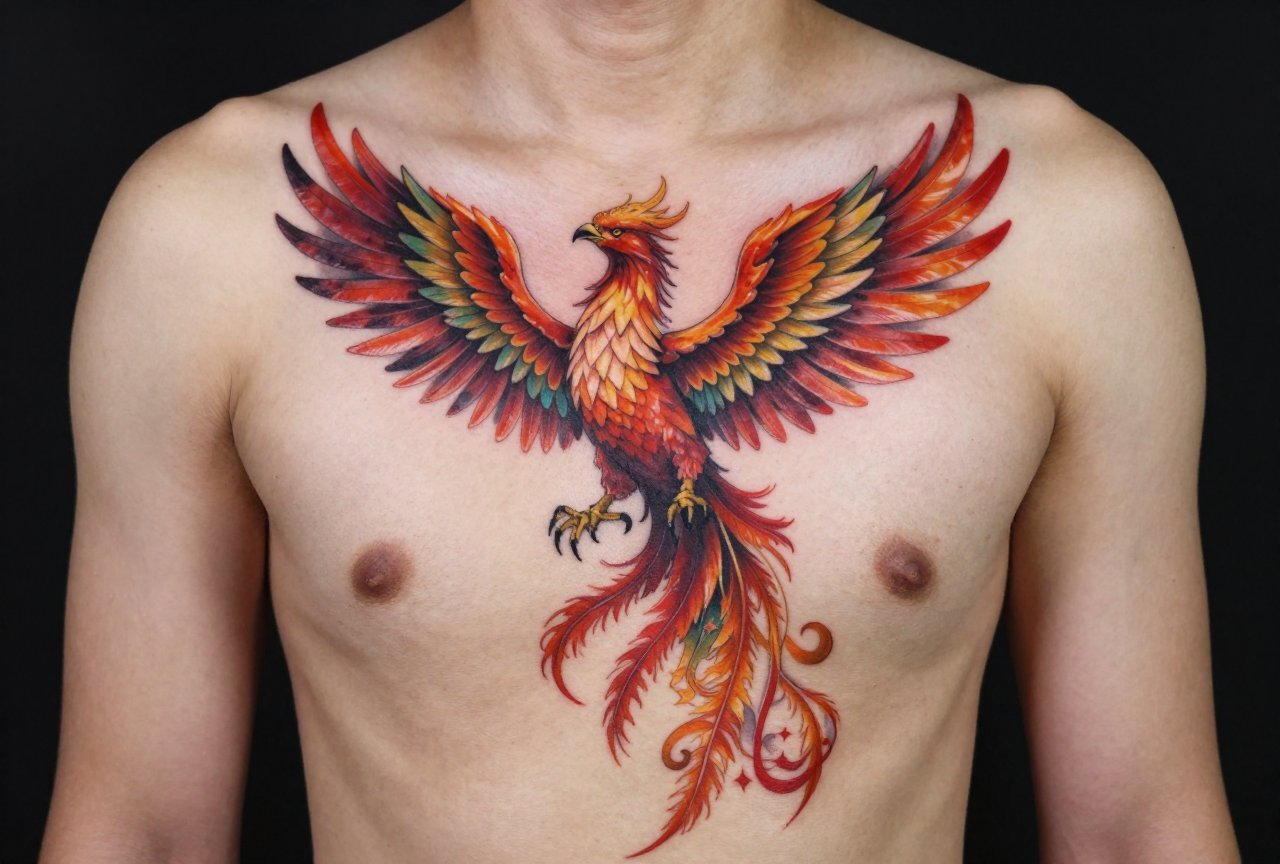
A realistic phoenix tattoo isn’t some cartoon bird bursting into tidy flames. Done right, it’s a study in motion, feathers dissolving into ash and ember, smoke curling into negative space, the eye catching light like a living thing. The style demands an artist who can render anatomy with photographic precision while still making magic feel plausible. Skin isn’t paper, though. What looks stunning on a reference board changes when it’s healing, settling, living under your surface for decades. This guide breaks down what actually matters if you’re serious about wearing one.
Origins & History
The phoenix myth spans cultures, Greek, Egyptian, Chinese, Persian, but the realistic tattoo treatment is distinctly modern. Traditional Japanese phoenixes (hou-ou) dominated for generations: bold outlines, flat color fields, stylized proportions. Realism as we know it emerged from the portrait boom of the 1990s and early 2000s, when artists started chasing photographic accuracy with tattoo machines.
From Fantasy Illustration to Skin
Early realistic phoenix work borrowed heavily from fantasy art, Boris Vallejo, Julie Bell, the airbrush-on-van aesthetic. Those pieces aged poorly. Too much dense black. Colors that looked nuclear fresh turned muddy. The breakthrough came when artists started treating the subject like wildlife photography first, myth second. Reference became king. Good artists now study actual birds of prey, golden eagles, red-tailed hawks, peacocks for the tail structure, then layer the supernatural elements over anatomically convincing foundations.
Shop Culture Context
Walk into a shop in 2010 asking for a realistic phoenix, you’d get side-eye. It was niche. Today, every convention has multiple artists specializing in “realistic fantasy”, a category that barely existed fifteen years ago. Social media changed the game. Artists could show process, build followings, and clients arrived with specific references instead of “something with fire.”
Key Characteristics & Motifs
What separates a realistic phoenix from other interpretations? Specific visual choices that tattooers recognize immediately.
- Feather architecture: Individual barbs visible, overlapping like roof shingles, catching light at different angles. Not symbol feathers, structural, weight-bearing plumage.
- Asymmetry in flight: One wing extended, the other folding. Real birds don’t pose. The best pieces capture that awkward grace of mid-motion.
- Fire as environmental, not costume: Flames emerge from the bird, not wrap around it like a separate element. Tail feathers might be actively combusting, transitioning from keratin to plasma.
- Smoke and negative space: Wisps of grey wash fading into untouched skin. This is where the tattoo breathes. Dense packing everywhere kills the effect.
- The eye: Often amber, reptilian, with a vertical pupil or human-like iris depending on the artist’s vision. It’s the focal point that sells the realism.
Line work is minimal to nonexistent. Outlines get replaced by hard edges where light meets shadow. This changes how the piece ages, more on that below.
Color vs Black and Grey
This decision shapes everything: healing, longevity, artist selection, cost, session count.
Color Realism
Fire demands orange, crimson, gold, white-hot yellow. The challenge is saturation without mud. Skin isn’t white canvas; it’s pink, brown, olive, freckled. Yellow especially struggles on darker tones. Experienced artists will adjust, more vermillion, less canary, strategic use of white ink (which yellows over time, by the way, so don’t let anyone sell it as permanent highlight).
Color realistic phoenixes need touch-ups. Plan for it. The reds and oranges that make fire pop are the first to fade. Budget a refresh at 5-7 years, sooner if you’re a swimmer or sun-worshipper.
Black and Grey
Smoke, ash, charred bone, ember glow suggested through warm grey washes rather than literal color. This approach ages gracefully. The contrast holds. Fire reads through value shifts, dark core, lighter edges, the suggestion of heat without naming it outright.
Many artists prefer black and grey for large-scale phoenix work. It’s faster, heals more predictably, and the “realistic” label applies more naturally when you’re not fighting pigment chemistry.
Best Placements
Phoenixes need room. The wingspan, the tail trajectory, the diagonal energy of ascent, these don’t compress well.
- Full back: The classic. Wings spread across shoulder blades, tail descending toward lumbar, head turned in profile or three-quarter view. Allows for maximum detail and the full narrative arc, birth, flame, flight.
- Thigh (front or side): Emerging choice for clients who want substantial scale without the back commitment. Wraps nicely, muscle movement adds life to the wings.
- Ribcage to hip: Vertical orientation, rising. Painful. Worth it for the natural flow with body contours.
- Upper arm to chest: The shoulder becomes the wing joint, chest the breast and forward-reaching talons. Popular with clients who want visible but concealable.
- Forearm: Only if you’re accepting a cropped composition, head and partial wing, maybe. Full phoenixes here look cramped by year three as skin settles.
One honest note: the sternum/underboob placement trending on Instagram? Terrible for phoenixes. The shape fights the bird’s anatomy. You’ll get a compressed, confused composition. Artists who suggest it are usually following your Pinterest board, not guiding you.
Who It Suits
Not everyone. That’s fine.
Realistic phoenix work rewards patience, multiple sessions, significant investment, a healing process that demands care. The symbolism (rebirth, resilience, rising from destruction) attracts people in transition: recovery, divorce, career shifts, survival. But the aesthetic is what you’re living with, not the meaning. Make sure you love the look independent of the story.
Skin type matters. Very oily skin holds detail poorly; the ink spreads slightly, edges soften faster. Dry, fair skin shows every nuance but also every imperfection in the artist’s technique. Darker skin can absolutely support realistic phoenixes, but color choices narrow and the artist needs specific experience, not just willingness, but a portfolio proving they’ve done it successfully.
Modern Variations
The style keeps evolving. Current directions worth watching:
- Double exposure: Phoenix silhouette containing landscape, forest fire, city skyline, cosmic nebula. Requires masterful grey wash control.
- Biomechanical fusion: Feathers transitioning to exposed machinery, pistons, circuitry. Appeals to the cyberpunk crowd. Technically brutal to execute.
- Micro-realism: Palm-sized pieces with insane detail, often single-needle. Heals soft. Fades faster. Polarizing among traditionalists.
- Neo-traditional realism hybrid: Bold enough outlines to hold structure, realistic rendering inside. Best of both worlds for longevity, though purists argue it’s neither fish nor fowl.
Choosing an Artist
This is where most people stumble. They find someone who “does realism” and assume phoenixes follow. They don’t.
What to Look For
Portfolio evidence of: birds (raptors specifically, not just generic “animals”), fire rendered convincingly, large-scale compositions that healed well (healed photos, not just fresh), and comfort with dynamic movement rather than static poses. Ask to see a piece from two years prior. How’s the orange holding? Did the smoke wash stay soft or blob out?
Red Flags
Flash sheets of phoenixes. This means they’re repeating a design, not building yours from reference. Quotes that seem too low, realistic color work at scale takes 15-30 hours minimum. Anyone promising completion in two sessions is either rushing or lying about the result. And beware the artist who can’t explain their fire technique. “I just wing it” is not a strategy that ages well.
Consultation culture matters. Good realistic phoenix artists sketch, revise, and often postpone booking until the drawing satisfies both parties. The ones who tattoo the stencil unchanged from your first email? Keep walking.
Final Thoughts
A realistic phoenix tattoo is a commitment in every sense, time, money, pain, and the slow reveal as your skin settles into its final version around month six. The fresh photo your artist posts will look different from what you see in the mirror at year five. That’s not failure; it’s the nature of the medium. Choose for the long shape, the structural intelligence, the way the composition moves with your body. The fire is temporary. The bird should still be rising decades later.
Related Style Guides
- Tribal Rites Fort Collins: A Tattoo Style Guide
- Hot Tattoo Designs Women Actually Want
- Don t Tread on Me Tattoo Ideas
- Explore more
Frequently Asked Questions
How much does a realistic phoenix tattoo typically cost?
A realistic phoenix tattoo usually ranges from $300 to over $2,000 depending on size, artist skill level, and location. Full back or chest pieces from renowned realism artists can command significantly higher prices due to the complexity of feathers and flame details.
What body placement works best for a realistic phoenix design?
The back, chest, and upper arm provide the most canvas space for the wingspan and flowing tail feathers that make phoenix designs visually striking. Thigh placements also work well for medium-sized pieces that need room for detail without the constraints of curved surfaces.
How long does a realistic phoenix tattoo take to complete?
Most realistic phoenix tattoos require multiple sessions spanning 10 to 30 hours total, with large-scale pieces sometimes exceeding 40 hours. Artists typically schedule sessions 2 to 4 weeks apart to allow proper healing between sittings.
What color palette works best for realistic phoenix tattoos?
Traditional fiery oranges, deep reds, and golden yellows remain popular, but many clients now choose cooler palettes like electric blues, purples, or even black and grey for a more unique interpretation. A skilled realism artist can make any color scheme appear lifelike through proper shading and contrast.









