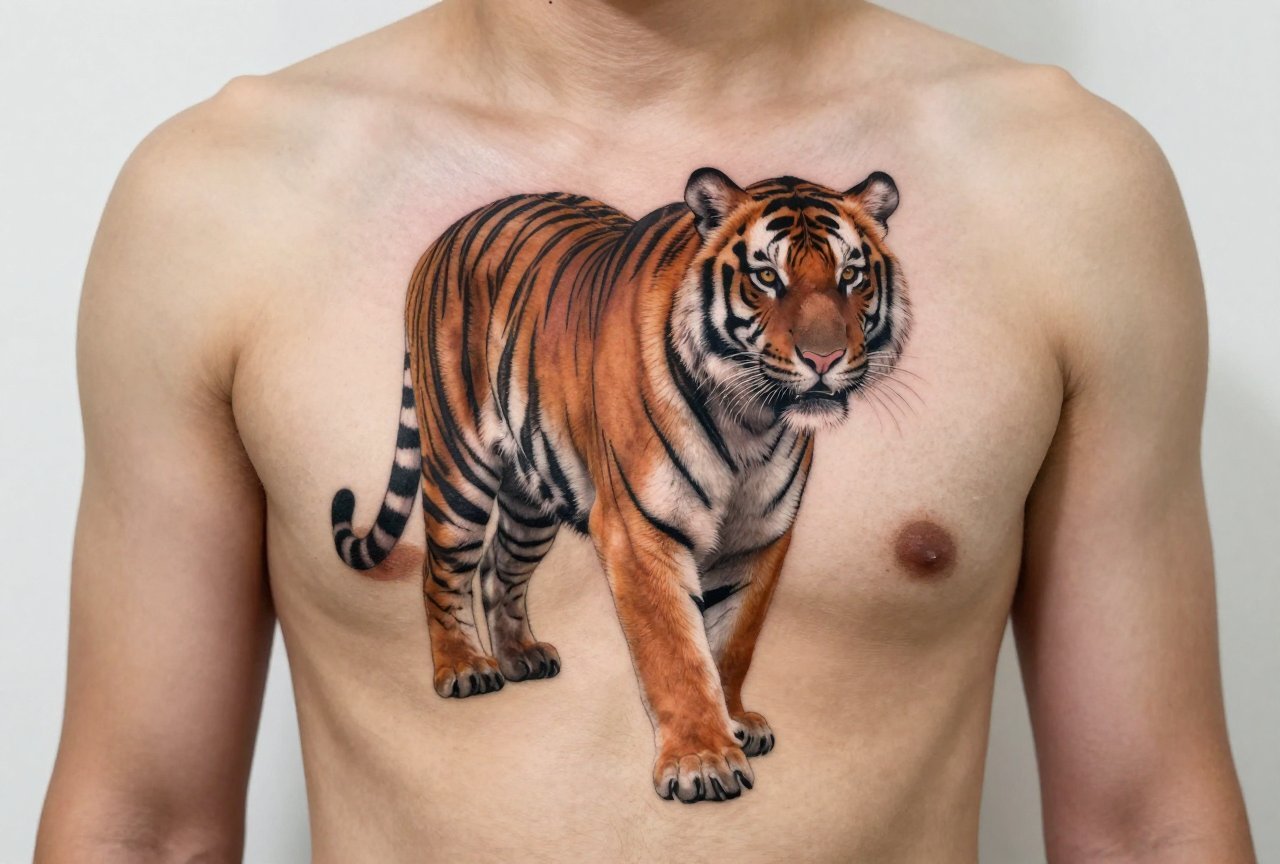
A realistic tiger tattoo is skin-level taxidermy without the glass eyes. The goal is simple: make the viewer do a double-take. Fur that catches light, whiskers that seem to twitch, that flat amber stare that makes you feel watched. It’s not tribal. Not Japanese traditional. Not some stylized cartoon. This is photorealism, and it demands a specific kind of artist, a specific kind of patience, and a specific kind of pain tolerance.
Origins & History
Realistic animal portraiture in tattooing didn’t really hit its stride until the late 1990s and early 2000s. Before that, you had your traditional big cats, bold outlines, saturated oranges, the Sailor Jerry aesthetic. Beautiful stuff, but not trying to fool anyone. The photorealistic approach came up alongside better machines, better needles, and better pigments. Artists started looking at wildlife photography and asking: why can’t skin look like that?
Tigers carried extra weight. In Asian cultures, they’ve been power symbols for millennia, Korean military flags, Chinese guardian paintings, the whole nine. But the realistic style stripped away the cultural shorthand. No more stylized stripes. Just the animal itself, raw and immediate. That shift appealed to people who wanted the symbolism without the traditional visual language.
From Photo Reference to Skin
Early realistic tiger work was rough. Artists worked from blurry magazine photos. Now? High-resolution wildlife shots, 4K video freeze-frames, even zoo photography sessions. The reference material changed the game. You can see individual guard hairs, the way light penetrates the undercoat, the wet sheen of a nose. Good artists study all of it. Great artists understand which details translate to skin and which get lost.
Key Characteristics & Motifs
What separates a realistic tiger from a failed attempt? Specifics. Here’s what the best pieces share:
- Eye detail: The catchlight, the radial iris pattern, the slight moisture at the corner. Dead eyes kill a piece. Alive eyes make it.
- Fur texture variation: Short dense hair on the nose, longer ruff at the cheeks, coarse guard hairs along the spine. Different needle groupings, different techniques.
- Stripe logic: Real tiger stripes aren’t random. They follow muscle structure, widen and narrow, have fuzzy edges where pigment meets orange. Machine-made uniformity looks fake immediately.
- Whisker pores: Tiny stippled dots where whiskers emerge. Subtle. Most people won’t notice consciously. But they’ll feel the difference.
- Depth through contrast: Deep shadows in the eye sockets, the hollow beneath the cheek, the fold of skin at the shoulder. Without this, you get a flat sticker.
Common compositions include the close-up portrait (face filling the frame), the stalking pose (low to the ground, muscles coiled), and the half-hidden jungle shot (emerging from leaves or bamboo, which lets the artist play with foreground/background blur). The sleeping cub motif has gained traction too, less aggressive, more vulnerable, harder to pull off because relaxed animals read as wrong more easily than alert ones.
The Roar vs The Stare
Two approaches, two different technical demands. The roaring tiger shows teeth, tongue, throat tissue. Soft pinks, wet membranes, the chaos of an open mouth. It’s dramatic. It’s also where a lot of pieces go wrong, those pinks fade fast, the fine lines in the tongue blur, and suddenly you’ve got a muddy scream instead of a controlled threat. The staring tiger is quieter. More sustained tension. The technical challenge is in the eyes and the subtle tension around them. Less forgiving of small errors because there’s no drama to hide behind.
Color vs Black and Grey
This choice changes everything.
Color gives you the orange. That specific burnt-sienna-to-gold range that no other animal carries quite the same way. Good color realism on a tiger pops from across a room. But, and this matters, those oranges and warm yellows? They’re temperamental. Some brands fade toward brown within five years. Others hold but shift slightly pink. The black stripes stay, which can leave you with a tiger that looks like it went through a sepia filter. Maintenance touch-ups are almost guaranteed. Budget for them.
Black and grey trades the immediate species recognition for something more sculptural. You’re reading form, texture, light. A great black and grey tiger can be stunning, think of the charcoal drawings you see in high-end wildlife art galleries. The downside: without color, stripe placement and fur texture become everything. There’s no orange to distract from a wonky line. The piece lives or dies on technical precision.
Most artists have a preference. Ask. If someone says “I can do either, no problem,” that’s a yellow flag. Real specialists know their medium.
Best Placements
Size matters here. A realistic tiger needs room for detail. That doesn’t mean full back or nothing, but there’s a minimum threshold below which you’re losing the effect.
- Thigh: Flat, stable, lots of real estate. The muscle structure even complements a stalking pose. Pain is manageable. One of the most popular placements for good reason.
- Upper arm/shoulder: Classic canvas. The deltoid curve works for a turned head, the bicep for a portrait. Watch the ditch (inner elbow) and the armpit, those spots hurt more and heal trickier.
- Back: Full back piece is the dream for many. Room for environment, bamboo, water, mist. The spine itself is rough. The shoulder blades, less so.
- Chest: Bold. The sternum hurts. The ribs move. But a tiger emerging from the center of your chest? Hard to beat visually.
- Forearm: Risky for full realism. Not enough width for a proper portrait unless you’re built like a lumberjack. Better for a partial face, a paw, something cropped.
- Calf: Underrated. Good flat surface, easy to show or hide, the muscle shape suits a crouching pose.
One thing shop veterans will tell you: avoid joints for the detailed parts. Elbows, knees, the neck. Skin moves differently there. Fine lines distort. Fur texture becomes weird. Put the detailed face on stable skin, let the motion areas carry background or looser elements.
Who It Suits
Not everyone. That’s honest.
The realistic tiger reads as intense, sometimes aggressive. It’s a statement piece. If your vibe is minimalist, delicate, understated, this clashes. If you’re drawn to power symbolism but want something softer, consider a cub, a sleeping pose, or a different species entirely.
It also suits people who can commit to the maintenance. Big color realism needs touch-ups. Sunscreen becomes religion. If you’re cavalier about aftercare, this style will punish you. The investment is front-loaded (good realism ain’t cheap) but the upkeep continues.
That said, there’s no demographic lock. I’ve seen them on 60-year-old accountants and 22-year-old gym rats. The unifying factor is wanting the animal itself, not the idea of the animal. There’s a difference.
Modern Variations
The style keeps moving. Some current directions:
- Double exposure: Tiger profile with landscape or night sky visible through the silhouette. Requires two strong images that don’t fight each other.
- Geometric fragmentation: Portions of the face breaking into polygonal shapes or mandala patterns. Polarizing. Done well, striking. Done poorly, looks like a filter.
- Neo-traditional realism: Tighter than pure realism, bolder outlines, slightly saturated color. Holds up better over time. Compromise style.
- Monochrome with single accent: Black and grey tiger, one orange eye. Or one slash of color in the background. The restraint makes the accent scream.
One trend to watch: artists combining photorealistic faces with painterly, almost abstract backgrounds. Loose brushstroke foliage, splatter effects, watercolor washes. The contrast in technique makes the realism hit harder. It’s technically demanding, you’re mastering two languages at once.
Choosing an Artist
This is where most people stumble. Not all realism is equal. Not all animal realism is equal. A portrait specialist who crushes human faces might struggle with fur. A wildlife painter might not understand how skin differs from canvas.
What to look for:
- Healed photos, not just fresh: Everyone looks good at the finish line. Ask to see work at 6 months, 1 year, 3 years. How’s that orange holding? Those fine whiskers?
- Animal-specific portfolio: If they’ve done three tigers, keep looking. You want someone who’s solved the specific problems this subject presents.
- Reference handling: Do they work from one photo or composite multiple? The best build their own reference, understanding that no single photo has perfect light and perfect pose.
- Skin type awareness: Darker skin needs different approaches for realism. Not worse, different. An artist who only shows work on light skin might not have that vocabulary.
Expect to travel. The best tiger realism specialists are concentrated in certain shops, certain cities. Budget for the consultation, the sessions, the travel, the tip. This isn’t a walk-in piece. Anyone who says they can bang out a full realistic tiger in one sitting is someone to avoid.
Final Thoughts
A realistic tiger tattoo is a commitment in every sense. Time in the chair. Money from your account. Attention to protection and maintenance for years after. But done right, it’s living art. Something that meets you in the mirror every morning with that impossible stare.
The best ones I’ve seen weren’t just technically perfect. They had presence. The artist captured something specific, a moment of tension, a particular light, an individual animal’s personality. That’s the gap between good and great. Anyone with skill can render a tiger. Few can make you feel like it might blink.
Take your time finding the right person. Save longer than you want to. Sit with the reference images until you know exactly what draws you in. Then trust the process, breathe through the sessions, and give it the care it deserves. The skin remembers everything.
Related Style Guides
- Realistic Heart Tattoos: Complete Style Guide
- Traditional Ship Tattoos: A Complete Guide
- Traditional Tattoo Stencils: Complete Guide
- Explore more
Frequently Asked Questions
How much does a realistic tiger tattoo typically cost?
A realistic tiger tattoo usually ranges from $800 to $3,000 depending on size, detail level, and artist expertise. Full sleeve or back pieces from renowned realism artists can exceed $5,000.
What body placements work best for realistic tiger tattoos?
The thigh, upper arm, back, and chest provide the most canvas space for capturing intricate fur texture and facial detail. Smaller realistic pieces on the forearm or calf are possible but may sacrifice some fine detail.
How long does a realistic tiger tattoo take to complete?
A medium-sized realistic tiger portrait typically requires 6 to 12 hours across multiple sessions. Large or highly detailed pieces can take 20 to 40 hours total depending on the artist’s pace and your skin’s healing between sessions.
Do realistic tiger tattoos age well over time?
Realistic tiger tattoos hold up reasonably well if properly cared for, though fine details like whiskers and subtle fur gradients may soften after 5 to 10 years. Choosing an experienced artist who understands how ink settles, plus diligent sun protection, significantly extends the tattoo’s crisp appearance.