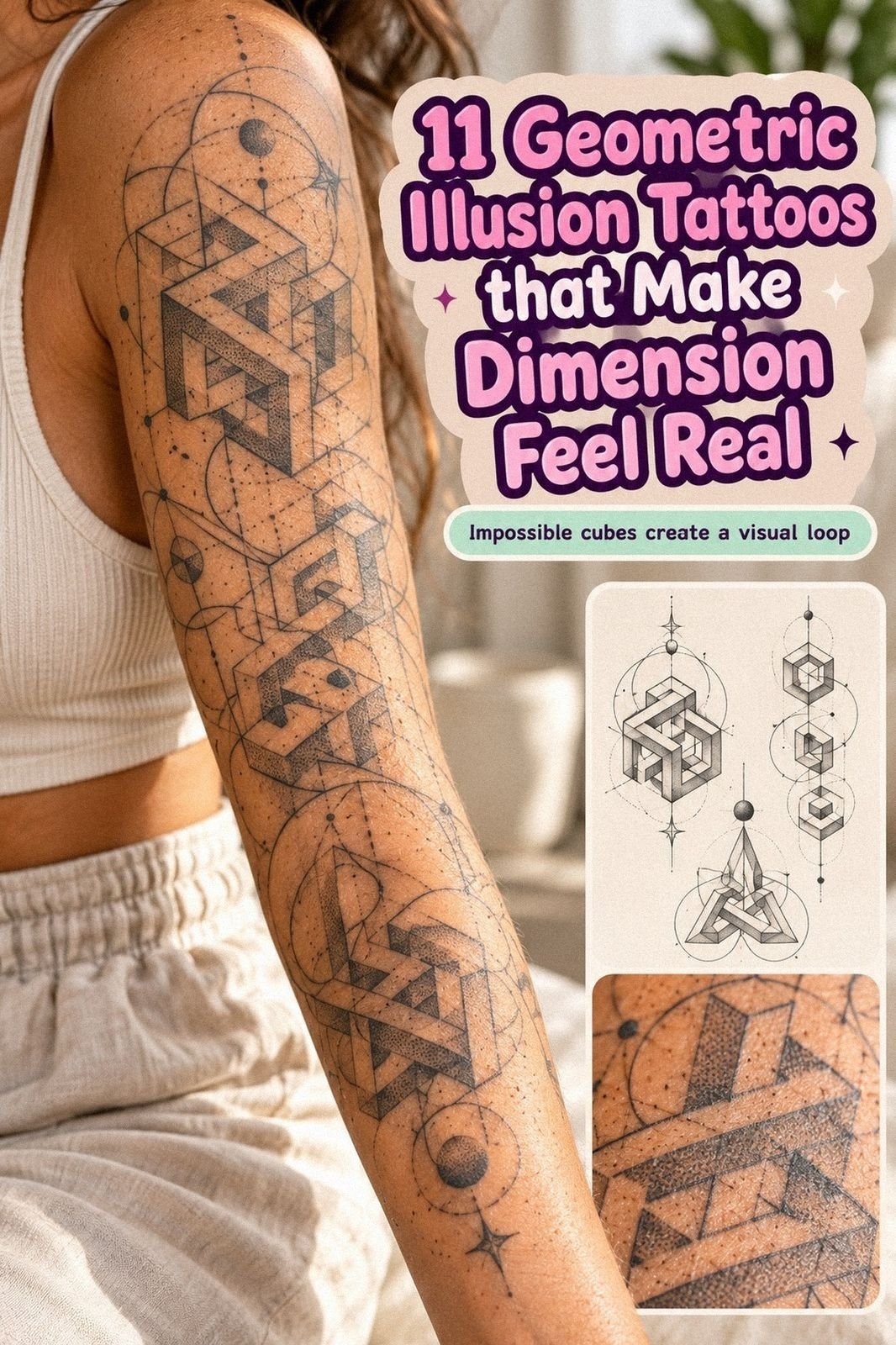
Geometric Illusion Tattoo designs can stay crisp geometric work and symbolic when placement and scale are planned together. I once chose a fine geometric piece that was too small, and the lines softened faster than I expected. Now I look at skin movement, sun exposure, and contrast first. These 11 ideas give you a striking starting point!
- Build an Escher-Inspired Geometric Illusion Tattoo Sleeve
- Could Interlocking Cubes Work Across the Forearm?
- Let Abstract Floating Lines Suggest Motion
Start With the Illusion, Not the Symbol
Quick answer: decide what you want the eye to see first, then choose the placement, scale, and budget. A design can be meaningful without carrying an elaborate story. Sometimes the visual effect is enough.
Before deciding whether a geometric tattoo is worth it, compare healed tattoo work, ask about total cost, and be honest about how private you need the placement to stay. That small bit of planning usually gives you better value than saving the cheapest reference you find.
What Will Stay Private in Daily Life?
Your clothing, hair, workplace, and weekend habits all matter. A calf design may disappear under trousers, while a forearm tattoo shows whenever you wear short sleeves. Behind-the-ear work can stay hidden, but it can also become visible quickly when your hair is tied back.
I’d save several references, then compare them with these geometric tattoo ideas before booking. Start here! The best choice is the design you’ll still want when privacy, visibility, and everyday comfort all matter at once.
- Build an Escher-Inspired Geometric Illusion Tattoo Sleeve
- Could Interlocking Cubes Work Across the Forearm?
- Let Abstract Floating Lines Suggest Motion
- Why Does an Esoteric Mandala Work Between the Shoulder Blades?
- Use Negative Space Geometry Along the Ribcage
- When Does a Three-Dimensional Triangle Suit the Calf?
- Follow an Optical Spiral Around the Upper Arm
- Make Sacred Geometry the Sternum’s Center
- Keep It Minimal Behind the Ear
- Choose Bold Blackwork Across the Chest
- How Should a Geometric Pattern Flow Down the Spine?
1Build an Escher-Inspired Geometric Illusion Tattoo Sleeve
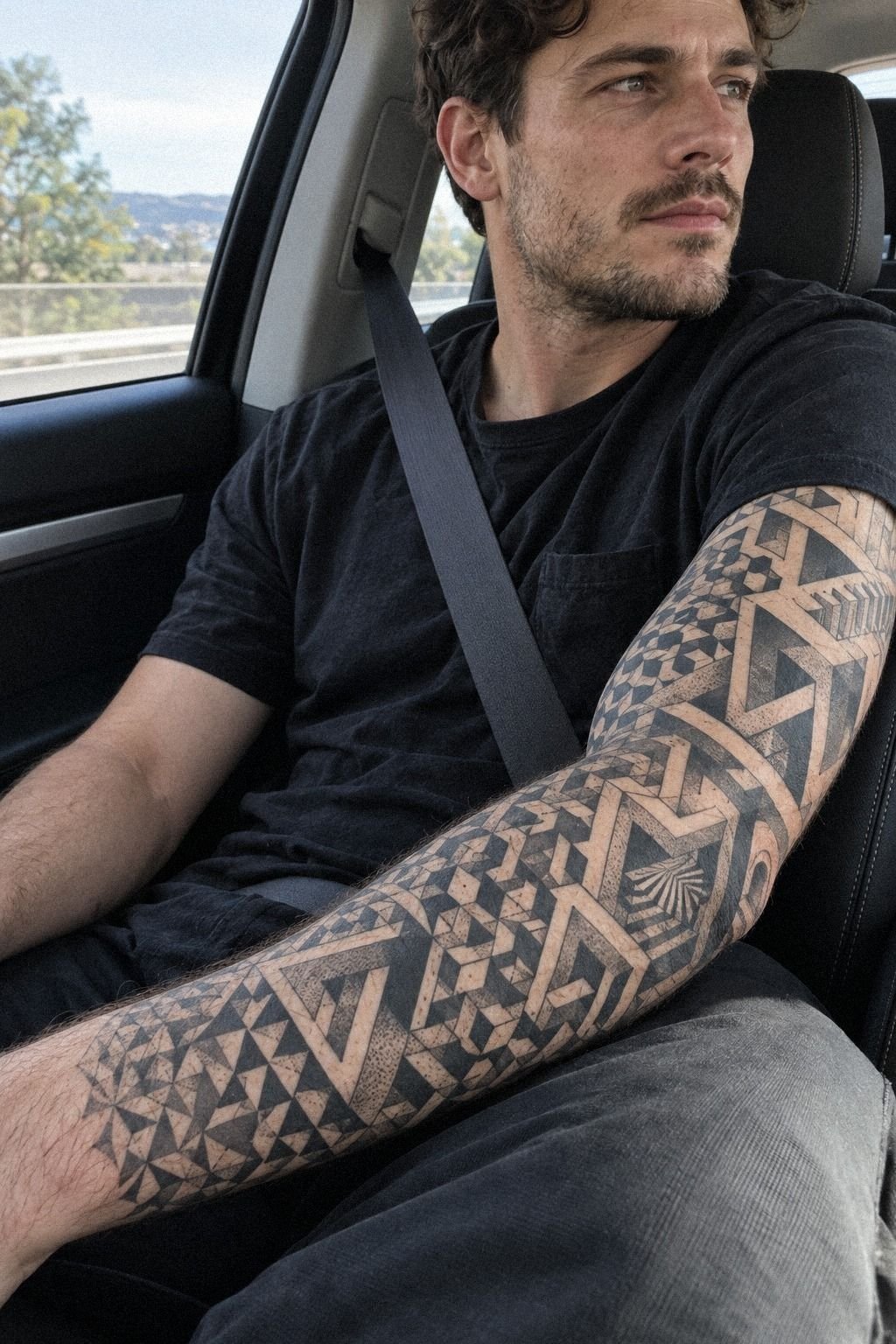
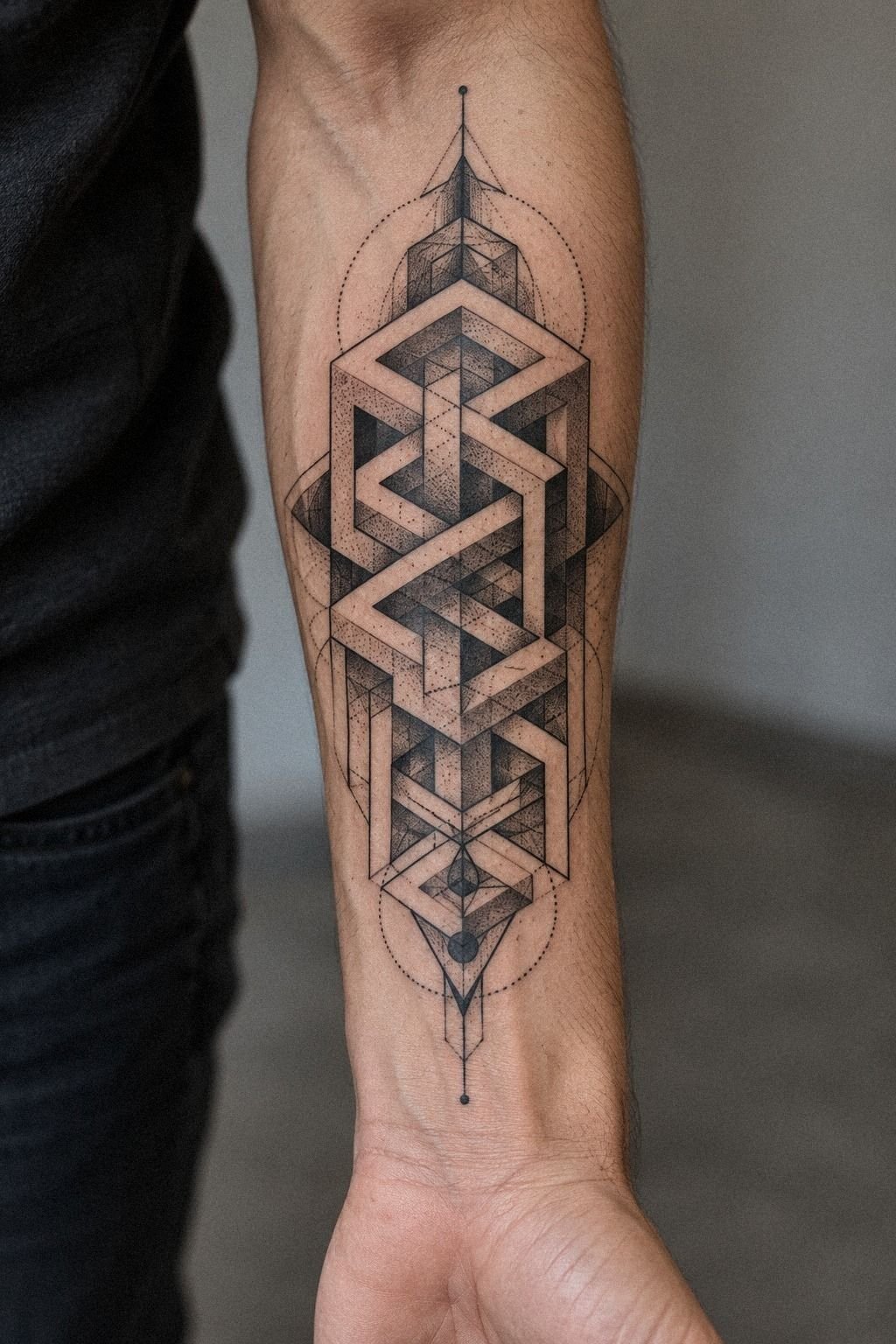
An Escher-inspired sleeve works because your eye keeps finding another shape inside the first one. On fair, cool-pink skin, black geometry can look especially intricate, with repeated stair-step forms, mirrored angles, and small areas of open skin.
You’ll want the pattern to follow your forearm’s length instead of wrapping randomly. I’d keep the central illusion clear and let the smaller marks taper toward the wrist.
– Measured black linework with consistent spacing. – Angular tessellation that turns around the forearm. – Negative skin breaks between repeated forms.
The artist should map the design while your arm is relaxed and slightly rotated. That matters because your sleeve will look different when you bend your wrist or grip something.
A 4- to 6-inch section can read clearly, but a full sleeve needs generous clearance between major forms. Don’t ask for every detail to be microscopic.
Fine lines can widen over time, especially if you’re in the sun often.
I’d choose this over a random collection of symbols because it has a visual rhythm from shoulder to wrist. Your best reference point is a geometric universe tattoo, especially if you want the illusion to feel layered rather than crowded. And if you’re building a full sleeve, leave one quiet section so the strongest shape still has impact.
2Could Interlocking Cubes Work Across the Forearm?
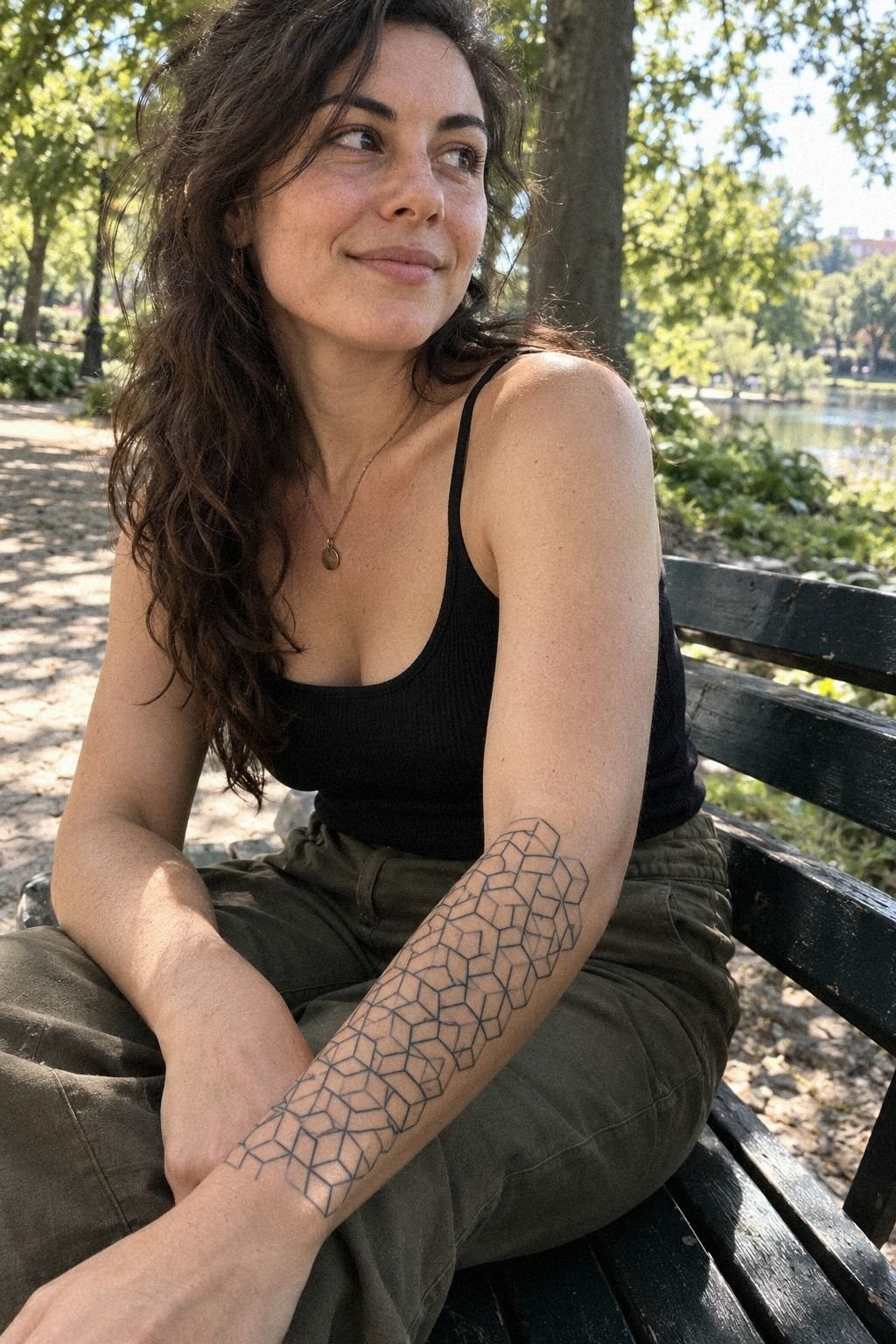
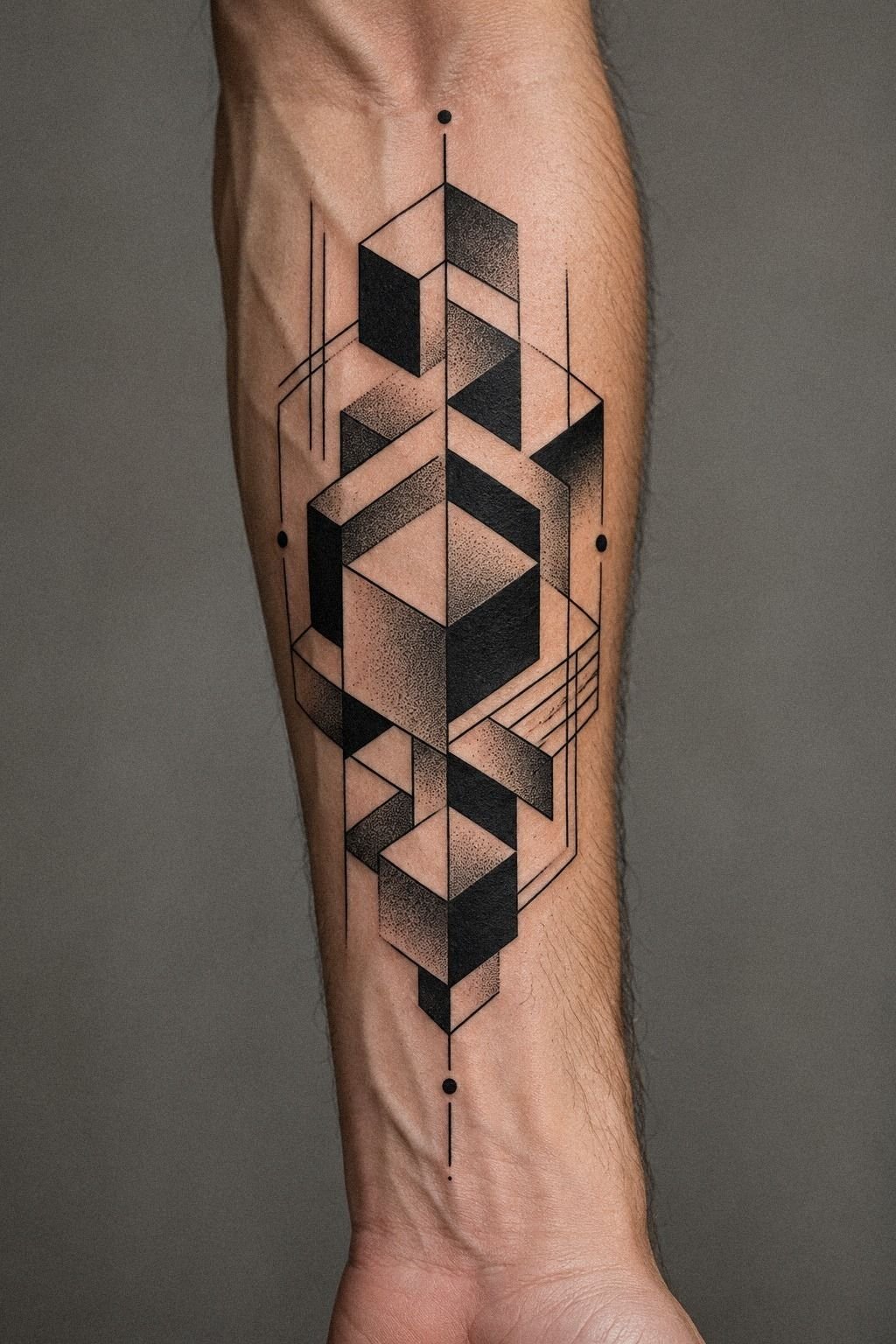
Interlocking cubes give you a sleek optical effect without needing heavy shading. On medium warm ivory skin, clean black lines can create a three-dimensional pattern that looks different from every angle.
I’d place the largest cube near the center of the forearm, then let two or three smaller cubes break away toward the wrist. That staggered movement keeps your tattoo from looking like a rigid stamp.
– Three-sided cube geometry with consistent corners. – Fine ruled lines and small open gaps. – Black geometric accents at the widest intersections.
Your artist should check every junction before beginning, because one misplaced line can flatten the entire illusion. You’ll want the cubes large enough that each plane remains readable after healing.
A piece around 3 to 5 inches can work well for a forearm, depending on how many cubes you’re requesting. I’d skip dense grey shading here.
Open skin does more for the illusion than smoky fill ever will.
If you prefer a more minimal version, ask for two large cubes with one shared edge instead of a full chain. You can compare proportions with these geometric tattoo ideas before your consultation.
But don’t copy a design without checking how its lines behave on your own arm. Skin curves, and your artist needs to redraw the pattern for you.
3Let Abstract Floating Lines Suggest Motion
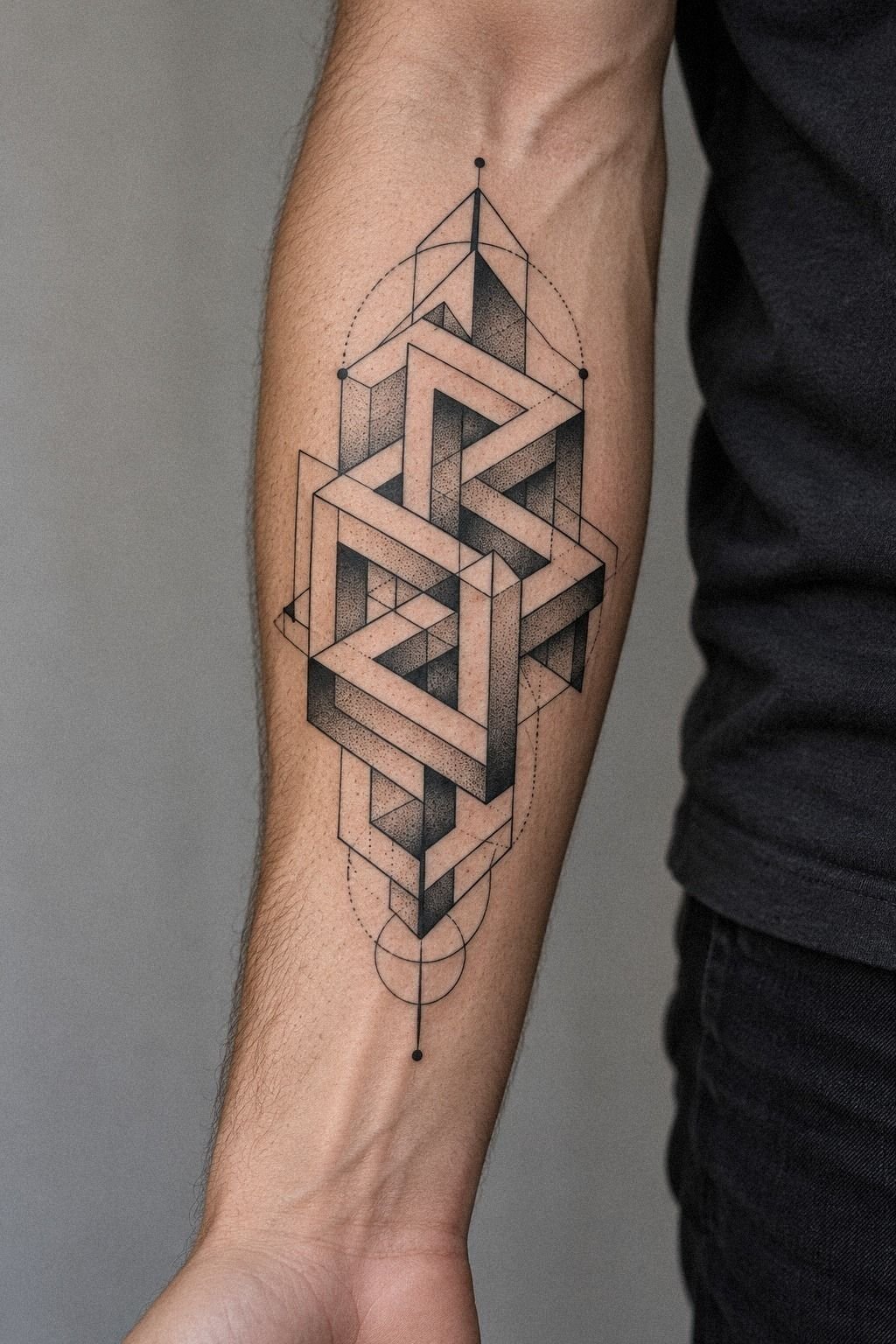
Floating lines make an abstract design feel ethereal without becoming vague. On medium olive skin, the contrast between dark ink and natural skin can give the pattern a quiet, graphic quality. This idea works best when the lines seem to hover around one central form rather than forming a maze.
I’d use one bold shape, two delicate arcs, and several short marks that stop before they collide.
– Abstract black contours with open spacing. – Curved geometric lines following the forearm. – Small circular anchors for visual balance.
You’ll need to discuss how the pattern should look from both the front and side of your arm. A floating line that looks perfect in a flat reference may disappear when your arm turns. I made that mistake once, and the outer curve became nearly invisible from the position I used most.
Now I’d ask the artist to check the stencil from several positions before the needle starts.
This is a thoughtful choice if you like designs that suggest motion without spelling out one fixed symbol. A geometric line tattoo can help you compare line weights and spacing.
Your strongest version won’t need five different textures. Keep the structure controlled, and let untouched skin create the floating effect.
4Why Does an Esoteric Mandala Work Between the Shoulder Blades?
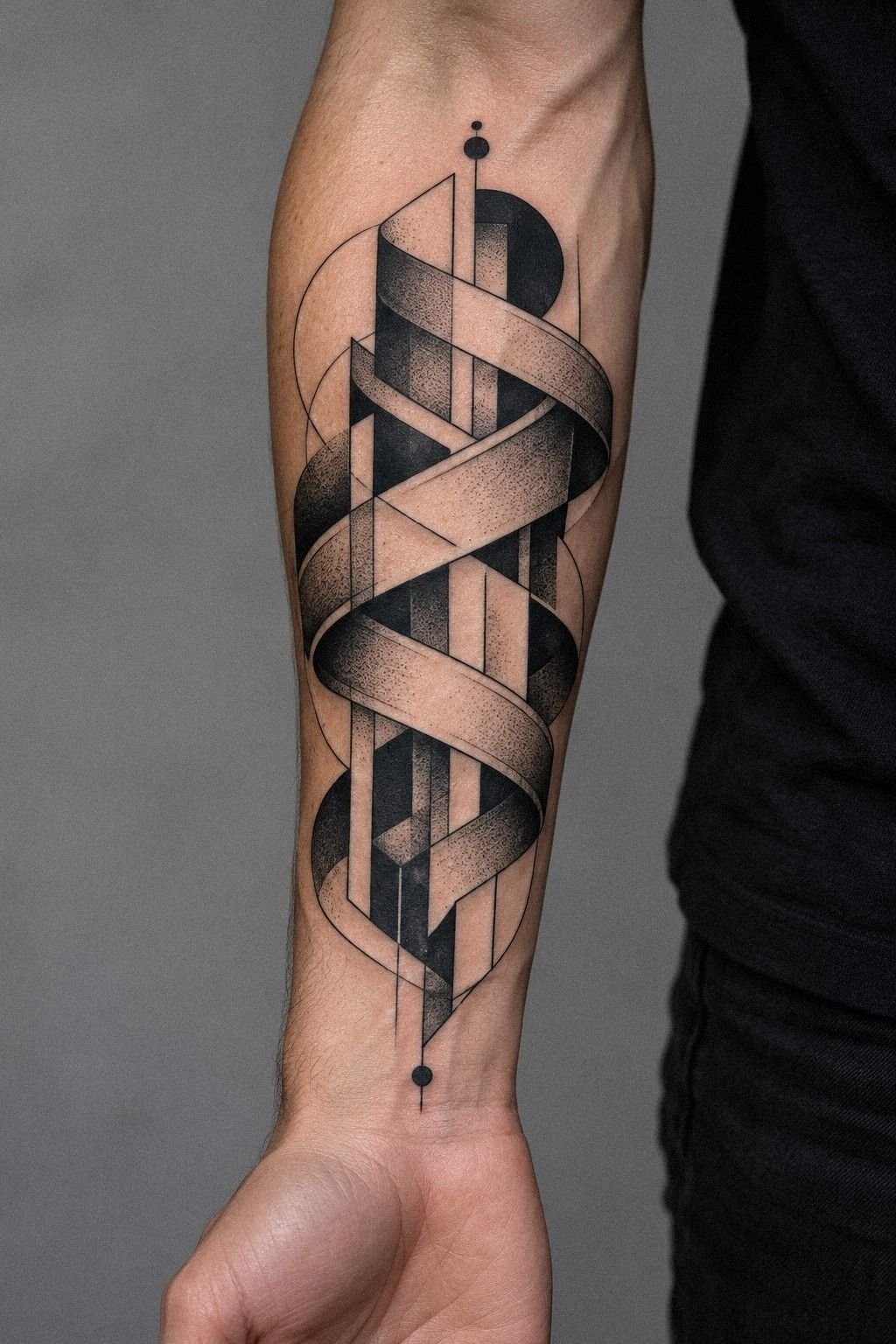
A mandala between the shoulder blades creates a sacred focal point that can stay private under most shirts. The broad, centered placement gives repeated circles and petals enough scale to remain separate after healing. I’d keep the outer edge lighter than the center so the design doesn’t become one dense mark.
– Central mandala geometry aligned with the spine. – Radial petal forms that repeat without crowding. – Open outer rings for a softer transition.
Your artist should mark the center while you’re standing naturally, not while you’re twisting to inspect the stencil. Shoulder movement can pull the pattern off balance. I’d also ask how the design will look when your arms lift, because the skin across the shoulder blades shifts more than people expect.
A geometric mandala tattoo can help you compare symmetry before the consultation. This option may be worth the cost if privacy is your main priority and you want a design with strong personal symbolism. It’s a classic placement, but the final redraw should still belong to your body.
5Use Negative Space Geometry Along the Ribcage

Negative-space geometry can look edgy and restrained along the ribcage.
6When Does a Three-Dimensional Triangle Suit the Calf?
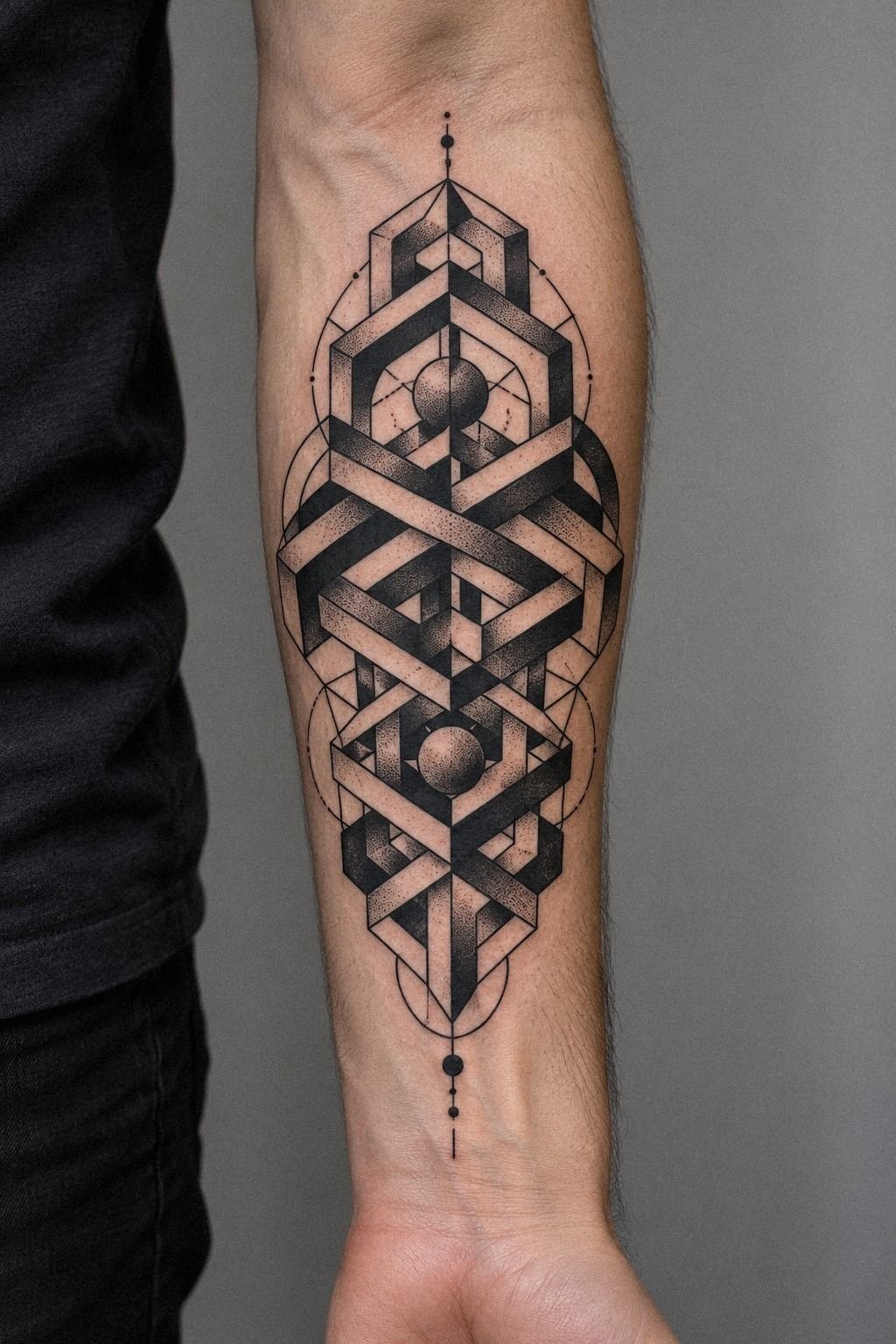
A three-dimensional triangle can look powerful on deep ebony skin when the artist uses black anchors and clean open planes. The calf gives the design a long, readable surface, so you can create depth without covering every inch. I’d place the largest triangle slightly off-center, then use smaller intersecting planes to make the form appear folded or suspended.
– Solid black triangle anchor for contrast. – Open geometric planes with defined corners. – Layered ruled lines that suggest depth.
Your artist should test the stencil while you’re standing and sitting. The calf changes shape when the muscle tightens, and a triangle that looks centered on a relaxed leg may shift visually when you walk. I’d choose a design between 4 and 6 inches high for a first piece, then expand only if the line spacing remains generous.
This placement is usually more tolerable than ribs, feet, hands, or the sternum, though every body responds differently. You can compare the structure with this abstract geometric tattoo before your consultation. And if you’re worried about visibility, the calf gives you an easy balance between privacy and occasional display.
7Follow an Optical Spiral Around the Upper Arm
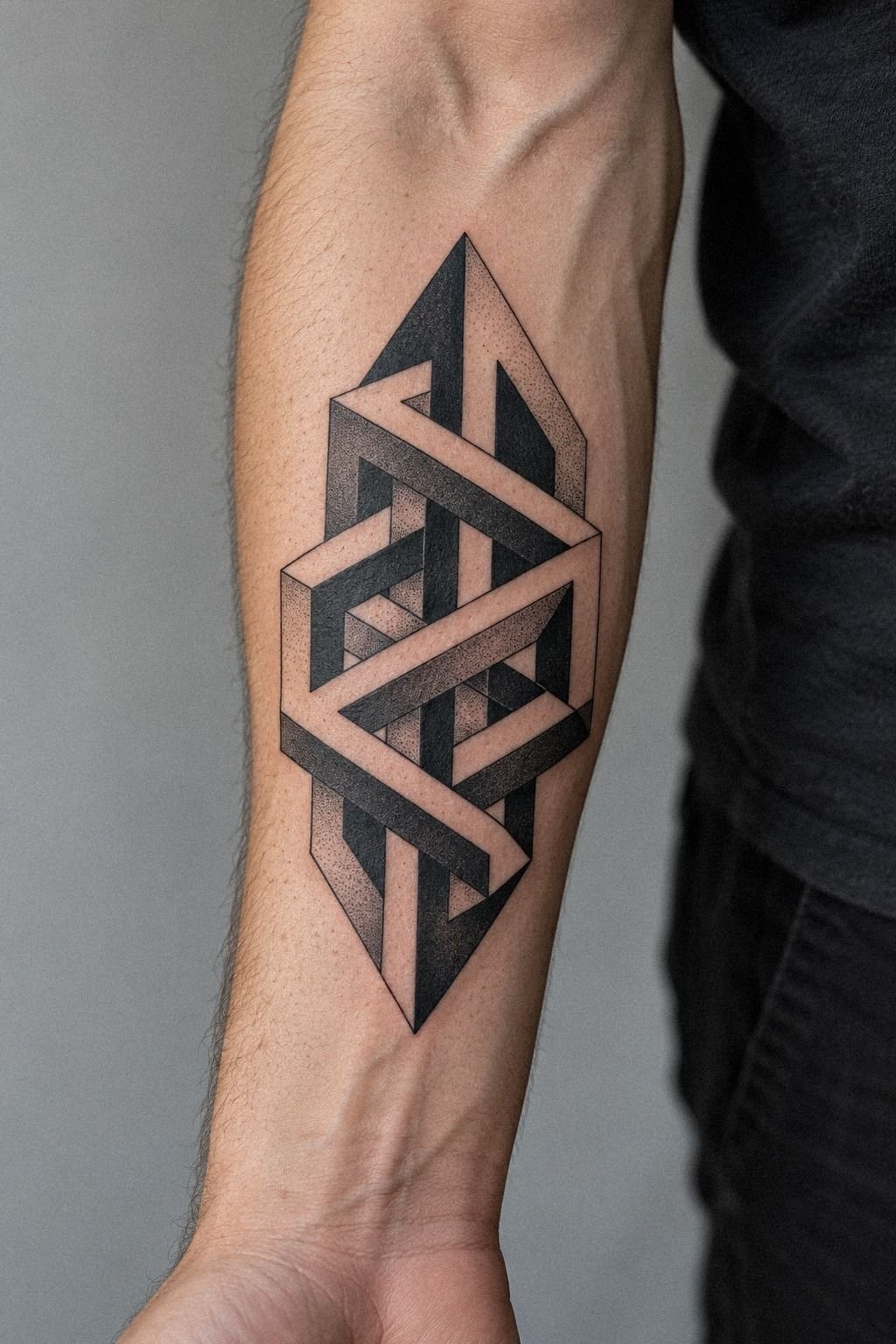
An optical spiral around the upper arm creates a flowing illusion because the pattern follows the body instead of sitting inside one flat shape. The strongest versions use one repeating curve, not several competing swirls. I’d leave the inside of the spiral lighter so the movement remains visible from across the room.
– Continuous spiral line following the arm’s circumference. – Tapered geometric turns that change scale gradually. – Open inner channels that protect the illusion.
Ask your artist to check the design with your arm hanging naturally and with your elbow bent. A spiral can look balanced in one position and compressed in another. You’ll also want to decide whether the ends should meet or fade before they complete the loop.
A second look at this geometric line tattoo style can help you compare line weights. The value is in the movement, so don’t pay for extra shading that hides the central pattern. If the spiral still reads with fewer marks, that’s the stronger design.
8Make Sacred Geometry the Sternum’s Center
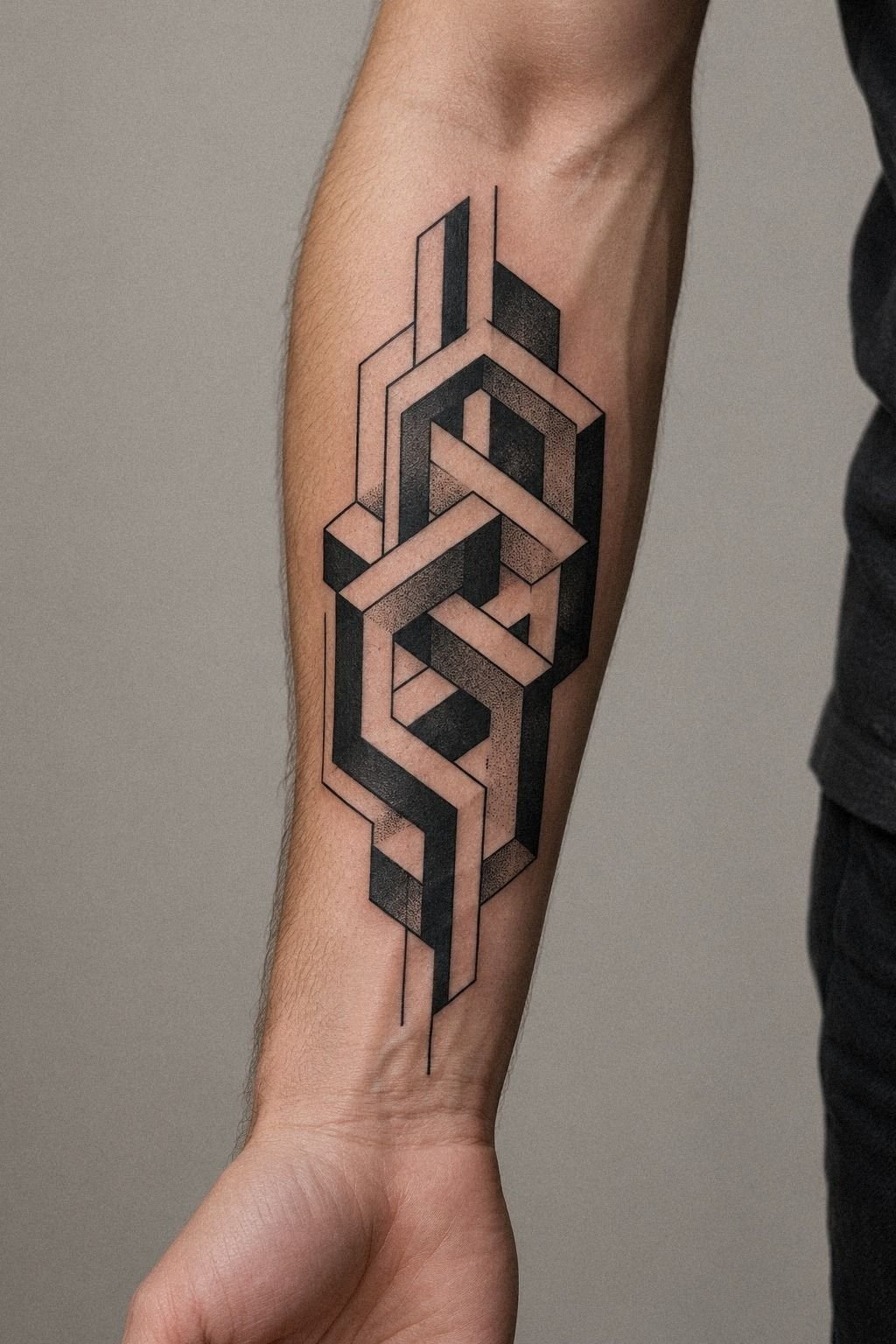
A sternum design can feel symbolic and quietly dramatic when it’s built around a central geometric mark.
9Keep It Minimal Behind the Ear
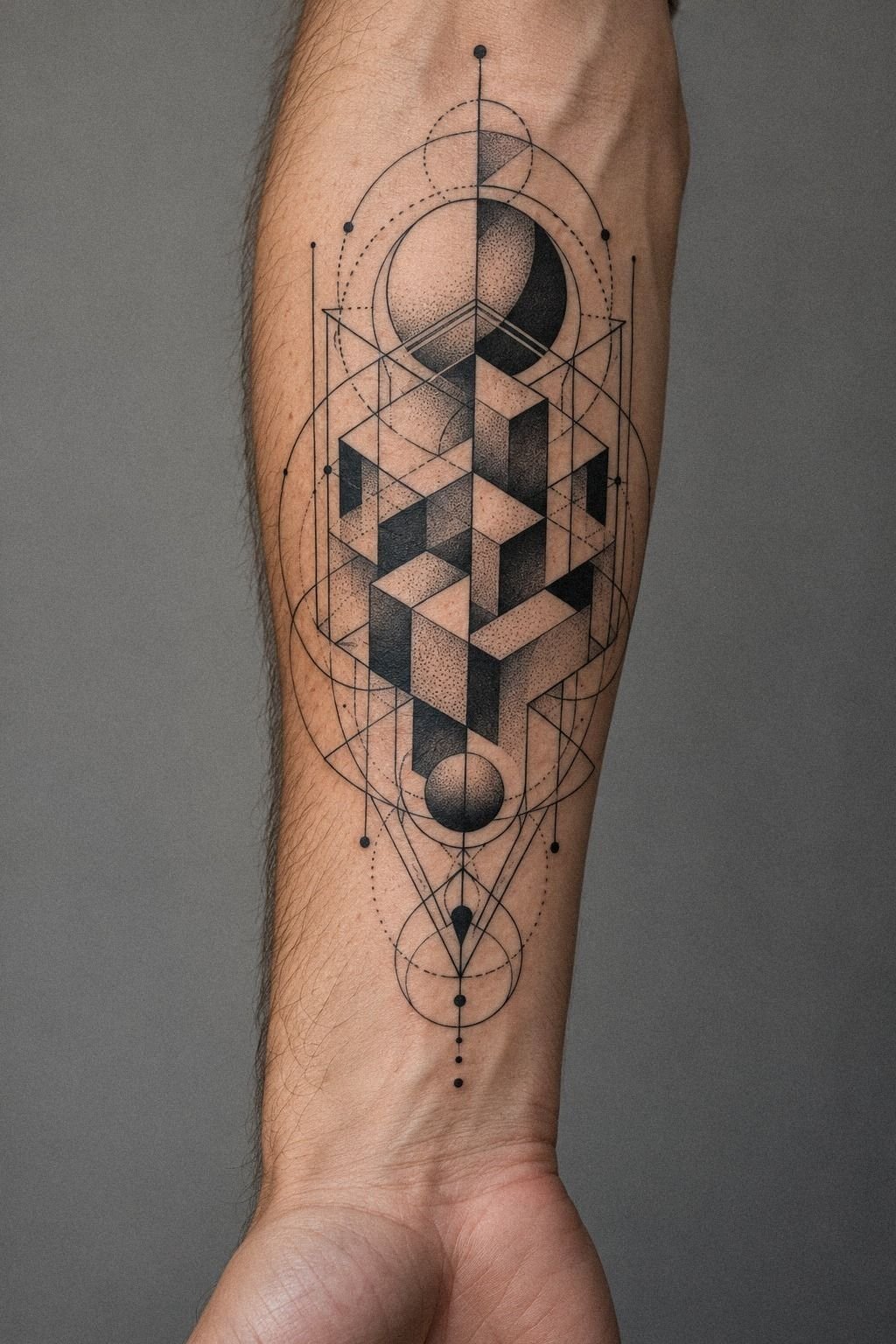
A behind-the-ear design gives you a dainty and understated version of geometric illusion. On medium olive skin, a small black triangle, nested arc, or tiny cube can look sharp without demanding attention.
I’d choose one central shape and keep the surrounding marks sparse. This placement rewards restraint because the available skin is limited and the area moves with your jaw and neck.
– Small black geometric mark with clear edges. – Single fine arc following the ear. – Open skin border around the design.
You’ll want to think about visibility before booking. Hair can cover the tattoo, while a short haircut or pulled-back style can reveal it immediately.
I’d avoid extremely fine single-needle detail if your chosen shape needs to stay readable for years. Tiny lines may spread, and behind-the-ear skin receives friction from hair, headphones, and clothing.
A geometric art tattoo gives you a useful range of small references. Your best version might be less ornate than the design you first save.
But that’s a strength here. One sharp triangle can say more than a crowded miniature pattern, especially when you want the tattoo to remain private until you turn your head.
10Choose Bold Blackwork Across the Chest
Across the chest, bold blackwork can create a dramatic illusion with strong planes, thick outlines, and intentional skin breaks. I’d use one large central structure rather than scattering unrelated shapes across both sides. The design should follow your chest anatomy instead of forcing perfect symmetry where your body doesn’t have it.
– Solid black planes with controlled grey transitions. – Healed linework references from the artist’s portfolio. – Balanced chest geometry with an open center.
Your artist should explain how the stencil will be adjusted for your chest anatomy. Pectoral movement, body hair, and natural asymmetry all affect the final placement.
I’d ask for a healed example in ordinary light, not only a fresh tattoo presented under strong studio lights. That comparison gives you a more honest sense of how the black areas and fine lines will settle.
This idea is daring and expressive, and it’s better suited to someone who already knows how they like visible body art. If you’re still choosing a direction, browse geometric tattoo artist near me portfolios and look for consistent healed work. Don’t choose an artist only because the fresh stencil looks impressive.
A tattoo needs to remain readable after swelling disappears.
11How Should a Geometric Pattern Flow Down the Spine?
A spine design can look timeless when repeated geometry follows the body’s natural center. On deep brown skin with a warm undertone, the contrast between black ink and skin can create a polished vertical rhythm. I’d use one central pattern, such as linked diamonds or stacked hexagons, and allow the spacing to change slightly near the neck and lower back.
– Vertical geometric pattern with measured intervals. – Black central marks for lasting contrast. – Tapered upper and lower ends that follow the spine.
You’ll want your artist to mark the center while you stand comfortably, because posture can shift the stencil. The spine is also a more sensitive placement than the forearm, thigh, shoulder, or calf. I’d rather see a shorter 5-inch design with clear spacing than a long piece packed with tiny lines.
This approach can feel iconic and masculine without relying on oversized coverage. A geometric pattern tattoo can help you compare repeated forms before your consultation. If you want the piece to stay private, a shirt covers it easily, but your artist still needs to plan for sun exposure and healing carefully.
A Budget Check Before You Book
Your tattoo’s price depends on artist experience, region, placement, size, and line density. A small design may be affordable, but the lowest quote isn’t always the best value if the artist has limited healed geometric work. Set a budget ceiling before the consultation, then ask what is included.
A practical cost question is, “What would this design cost if we enlarge it enough to preserve the spacing?” That answer is often more useful than asking only for the cheapest version. Paying for the right scale can protect the design’s longevity and save you from an expensive correction later.
For a broader pricing comparison, review this geometric tattoo gold reference before you book. The investment should match the complexity, placement, and artist’s demonstrated results.
Questions to Ask at the Consultation
Bring your preferred reference, but expect the artist to redraw it for your anatomy. Ask how the lines will age, how much open skin the illusion needs, and whether the proposed scale is realistic for your chosen placement. You’ll get more useful answers when you show the design from several positions.
– Healed portfolio examples from similar placements. – Estimated session length and total cost. – Aftercare instructions written in plain language. – Stencil adjustments for movement and posture.
If you’re comparing artists, look for consistent healed work rather than one unusually polished post. A geometric tattoo artist near me search can give you names, but the portfolio still needs your attention. The right artist should explain the tradeoffs clearly and welcome questions.
The Honest Data Behind Placement, Cost, and Healing
Geometric illusion tattoos vary by artist, region, size, and placement. Typical US shop minimums may fall around $50 to $100, while hourly rates commonly range from $100 to $250.
A small forearm design might land around $100 to $300, but that’s only a broad guide, not a quote. Ask your artist for a written estimate after they review the size and detail.
Your aftercare should stay simple. Wash gently, moisturize as directed, avoid direct sun, and skip swimming while the surface heals.
Fine lines may widen over time, while solid black areas with sensible spacing often remain more readable. You’ll protect the result by using sunscreen after healing, especially if your tattoo sits on the arm, calf, or shoulder.
The Three-Scale Rule for a Tattoo That Ages Well
I’ve changed my mind about tiny geometric tattoos. Smaller doesn’t always mean easier, because a design can lose its spacing when every corner is compressed into a narrow area. My preferred approach is the three-scale rule: one main shape, a second supporting shape, and small details only where your skin can hold them clearly.
The first scale gives your eye an anchor. The second creates the illusion.
The third adds personality without turning the tattoo into visual noise. That’s why I’d choose a 4-inch structured design over a 2-inch knot of fine lines, even if the smaller piece looks more delicate in a reference photo.
You’ll also want to consider privacy. A behind-the-ear tattoo can stay hidden beneath hair, while a forearm piece becomes visible whenever you wear short sleeves. There’s no wrong answer, but there is a right answer for your daily life.
Ask yourself, “Will I still like this placement when I’m not thinking about the tattoo?”
The strongest geometric work feels raw, feminine, masculine, or playful because the structure supports your personality. It doesn’t need a complicated explanation.
Your artist should be able to explain the line weight, spacing, and healing plan in plain language. If they can’t, keep looking.
What People Always Want to Know
How much does a Geometric Illusion Tattoo usually cost?
A Geometric Illusion Tattoo typically costs about $100 to $300 for a small or medium US piece, though a studio may charge a $50 to $100 minimum or $100 to $250 hourly rate. Your artist, region, placement, and detail level will change the estimate.
Are Geometric Illusion Tattoo designs a good idea for a first tattoo?
Yes! They can be a meaningful first tattoo when you choose a tolerable placement and a readable scale. Forearm, thigh, calf, and shoulder designs are often easier starting points than ribs, feet, hands, or the sternum.
Your reference should match your personality, not only a trend.
How do I choose a tattoo artist for Geometric Illusion Tattoo work?
Review a portfolio for healed geometric linework, consistent symmetry, and clear spacing. Ask whether the artist has worked on your chosen placement. You’ll also want to confirm hygiene, consultation practices, and aftercare instructions before booking.
How much do Geometric Illusion Tattoo designs hurt?
Pain depends on your body and the placement. Ribs, feet, hands, and the sternum are commonly more sensitive, while forearms, thighs, shoulders, and calves are often more tolerable. Your session may feel sharper over bone and less intense where there’s more padding.
How long does a Geometric Illusion Tattoo take to heal?
The surface usually heals in about 2 to 3 weeks, while complete healing may take about 2 to 3 months. Wash gently, moisturize as directed, avoid direct sun, and don’t swim until your artist says the surface has closed.
What’s the best placement for a Geometric Illusion Tattoo?
The forearm, calf, shoulder, and thigh are strong choices for readable lines and easier visibility control. A behind-the-ear or ribcage design offers more privacy, while the sternum and spine create a more central effect. Your artist should redraw the pattern for your body.
Should I choose fine lines or bold blackwork?
Choose bold blackwork when longevity and contrast matter most. Fine lines can look refined, but they may spread as they age, especially when packed too closely. Your best design usually combines one strong anchor with enough open skin to preserve the illusion.
Where I’d Start First
If I had to pick one, I’d start with the interlocking cubes across the forearm. The placement is easier to tolerate, the geometry reads from several positions, and the open spacing gives fine lines clearance to age.
Pin that design for later and compare it with more geometric tattoo ideas before your consultation. That’s the option I’d consider first if you want strong value, manageable visibility, and a design that still feels vibrant years from now.