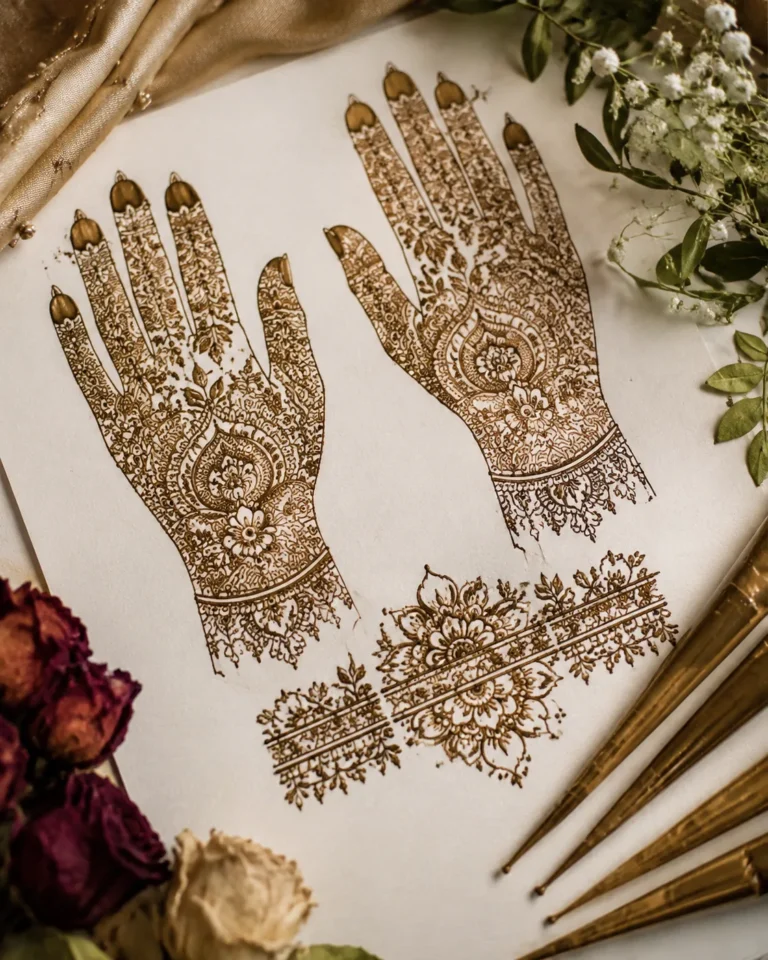
Peacock mehndi designs are beautiful because the bird already gives the artist movement, feathers, curves, and a strong focal point. The risk is over-detailing every feather.
Quick answer: Good peacock mehndi designs use a clear bird body, flowing feather shapes, paisley curves, finger trails, wrist extensions, and enough open space to keep the feathers readable.
Peacock mehndi design directions
The peacock should lead the hand, not disappear inside filler.
| Option | Best use | Keep in mind |
|---|---|---|
| Palm peacock | Bridal or formal focus | Needs skilled detail |
| Feather wrist flow | Elegant extension | Avoid too many lines |
| Back-hand peacock | Photo-friendly design | Body placement matters |
| Arabic peacock vine | Lighter event design | Open space is important |
| Simple feather | Beginner peacock hint | Keep the eye clean |
Peacock mehndi breaks into three main directions. Traditional Indian runs the bird across the hand with a full fan tail spilling down the fingers, heavy with paisley fill and geometric borders. Arabic-style strips it back, one bold peacock on the wrist or forearm with clean negative space doing the work. Indo-Western fuses both, detailed head and body, minimal tail so the design reads from across the room without competing with a sleeve.
Placement drives the direction you pick. A full back-of-hand composition needs the real estate, so Arabic or Indo-Western fits wrists and lower arms better. For mehndi, the same logic applies. Forearm gives you the canvas for a full tail. Upper arm or calf handles a single-bird portrait without the design getting cramped or the paste smearing on curves.
What makes this work on real skin
A peacock in henna is only as good as its tail, rush the details and you lose everything.
The peacock feather is already decorative. Let the curves do the work instead of filling every gap with dots and mesh.
For smaller hands, a feather-only design can look cleaner than a full bird.
Peacock designs live or die by their feather eyes, those round teardrop shapes inside the tail. In henna, fine-line detail there stains dark if paste sits 6 to 8 hours on palm skin, lighter on the back of the hand, and barely registers on forearms. If you want the eyes to pop, your artist needs to pack them with solid fill rather than outline only. Outline-only feather eyes disappear in photos and in person after a week.
In mehndi work, a peacock tail is mostly delicate or shaded feathers against the skin, with intricate paisley and floral details around it. Fine details stay crisp while the paste dries and the stain develops, then soften as the reddish-brown color fades over one to three weeks. High-wear spots like the inner wrist and fingers lose those feather edges faster. Bold outlines with denser filled areas develop more predictably, especially when the paste stays on long enough to deepen on day two.
Before you book or apply it
Choose whether the peacock is the main subject or a decorative accent.
- Keep the bird silhouette readable.
- Use feather curves to guide the hand.
- Do not overfill the background.
- Use natural henna paste and avoid black henna.
For henna, exfoliate the skin two days before, not the day of. Fresh exfoliation removes the dead layer you actually want stain to grab. Skip lotion, oil, and sunscreen on application day. Those create a barrier and you’ll end up with a patchy, uneven stain that looks bad by day three. Bring a reference photo and confirm whether your artist uses natural henna or a black henna substitute. Natural henna stains orange-to-brown. Anything that promises jet black is likely PPD, which can cause chemical burns and scarring.
For a detailed peacock mehndi design, book a consultation first, not just an appointment. Peacock tails involve dense feather layering, and the design needs to be scaled to your actual body part before the paste goes on. Ask to see finished-stain photos of detailed work from that specific mehndi artist, not just fresh paste photos. Fresh paste looks dramatic on everyone. Finished stains tell you whether their fine lines stay crisp or turn uneven, and whether the color develops richly or fades patchy.
Mistakes to avoid
Avoid trying to fit a full peacock, mandala, flowers, and heavy fingers into a small casual design.
Do not let the feather detail become so dense that the peacock shape disappears.
Safety source note: This guide keeps safety advice conservative and points readers to primary public-health or dermatology sources.
The biggest henna mistake is pulling the dried paste off too early. Let it crack and flake naturally, or rub it off gently after 6 to 8 hours minimum. Washing it off defeats the purpose. After removal, keep the area away from water for another 12 hours. Chlorine, dish soap, and sweat all pull the stain fast. A dab of lemon-sugar or mustard oil over the dried design before bed helps the paste stay moist longer and deepens the color.
On the mehndi side, the mistake we see constantly is going too small with a peacock tail. Artists compress the feather eyes down to tiny dots trying to fit the design on a small wrist or ankle, and those dots can smudge while the paste is fresh. If your placement is tight, edit the design, drop some feather rows, keep the ones that stay readable. Another one is skipping aftercare while the paste dries. Keep it on for one to two hours, seal it with lemon-sugar, and let the stain deepen on day two before reapplying after it fades.