
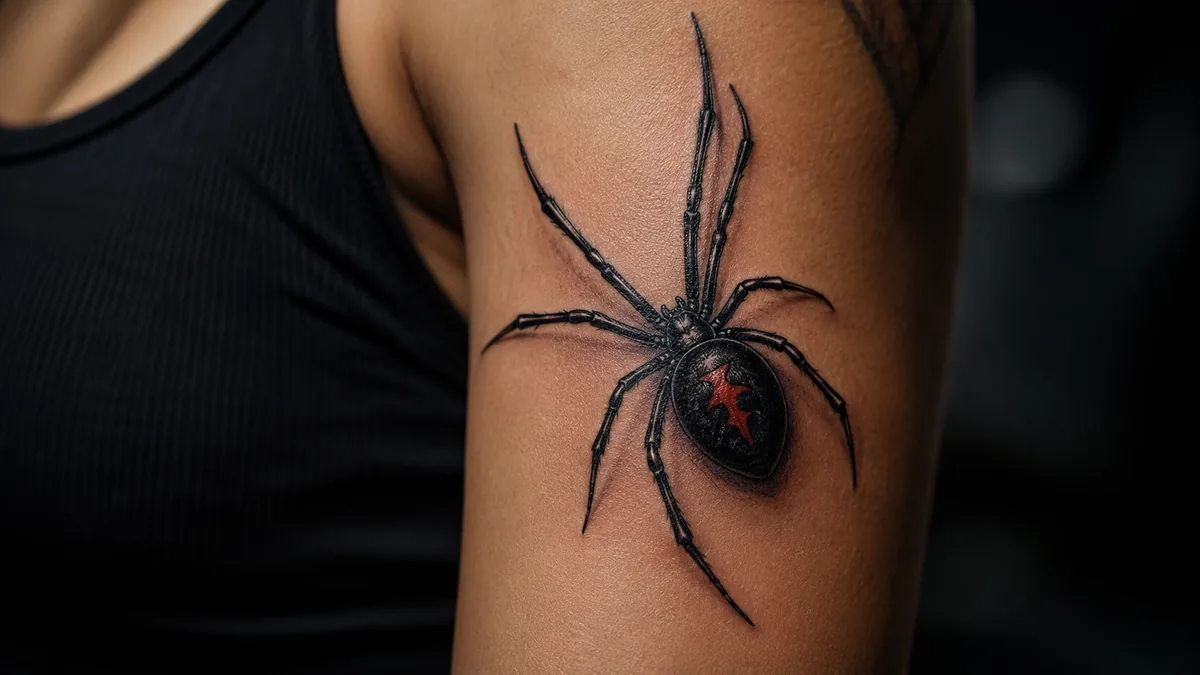
The black widow is one of the most loaded symbols you can put on your body. It’s not just a cool spider. It carries real weight: danger, survival, sexual power, independence, and grief. People who get this tattoo usually know exactly what they’re saying.
There’s a reason this design has stayed popular across decades of tattoo culture. It reads clearly, it looks incredible in ink, and it means something different to almost every person wearing it. This is what the black widow tattoo actually stands for.
Core Meaning: Danger and Power
The black widow spider is venomous. That’s the foundation of everything this tattoo communicates. When someone puts a black widow on their skin, they’re signaling that they’re not to be underestimated. There’s a warning built into the image. It says: I look beautiful, but I bite back. That combination of attractiveness and danger is exactly what draws people to this design.
A lot of wearers connect to the idea of hidden strength. The black widow isn’t the biggest spider, it’s not the most aggressive one, but it’s deadly. That resonates with people who’ve survived hard things, who’ve been overlooked, or who want to project quiet confidence. It’s power without announcing itself.
Feminine Energy and Sexual Power
She does not chase. She waits, and that is what makes her dangerous.
The black widow has a long association with feminine power, specifically the kind that doesn’t apologize. The female of the species is the venomous one, and the myth of the female killing the male after mating made this spider a symbol of dangerous femininity in Western culture. That narrative stuck, and tattooed women have claimed it ever since.
For a lot of women getting this piece, it’s about owning a sexuality that society tends to frame as threatening. It’s reclaiming the narrative. Some wear it as a statement about being independent, not needing anyone, thriving alone. Others connect it to relationships that cost them something real, a reminder of what they survived and what they’re capable of.
Grief, Loss, and Widowhood
Black widow is a literal term for someone who has lost a spouse. Some people get this tattoo as a memorial piece, a way to carry that loss. The spider in mourning colors, all black with the red hourglass, becomes a visual shorthand for grief that doesn’t fully go away. It honors the person lost while acknowledging the survivor’s strength.
This reading is less common in flash and street tattoos but it shows up constantly in custom work. A client will come in with a story, a partner lost to illness, an accident, sometimes a violent death. The black widow becomes a personal symbol: I loved someone, I lost them, I’m still here. That’s a heavy tattoo. It deserves care.
Cultural and Historical Context
The black widow spider, Latrodectus mactans, has been part of American folklore for generations. Rural communities in the South and Southwest feared it for real reasons. It showed up in Depression-era blues music and later in crime fiction as a metaphor for femmes fatales. Hollywood leaned into it hard. The “black widow” archetype, the beautiful and dangerous woman, was a fixture in noir cinema from the 1940s through the 1980s.
In tattoo culture specifically, the black widow became mainstream through biker and counterculture communities in the 1960s and 1970s. It fit alongside skulls, daggers, and panthers as a symbol of toughness and non-conformity. Later it crossed into fine line and neo-traditional work, which opened it up to a much wider audience without losing the core symbolism.
Design Styles and What Works on Skin
Traditional American style is where this design is most at home. Bold outlines, heavy blacks, a saturated red hourglass, flat color fields. It reads from across the room and holds for decades. The simplicity of the spider form makes it ideal for this style. Neo-traditional adds dimension and ornamental details, web patterns, florals, geometric framing, without sacrificing legibility.
Fine line black widows are popular right now, especially on the forearm and collarbone. The detail work can be stunning fresh out of the needle. Be honest with your clients though: fine line does fade and spread over time, especially in high-wear zones. If someone wants a crispy fine line piece that lasts, placement matters as much as execution. Black and grey gives the spider a moody, painterly look that ages gracefully.
Color vs. Black and Grey
The red hourglass marking is the black widow’s signature, and how you handle that color choice says a lot about the piece. Full color with a saturated red mark pops hard against the black body. It’s immediate, it’s aggressive, and it signals danger clearly. That contrast is part of why traditional black widows hit so well visually.
Black and grey strips the color and forces the design to work entirely through value and texture. Whip shading on the spider’s abdomen, subtle gradients on the legs, a suggestion of web in negative space. The result is more atmospheric, almost gothic. Some artists skip the red entirely and render the hourglass in negative space or white ink. Both approaches are valid. It comes down to what emotional tone the client wants to carry.
Best Placements and How It Ages
The black widow works well in compact formats, which gives you a lot of real estate options. Inner wrist, back of the neck, behind the ear, sternum, ankle, and shoulder cap are all strong placements. Anywhere you want something small that still has visual authority. The design is tight enough to fit in spots where larger pieces can’t, and simple enough to stay legible as the skin changes.
High-wear zones like the hands, fingers, and feet will soften the lines faster. If someone wants it somewhere spicy like the ribcage or sternum, warn them: those sessions are not comfortable, but the placement heals well and the skin is protected. Avoid stretchy areas if you’re doing fine line work. Bold will hold in more locations than delicate linework will.
Who Gets This Tattoo and How to Make It Personal
The black widow cuts across a wide range of clients. Women who want a symbol of fierce independence. People processing grief or a dark chapter. Men who connect to the danger and the counterculture history. Survivors of toxic relationships. Collectors building a dark or nature-themed sleeve. The meaning is flexible enough to hold all of that without feeling generic.
To personalize it, think about what element you want to emphasize. Add a web that incorporates a name or date for a memorial piece. Combine it with florals for a contrast of beauty and danger. Use a specific color palette tied to something personal. Frame it in a locket shape for a different emotional register. The symbol is strong enough to carry additions without losing its core meaning.









