The spider lily is one of those flowers that hits different. It’s stunning and strange at the same time, with those long spidery stamens shooting out past the petals. On skin, it reads dramatic and intentional. People aren’t getting spider lily tattoos because they saw one at a nursery. They’re getting them because the symbolism cuts deep.
The plant is mostly known from East Asian cultures, particularly Japan, where it’s called higanbana. It blooms at the autumn equinox, often around graveyards and rice paddies. That context shapes nearly every meaning it carries. Before you book your appointment, here’s the real breakdown of what a spider lily tattoo says.
Core Symbolism: Death, Rebirth, and the In-Between
The spider lily’s most recognized meaning is the threshold between life and death. In Japanese Buddhist tradition, the flower blooms along the path of the dead as they cross into the afterlife. It’s called ‘higanbana,’ meaning ‘flower of the other shore.’ That other shore is Higan, the world of the dead in Buddhist belief. So right out of the gate, this flower lives at a boundary. Not death as darkness, but death as transition.
That dual nature is what makes it such a powerful tattoo. It’s not nihilistic. It’s about cycles. You die, you return, you change. People going through major life shifts, grief, recovery, or reinvention gravitate toward this image naturally. The meaning fits without needing to force it.
Japanese and Korean Cultural Background
It blooms where no one returns, that is the whole point.
In Japan, the red spider lily, specifically Lycoris radiata, is heavily associated with funerals and the dead. It was historically planted around graves and field borders because it’s toxic to rodents and insects. That practical use layered on top of the Buddhist symbolism. You see these flowers bloom in early fall, bright red against dying green, and the imagery is undeniable. It became a shorthand for mourning, for things that cannot return.
Korean folklore ties the spider lily to separation and longing. There’s a legend about two spirits, a flower spirit and a leaf spirit, who are never allowed to meet. The leaves die before the flower blooms, and the flower dies before the leaves return. That’s why in Korean, they’re sometimes called ‘flowers that cannot see leaves.’ That meaning of beautiful, impossible separation resonates strongly with people who’ve lost someone.
The Anime Connection and What It Adds
Let’s be real. A large chunk of people getting spider lily tattoos found the image through anime, specifically ‘Demon Slayer,’ where it appears as a rare, nearly mythical flower. That’s a totally valid entry point. The show uses the flower’s real symbolism correctly. It represents something precious and out of reach, tied to death and great power. The cultural meaning didn’t get invented by the show. It was already there.
That said, if your reference is pure Demon Slayer fandom, own that. Your artist can steer the design toward that aesthetic, bold outlines, high contrast, dramatic composition. If you want the deeper cultural read, that’s equally valid. The two aren’t mutually exclusive. Just be clear with your artist about which direction you’re going so the design serves your intent.
Design Variations: From Fine Line to Neo-Traditional
The spider lily is naturally architectural. Those long stamens demand precision. Fine line black and grey is extremely popular and works well when the artist is skilled. You get delicate, wispy lines that mirror the actual flower structure. The downside is fine line fades faster, especially in high-wear spots. You want a low-wear zone for that style to hold its crispness long-term. Forearm inner, upper arm, ribcage, thigh. Avoid hands and wrists if you want it to stay clean.
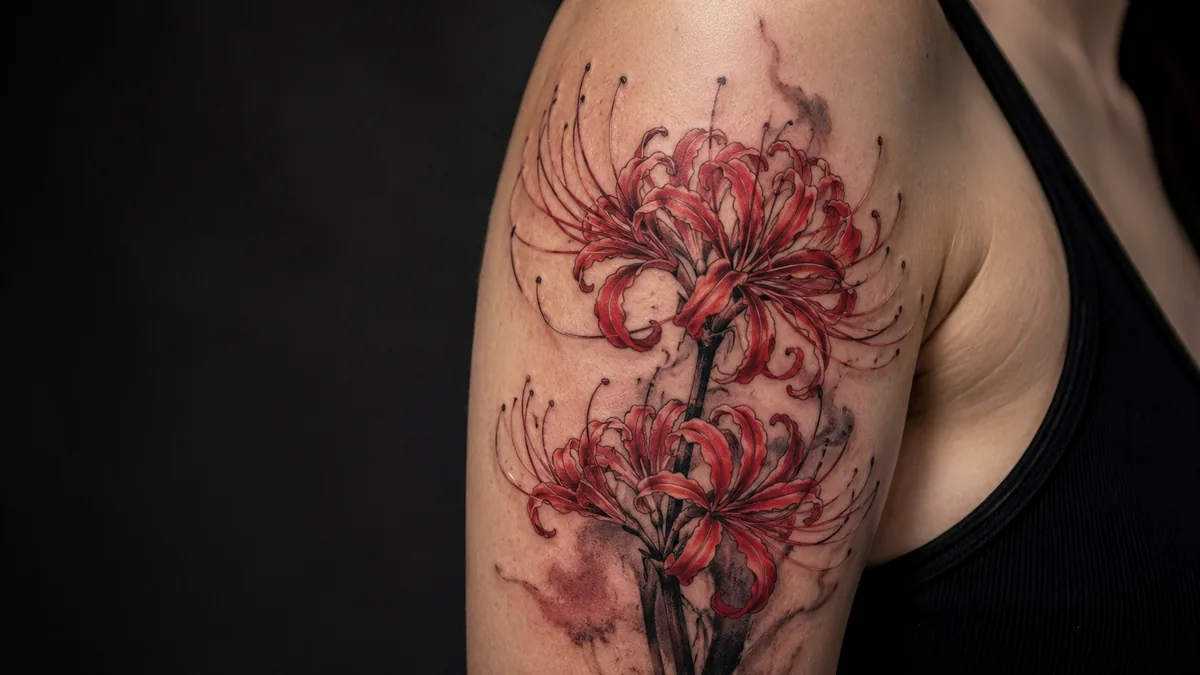
Bold outlines with flat color or whip shading read from across the room and hold up for decades. Neo-traditional and Japanese traditional styles suit this flower perfectly. The strong graphic lines of traditional Japanese tattooing were basically built for florals like this. A tebori-style piece or a solid Americana-influenced spider lily will outlast almost any fine line interpretation by years.
Color vs. Black and Grey
Red is the most iconic choice and carries the full weight of the Japanese symbolism. A saturated, bold red spider lily is a statement piece. It pops on any skin tone when done right. The challenge is keeping red bold long-term. Sun exposure breaks red pigment down faster than black. Proper SPF care and occasional touch-ups keep it sharp. Yellow and white spider lilies exist botanically and carry slightly softer meanings, associated more with new beginnings than death.
Black and grey opens up a ton of creative space. You can push contrast hard, go full realism with deep shadows, or keep it soft and ethereal with light whip shading. A black and grey spider lily with strong negative space reads as sophisticated and timeless. It also ages more predictably than saturated color. If you’re unsure which direction to go, discuss your skin tone with your artist. They’ll know what holds best on you specifically.
Placement and How It Wears Over Time
The spider lily’s long, radiating stamens make it a natural fit for vertical placements. The spine is a dramatic choice and suits a single large bloom or a cascading cluster beautifully. The outer thigh and inner forearm give you room to let the stamens breathe. Upper arm and shoulder work well for wrapping designs. The flower’s shape adapts to most body contours without losing its identity. That’s a practical advantage not every floral tattoo has.
Avoid placement on the fingers, palms, and the sides of feet unless you’re committed to regular touch-ups. Those are high-wear zones where ink breaks down fast. Blowout risk is real in areas with thin skin and lots of movement. The knee ditch and inner elbow are spicy placement-wise and will spread slightly over time. Stick to flatter, less-flexed zones for fine line work. Bold traditional pieces can handle more adventurous placement.
Who Gets Spider Lily Tattoos and How to Make One Yours
People who choose this flower tend to be drawn to meaning that sits between extremes. Grief mixed with beauty. Loss mixed with hope. That emotional complexity is the tattoo’s core appeal. It’s popular with people who’ve lost a parent or partner, people who’ve survived serious illness, and people who mark big personal reinventions. It’s also a strong choice for anyone with ties to Japanese or Korean culture who wants to honor that heritage without a literal cultural symbol.
To make it personal, think about what moment or person you’re tying it to. That informs whether you go red or white, solitary bloom or cluster, stark isolation or surrounded by other elements. Talk to your artist about composition before you lock in a reference image. A great artist will take the symbolism you bring and translate it into something that fits your body, your skin tone, and will still look sharp in twenty years.