The turtle is one of those tattoos that carries real weight without being loud about it. People get turtles for all kinds of reasons, and almost every one of them connects to something genuine. Protection, patience, endurance, the long game. If you’re drawn to the idea, there’s probably a reason.
Turtles are ancient animals. They’ve been on this planet for over 200 million years. That survival track record is baked into what they mean as a tattoo. This isn’t a design you slap on for aesthetics alone. Most people who choose a turtle have something specific they want to carry on their skin.
Core Symbolism: What a Turtle Tattoo Actually Means
The turtle’s shell is the first thing people think about. It represents protection, resilience, and the ability to carry your home with you wherever you go. That last one hits hard for people who’ve relocated a lot, lived nomadic lives, or just learned to be self-sufficient. The shell is a shelter. It’s yours, always.
Beyond the shell, turtles symbolize longevity, patience, and wisdom. They move slowly and they live long. That combination means a lot to people who believe in the slow build, who’ve been grinding for years, or who want a reminder that the pace doesn’t matter as much as showing up consistently. Steady wins.
Cultural and Historical Background
Slow and protected, the turtle carries its home and never rushes.
In Hawaiian and broader Polynesian culture, the honu (sea turtle) is deeply significant. It represents good luck, navigation, safe passage, and a link between the living and the spirit world. Traditional Polynesian tattoo designs often incorporate the turtle into geometric tribal patterns, with each element carrying its own meaning. It’s not decoration. It’s identity and lineage.
In many Native American traditions, the turtle is connected to the earth itself, sometimes called Turtle Island in creation stories. Chinese and Japanese cultures associate turtles with longevity and cosmic order. Across West African mythology, the turtle represents cleverness and adaptability. These aren’t interchangeable meanings, so if you’re pulling from a specific culture, do your homework and be intentional about it.
Popular Design Variations and Styles
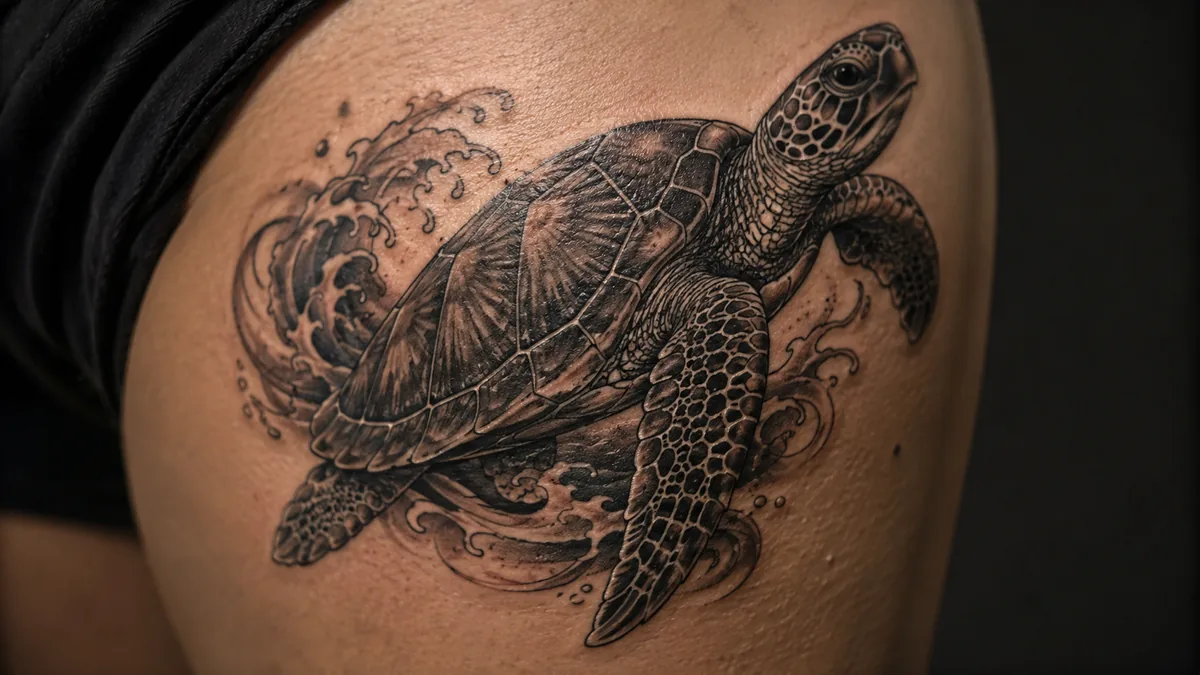
The most common styles break into a few camps. Traditional and neo-traditional turtles are bold, graphic, and built to last. Big fills, strong outlines, saturated color. They read from across the room and they age clean. Polynesian tribal turtles use geometric fills, often black only, and have a very different visual weight. Realistic sea turtles in black and grey are popular right now, especially large back or thigh pieces where the artist can render the shell texture and water movement properly.
Fine line turtles are everywhere too. Delicate, minimal, single needle. They look incredible fresh but they’re high-maintenance long-term. Fine lines in high-wear zones fade and spread. Watercolor turtles are another trend, but without solid line work anchoring them, they blur and muddy over time. Whip shading on a neo-trad or Japanese-style turtle will hold better than a watercolor wash with no structure underneath.
Color vs. Black and Grey
Color turtles lean bright or earthy depending on the concept. A Hawaiian sea turtle in turquoise and green looks stunning on lighter skin tones but needs a solid touch-up plan. Saturated color needs good light exposure and sun protection to stay crispy. Rich jewel tones on a neo-trad piece, think deep teal, olive, amber, hold better than pastels and stay readable as the skin ages.
Black and grey turtles are lower maintenance and more versatile across skin tones. A well-executed black and grey realistic sea turtle with smooth gradients and clean highlights is a genuinely timeless piece. If your artist is good at smooth transitions and subtle texture work, black and grey is the smarter long-term bet. Bold will hold is the old rule, and it still applies.
Best Placements and How It Ages
Turtles are naturally suited to certain shapes. The shell is round, so circular compositions work great on the shoulder, knee cap, upper arm, or calf. Larger pieces open up the back, thigh, or chest. The back is ideal for a big detailed sea turtle because you have room for the full body, fins extended, maybe some water. It stays protected from sun and friction better than forearm or hand placements.
High-wear zones, hands, fingers, feet, the inside of the wrist, will break down faster. Fine line turtles in those spots are especially vulnerable to blowout and fading. Ribs are spicy but the skin is thin and relatively stable once healed. Elbow ditches and knee areas move a lot and can chew up detail over time. Placement is a conversation with your artist. Don’t skip it.
Who Gets Turtle Tattoos and How to Make It Personal
People who get turtles tend to be intentional. Travelers, divers, surfers, people with Pacific Islander roots. Also people who’ve been through something slow and hard, illness, loss, recovery, a long stretch of building something from nothing. The turtle fits that narrative without being heavy-handed. It’s quiet symbolism.
To make yours personal, think about which meaning actually resonates. If it’s protection, lean into the shell as the focal point. If it’s cultural heritage, work with an artist who respects that context and designs accordingly. Add elements that mean something to you, water, hibiscus, specific geometric patterns, a specific species like a leatherback vs a hawksbill. The shape of the tattoo should match the shape of the meaning.