
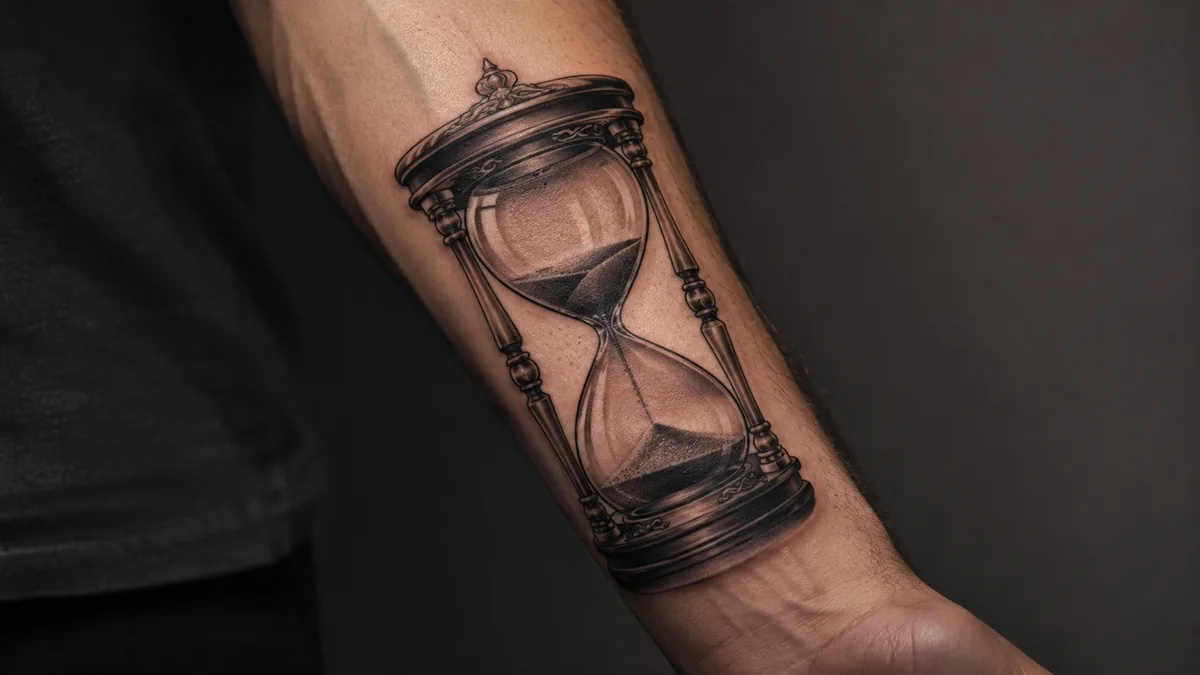
The sand clock tattoo is one of those designs that hits on a universal truth: time is running out for all of us. That’s not dark for the sake of dark. It’s honest. People get this piece because they’ve lived through something, lost someone, or just woke up one day and decided to stop sleepwalking through life.
Also called an hourglass tattoo, the sand clock is a centuries-old symbol that still reads perfectly on skin. Whether it’s a bold traditional piece with thick outlines or a delicate fine-line work on a forearm, the meaning carries weight every single time.
Core Meaning: What a Sand Clock Tattoo Actually Represents
The central meaning is time, plain and simple. More specifically, it’s about time passing, time being finite, and the pressure that comes with knowing that. Sand flowing from the top chamber to the bottom is a visual countdown. You can’t stop it, reverse it, or pause it. That’s the point. The tattoo is a personal reminder to pay attention to your life right now.
Beyond urgency, the sand clock also represents balance and duality. Two equal chambers, one full and one emptying. That maps onto life and death, past and future, patience and speed. A lot of people see it as a symbol of inevitability, that fate moves at its own pace regardless of what you do. Both readings are valid and both hit hard.
Historical and Cultural Background
Every tattoo ages, an hourglass reminds you that was always the point.
The hourglass as a symbol goes back to medieval Europe, where it was paired with the Grim Reaper, skeletons, and memento mori iconography. Memento mori means ‘remember you must die’ in Latin, and it was a serious artistic tradition reminding people that wealth and status meant nothing against mortality. You’ll find hourglasses carved into tombstones, painted in vanitas still-life art, and etched into old woodcuts alongside skulls and scythes.
That history is real and it feeds directly into the tattoo tradition. Traditional American tattoo flash picked up the hourglass alongside skulls, daggers, and roses as part of its dark-but-beautiful vocabulary. In alchemy, the hourglass was linked to Saturn, the planet governing time, discipline, and endings. None of this was invented for Pinterest boards. It’s a genuinely old symbol with serious weight behind it.
Popular Design Variations
The classic execution is a standalone hourglass with sand mid-flow. From there, artists layer in details that shift or sharpen the meaning. Wings on the frame turn it into a comment on how fast time flies. A cracked or broken glass says time is fragile and so are you. Combining the sand clock with a skull doubles down on the mortality angle. Adding flowers, especially roses, softens the piece and introduces beauty alongside the inevitable.
Geometric and mandala-inspired versions are popular right now, where the hourglass frame becomes a network of precise lines and sacred shapes. Some clients want the sand replaced with stars, galaxies, or ocean waves inside the chambers for a more personal cosmic feel. Fine-line illustrative styles have also taken off, where the whole piece looks like an engraving from an old book. Every one of these variations is still an hourglass. The extra elements just tell more of your specific story.
Black and Grey vs. Color
Black and grey is the dominant choice for sand clock tattoos and it makes sense. The subject matter is serious, and black and grey handles that tone naturally. A skilled artist can whip shade the background, give the glass dimension with highlights, and make the sand feel like it’s actually moving. This style ages well, too. A solid black and grey piece on good skin, kept out of the sun, will still look clean fifteen years in.
Color opens up creative options without weakening the design. Some people add deep reds or burnt oranges to the sand for a dramatic, almost burning effect. Blue and purple tones inside the chambers suggest a mystical or cosmic reading. Full saturated color in a neo-traditional style gives the whole piece a bold, illustrative pop that reads from across the room. Color on thin glass details can fade faster, so your artist should use high-quality pigments and you need to commit to touch-ups.
Placement and How It Ages
The forearm is the most popular placement, and for good reason. The vertical shape of a sand clock maps naturally onto the length of the forearm. It sits flat, heals nice, and you can actually see it yourself every day, which matters for a piece that’s meant to remind you of something. The upper arm, thigh, and calf are all solid choices for the same reasons: relatively flat surfaces, moderate pain, and good longevity.
Ribs and sternum placements look stunning but are high-wear zones where fine details can blowout or blur over time. Hands and fingers are spicy for pain and the skin there chews through ink fast, so anything intricate will need frequent touch-ups. Fine-line sand clocks on the inner wrist or behind the ear are delicate and beautiful, but you need to accept they’ll soften with age. If you want crispy lines that hold for decades, go with a bold execution on a low-wear zone. Bold will hold.
Who Gets Sand Clock Tattoos and How to Make It Yours
People who get this tattoo have usually lived through something. A close call, a loss, a season of life that clarified what actually matters. It’s common after a death in the family, a serious illness, a divorce, or hitting a major milestone birthday. It’s not a trendy piece people grab impulsively. It tends to be a deliberate choice made by someone who has thought hard about time and what they’re doing with it.
Making it personal is about the details you add and where you put it. If you lost a parent, consider integrating their birth and death years into the frame. If it’s about a personal turning point, the date can live in the sand itself. A phrase in the banner, a specific flower, a name worked into the base. Talk to your artist about what the piece needs to say. A good tattoer will build those elements in without cluttering the composition. Keep the core shape readable and let the personal details add depth, not noise.









