
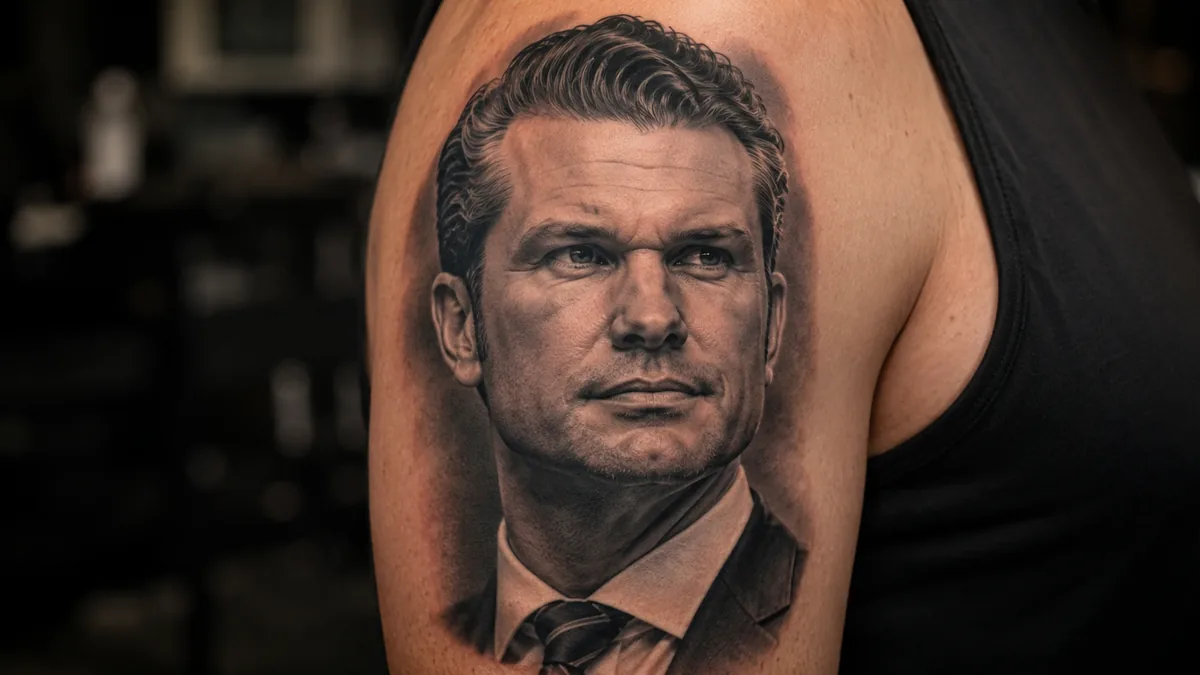
Pete Hegseth, the U.S. Secretary of Defense and former Fox News host, is heavily tattooed. His ink caused a wave of conversation during his confirmation hearings, and for good reason. These aren’t random flash pieces. Every tattoo on his body is part of a deliberate visual statement about faith, military identity, and American patriotism.
If you’re curious about his tattoos because you want similar work, or you just want to know what you’re actually looking at, here’s the straight breakdown. Real symbolism, real history, no spin.
The Jerusalem Cross: Five Wounds, Four Directions
The Jerusalem Cross is the centerpiece of Hegseth’s chest. It’s one large cross surrounded by four smaller crosses in each quadrant. Traditionally, those five crosses represent the five wounds Christ suffered at the crucifixion: hands, feet, and the spear wound to the side. The design doubles as a missionary symbol, the central cross standing for Jerusalem and the four smaller ones pointing outward to spread the Gospel globally.
This cross was also the coat of arms of the medieval Crusader Kingdom of Jerusalem, which is where things get layered. On skin it reads as deep Christian devotion for many wearers. In a political context, especially combined with other Crusader imagery, it signals a more militant Christian identity. Most tattoo artists will tell you this one carries serious visual weight and demands a strong composition to land right.
Deus Vult: The Crusader Battle Cry
The same cross means five wounds of Christ to one man and a call to arms to another.
“Deus Vult” is Latin for “God wills it.” It was the battle cry of the First Crusade, shouted when Pope Urban II called Christian armies to take Jerusalem in 1095. As a tattoo, it expresses the belief that one’s actions are under divine sanction. Hegseth leaned into it heavily in his book “American Crusade” and has always framed it as personal Christian conviction rather than political provocation.
That said, “Deus Vult” has also been adopted in recent years by far-right online communities as shorthand for Christian nationalism or hostility toward Islam. That baggage is real and has nothing to do with what a medieval pilgrim meant by it. If you’re considering this piece, know what you’re putting on your body. The phrase reads differently in a church than it does at a Senate confirmation hearing.
Chi-Rho: The Oldest Christian Monogram
The Chi-Rho is the two Greek letters chi and rho overlaid on each other, forming a symbol that looks like a P with an X crossing through it. These are the first two letters of Christos, Greek for Christ. It’s one of the earliest Christian symbols on record, predating much of what people commonly recognize as church iconography. The Roman Emperor Constantine adopted it as a military emblem after his conversion in the fourth century.
On Hegseth’s arm, the Chi-Rho is a cleaner, more universally understood statement of Christian identity than the Crusader-heavy pieces. Among tattoo collectors with religious ink, this one usually reads as straightforward devotion. It’s a well-tested design, holds beautifully in black and grey, and the bold geometry of those two letters scales from a small forearm piece to a full sleeve anchor.
The Cross, the Sword, and Hebrew Script
Hegseth has a cross pierced by a sword, referencing Matthew 10:34: “I have not come to bring peace, but a sword.” It’s one of the more confrontational verses in the New Testament and Hegseth has cited it directly as the inspiration. Below that imagery he added Hebrew script he describes as meaning “Jesus” in Hebrew, linking the piece explicitly to his faith in Christ.
The Hebrew term “Yeshua” is the actual name Jesus would have been called historically. Some coverage has mixed it with “Yahweh,” the Old Testament name for God, but Hegseth’s intent with the Hebrew addition is clearly Christ-centered. The sword-and-cross combination is a recurring motif in militant Christianity and in military memorial tattoos more broadly. Bold black linework on this one is the move. Fine line won’t hold the drama the composition needs.
We the People, 1775, and the Join or Die Snake
On his forearms, Hegseth carries the opening words of the U.S. Constitution alongside MDCCLXXV, the Roman numeral year 1775, ringed by 13 stars for the original colonies. These are recognizable patriot tattoos. The founding-era aesthetic is hugely popular across American military and veteran communities. 1775 also happens to be the year the Continental Army was established.
The “Join, or Die” segmented snake is Benjamin Franklin’s famous political cartoon from 1754, originally printed to urge colonial unity against the French. It got revived during the Revolution and today it’s a staple of anti-tyranny, libertarian-adjacent American patriotism. As a tattoo, it’s clean, graphic, and immediately readable. That woodcut style translates great in traditional American tattooing: thick outlines, flat fills, serious shelf life.
The Kafir Tattoo: The Most Controversial Piece
This one is real and it’s the piece that drew the sharpest criticism. Photos revealed Arabic script on Hegseth that scholars and Arabic-language experts widely read as “kafir,” a Quranic term for an unbeliever or someone who rejects the Islamic faith. Placed next to “Deus Vult” and a Jerusalem Cross, the combination sent a clear message to Muslim communities and civil rights organizations. Hegseth has not publicly explained this tattoo in detail.
From a purely tattooing perspective, Arabic script is notoriously difficult to execute cleanly on skin. It requires an artist who actually reads the language, because spacing and letterforms degrade badly and meaning can shift. From a symbolism perspective, this is the piece in his collection that most definitively moves beyond personal faith into outward-facing provocation, intentional or not.
Military Unit Pride: Ne Desit Virtus
Hegseth also carries a U.S. Army regimental coat of arms with the Latin motto “Ne Desit Virtus,” meaning “Let valor not fail.” This is the most conventional piece in his collection. Military unit tattoos are a longstanding tradition across all branches. You get the crest of your unit, your regiment, your deployment patch. It’s a badge of belonging, a permanent record of service.
This piece doesn’t carry the ideological freight of the Crusader imagery. It’s a straight military pride tattoo, the kind you see on veterans across the country regardless of politics. If you’re a veteran looking to commemorate service, unit crests work in black and grey or color. Tight detail is key. These pieces age best on flat, low-flex zones like the upper outer arm or the chest.
Placement, Style, and Who Gets These Tattoos
Hegseth’s work is spread across chest, forearms, and upper arms, mostly black and grey with strong linework. Those are smart placement choices for this kind of bold symbolic imagery. Forearms are high-visibility, high-wear zones: ink there fades faster than on the chest or upper arm, so you need a solid artist and good aftercare. His chest piece, the Jerusalem Cross, benefits from a large flat canvas that lets the symmetry breathe.
People drawn to this collection are typically practicing Christians, military veterans, or both. These aren’t casual flash choices. Each piece has a deliberate worldview behind it. If you want to borrow from this visual vocabulary, the Jerusalem Cross, Chi-Rho, and unit crest are understood in most contexts as faith and service. The Crusader slogans and the kafir piece carry associations that extend beyond personal devotion. Know the full read before you sit in the chair.









