Guardian lions, also called foo dogs or shi, are one of the oldest protective symbols in human iconography. On skin, they mean exactly what they’ve always meant: you’re putting a sentinel on your body. Protection, strength, ferocity in service of something worth defending.
People get guardian lion tattoos because the symbolism is legit. This isn’t trend ink. These creatures have stood at the gates of temples, palaces, and tombs across Asia for over two thousand years. That weight carries over when you put one on your arm.
What a Guardian Lion Tattoo Actually Means
The core meaning is protection. Guardian lions are threshold guardians. They stand at entrances and ward off evil, bad luck, and negative energy before it can cross. In tattoo culture, that translates directly: you’re marking yourself as someone who protects, or someone who is protected. A lot of people get them after hard periods in their life, like a statement that nothing’s getting through again.
Strength is the second pillar. These aren’t decorative cats. They’re ferocious, powerful, and deliberately intimidating. They also carry courage and authority. In many traditions the lion, especially the male with the ball, represents the world and dominance over it. The female with the cub represents nurturing and protection of family. That pairing is popular in matching sets for a reason.
The Real History Behind the Symbol
The lion does not roar for show, it stands so nothing gets through.
Guardian lions originated in China, where they’re called shishi or shi, and spread across East and Southeast Asia along trade and Buddhist pilgrimage routes. The design was actually influenced by real lions imported as gifts to Chinese emperors from Central Asia and Persia. Chinese artists had never seen a lion in person, so they stylized it heavily. That’s why foo dogs look like they do: part lion, part dog, part myth.
The Buddhist connection matters. Guardian lions were placed at temple gates to protect sacred spaces from evil spirits. That religious layer isn’t incidental. It’s baked into the symbol. When you see them at the entrance of a Chinese restaurant or a Japanese shrine, they’re doing the same job they’ve always done. Your tattoo carries that lineage whether you intend it to or not.
Japanese Komainu vs Chinese Foo Dog: Same Idea, Different Look
Both are guardian lions, but they read differently on skin. Chinese foo dogs tend to be rounder, more stylized, with curly manes and a toy-like heaviness to the form. They come from Chinese folk art and temple sculpture. Japanese komainu are leaner, more angular, sometimes more wolf-like. One has its mouth open, one closed. The open mouth is said to be pronouncing ‘A’, the closed one ‘UN’, together forming ‘AUM’, the sound of the universe.
For tattoo purposes, the distinction gives you options. Chinese foo dogs work great in traditional American or neo-traditional styles because the bold, rounded shapes hold ink well and read from across the room. Japanese komainu fit naturally into Japanese traditional tattooing, with thick outlines, flat color, and that classic style composition. Know which one you’re getting, because they carry slightly different visual language.
Style Variations That Actually Work on Skin
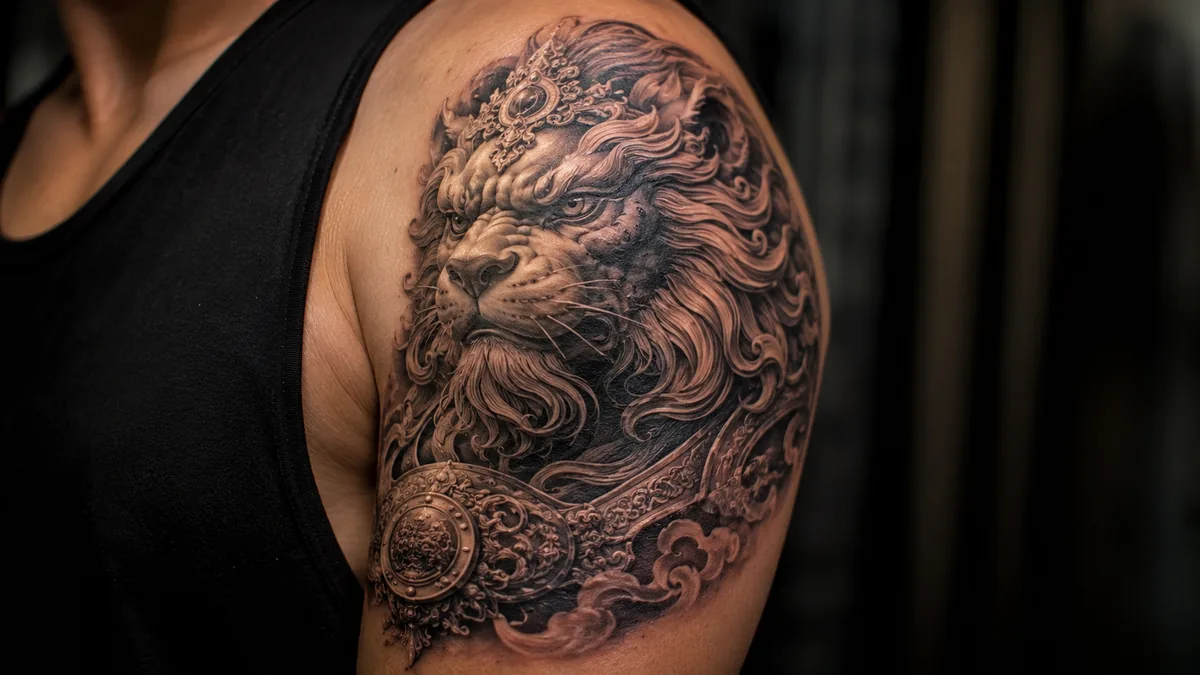
Black and grey is probably the most popular execution right now. A solid black and grey guardian lion with smooth whip shade on the mane and deep contrast in the face looks sharp and ages well. The linework does the heavy lifting. You want crispy, confident lines on the face and body, then the shading can build dimension behind it. Fine line versions exist but push them too delicate and the detail blurs out over time. Bold will hold.
Traditional American guardian lions lean into the symbolic weight with saturated color, thick outlines, and that flat, graphic quality that reads strong at ten feet. Neo-traditional gives you more painterly detail while keeping the outline structure. Realism can be stunning but requires a skilled hand and a large enough canvas to keep the facial detail from mudding up as it heals. Whatever style, the face is everything. Get a strong, expressive face and the piece works.
Color vs Black and Grey
Color guardian lions look powerful when done right. Gold and red is a classic combination pulled straight from traditional Chinese temple sculpture. Gold for prosperity and imperial power, red for luck and protection. Some clients go with a full palette: green mane, red detailing, gold body. It pops. The trade-off is that saturated color needs touch-ups over time, especially on high-wear zones like the forearm or hand.
Black and grey is more forgiving long-term and suits a wider range of skin tones. It also photographs better in most lighting, which matters for portfolio pieces. A dark, dramatic guardian lion in black and grey with strong contrast can outlast a color version on the same body placement by years without looking faded. If you’re committed to color, keep the palette tight. Two or three colors max. More than that and the piece gets muddy as it heals and settles.
Best Placements and How They Age
Guardian lions need space. They have detail in the face, mane, body, and base that gets lost when you squeeze them small. Thigh, upper arm, chest, back, and calf are ideal. The thigh gives you the most real estate and is relatively low on the pain scale. Upper arm reads well and stays visible. The chest works great for a single guardian lion centered or off to one side. A matching pair on the shins or forearms is a strong composition.
Avoid putting a detailed guardian lion anywhere that gets serious wear: hands, fingers, feet, inner wrists. The ink will blow out faster and the fine detail won’t survive. Inner bicep and ribs are spicy but the skin holds ink well there. Placement on the back of the calf is low-wear and heals nice. If you want matching foo dogs framing something, thighs or upper arms are your best bet for longevity. A good placement choice matters as much as good linework.
Who Gets Guardian Lion Tattoos and How to Make Yours Personal
People who get guardian lion tattoos are usually drawn to the protection angle first. Parents protecting their kids. People who’ve survived something rough and want a permanent marker of that toughness. Martial artists. People with a connection to East Asian culture, either by heritage or genuine interest in the tradition. And plenty of people who just find the imagery powerful and want a piece that carries real symbolic weight, not just aesthetic.
Personalization comes through the details. You can incorporate specific cultural elements, like a Japanese-style piece with chrysanthemums and waves, or a Chinese-style piece with clouds and flames. Some clients add names or dates at the base. The expression on the lion’s face matters: you can push it toward fierce, regal, or even serene depending on what the piece means to you. Bring reference, talk to your artist about what resonates, and let the design develop from there rather than copying flash off a wall.