
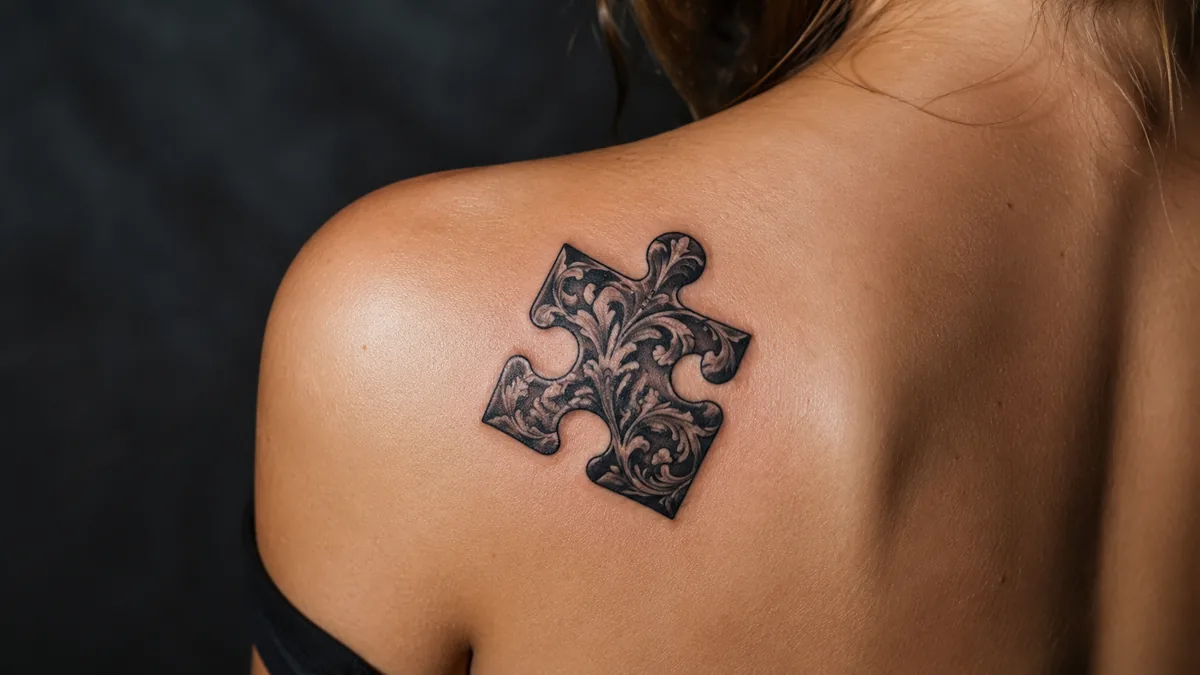
The puzzle piece tattoo carries more weight than most people expect. At its core it’s about connection, missing pieces, and belonging. Whether someone wears it for autism awareness, to honor a lost person, or to represent finding their place in the world, the meaning is personal and the imagery is instantly readable.
It’s a deceptively simple design. One interlocking piece, clean geometric edges, reads bold from across the room. But the story behind it depends entirely on who’s wearing it and why. Here’s what people actually mean by this tattoo, and how to make it hit right on skin.
The Core Symbolism: What a Puzzle Piece Actually Represents
The most universal reading is incompleteness and connection. A single puzzle piece suggests something is missing, or that you yourself are the missing piece someone else needed. It’s about fitting together with people, places, or purpose. That resonates with a huge range of people, which is why this design crosses demographics and age groups without losing its meaning.
A completed puzzle section, or two interlocking pieces, shifts the meaning toward unity and partnership. Couples, best friends, and siblings get matching sets where each person holds one piece. Apart they’re incomplete, together they lock in. That’s not a cliche reading, that’s exactly what the image communicates, and it does it without a single word.
Autism Awareness: The Most Recognized Cultural Meaning
One piece does not complete a puzzle, but it still belongs.
Since the 1990s the puzzle piece has been the primary symbol of autism awareness, originating with the Autism Society of America and later Autism Speaks. The imagery was chosen to reflect the complexity and mystery of autism spectrum disorder. A lot of parents, siblings, educators, and autistic individuals themselves have adopted the puzzle piece tattoo as a permanent statement of support and identity.
It’s worth knowing that some autistic self-advocates have pushed back on the puzzle piece symbol over the years, preferring the gold infinity loop as a neurodiversity symbol instead. That conversation is real, and clients who want an autism tattoo sometimes ask about it. As their artist, knowing that context lets you have an honest conversation so they get exactly what they mean to wear.
Loss and Grief: Wearing the Missing Piece
One of the most emotionally heavy uses of this tattoo is grief. When someone loses a person who felt irreplaceable, a puzzle piece says what words don’t cover cleanly. The single missing piece communicates a permanent gap. People get this for lost children, parents, partners, close friends. Sometimes combined with a name, a date, or a small portrait inset into the piece itself.
The grief reading works best in black and grey. Soft whip shading inside the piece, clean solid outline, maybe a subtle drop shadow. Fine line can work for minimalist clients but the design needs enough size to hold detail over time. A piece that’s too small in a high-wear zone will soften and lose its emotional clarity within a few years.
Design Variations: From Minimalist to Bold
On the simpler end you’ve got a clean black outline, single piece, no fill. That reads crispy in fine line and ages reasonably well if placed smart. Mid-range is a solid filled piece with geometric precision, sometimes with a subtle texture or pattern inside, watercolor splashes, or a flag design layered in. Bold traditional-style puzzle pieces with thick black outlines and saturated color are workhorses. They hold. They read from across the room. Ten years later they still look intentional.
On the illustrative or neo-trad side artists incorporate puzzle pieces into larger compositions, a heart breaking apart into puzzle pieces, a portrait where part of the face is a puzzle, a landscape where a section is lifted out. These are strong concepts but they need a skilled hand and enough real estate on the body to execute properly. Don’t squeeze a complex composition into a two-inch space and expect it to stay clean.
Color vs. Black and Grey
Color puzzle piece tattoos are common, especially for autism awareness pieces where the traditional imagery uses a multicolor jigsaw pattern. Saturated primaries, a rainbow arrangement of pieces, or a single piece in vivid blue all carry that awareness association clearly. Color work here benefits from a bold black outline to anchor each color block and prevent muddiness as the piece heals and settles.
Black and grey is the better call for grief pieces, minimalist concepts, or fine line work. A well-executed black and grey puzzle piece with tight whip shading has a timeless quality. It photographs well, heals clean on most skin tones, and doesn’t compete visually with surrounding tattoos. If a client is unsure, black and grey is almost always the safer long-term choice on a design this geometric.
Placement: Where It Works and Where It Ages Out
Forearm, upper arm, shoulder, and calf are all solid placements. Low-wear zones, stable skin, good visibility if the client wants it shown. The forearm is probably the most common spot for this design because clients want to see it themselves and show it easily. A piece the size of a quarter or larger holds fine there for years. Clean lines stay crispy, solid fills don’t fade into the background.
Hands, fingers, and inner wrists are high-wear and honestly spicy for a geometric piece. Finger tattoos blur fast, the outlines spread, and that precise interlocking edge turns soft. Ribs and sternum are spicy pain-wise but they give you great real estate for larger compositions. Avoid placing a tiny puzzle piece in a spot with a lot of friction or sun exposure if the client wants it to stay sharp long-term. Bold will hold. Fine lines in soft crease areas will not.
Who Gets This Tattoo and How to Make It Yours
Parents of autistic kids get this constantly. Partners who met at the right moment. People coming out of a dark period who finally feel like they found where they belong. People tattooing a tribute to someone gone. It spans a wide range of clients because the core idea, that we are incomplete alone and whole together, is nearly universal.
To make it personal, bring in a specific element inside the piece. A birth flower, a small constellation, a meaningful date in Roman numerals, a texture that references something specific to your story. Or go the opposite direction and keep it stark and simple. A single clean outline with no fill reads confident and deliberate. Tell your artist the story first. A good artist will build the right design around the meaning, not the other way around.









