
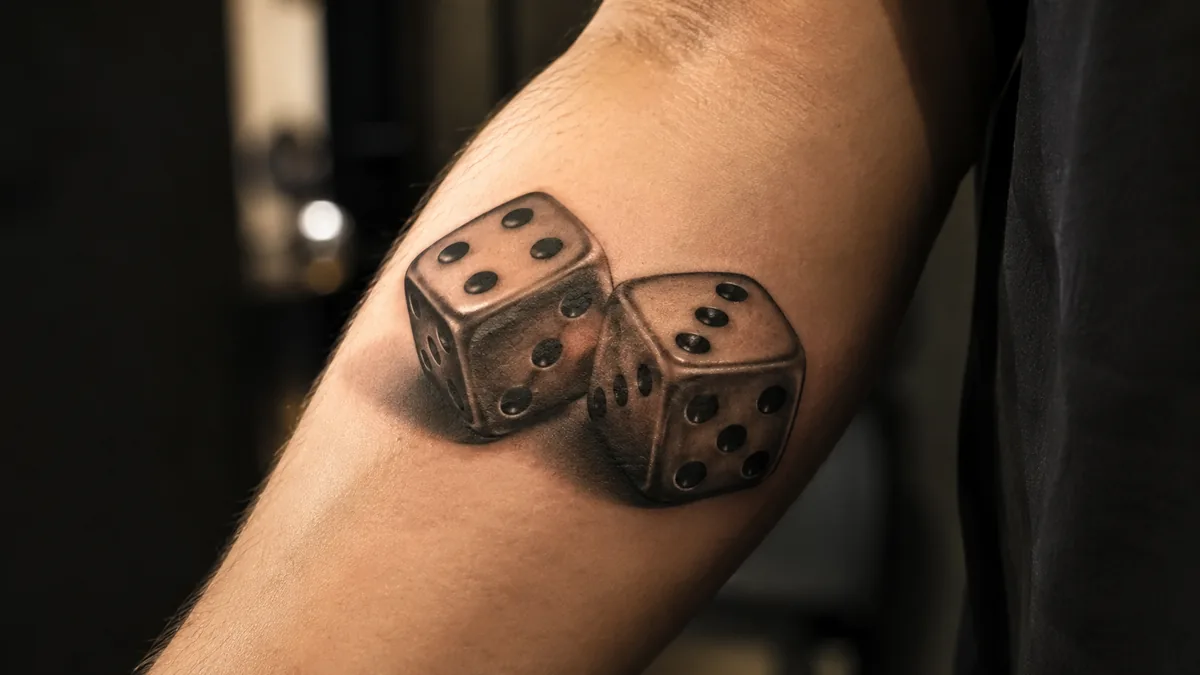
Dice tattoos have been a staple in American traditional tattooing for over a century. They’re compact, bold, and loaded with meaning, which is exactly why they keep showing up on skin decade after decade.
At their core, dice are about chance. Rolling them means you’re at the mercy of fate, or you’re the kind of person who leans into that. Depending on the details in the design, a dice tattoo can read as luck, rebellion, addiction, or pure swagger.
The Core Symbolism: Luck, Risk, and Fate
Dice represent chance. That’s the foundation. When you roll them, the outcome is out of your hands, and a lot of people connect with that idea on a personal level. It’s a reminder that life doesn’t always go the way you planned, and sometimes you just have to roll and see what happens. For some wearers it reads as acceptance of uncertainty. For others it’s straight-up bravado.
The symbolism shifts based on what numbers are showing. Snake eyes, two ones, traditionally means bad luck or a rough outcome. Boxcars, double sixes, is tied to winning and fortune. Lucky seven, a one and a six together, is probably the most optimistic reading in the whole dice tattoo vocabulary. The number you lock into the design tells half the story.
Historical Roots in American Traditional Tattooing
You're not just tattooing dice. You're tattooing your relationship with risk.
Dice tattoos are deeply rooted in American traditional tattooing, the bold-outline, primary-color style popularized by sailors and soldiers in the early twentieth century. Flash sheets from that era are packed with dice, playing cards, horseshoes, and four-leaf clovers, all part of a tight visual vocabulary around gambling, luck, and tempting fate. Sailors carried these symbols like talismans.
The gambling imagery made sense for people living high-risk lives, guys shipping out not knowing if they’d come back, or workers blowing their wages at card tables. Dice fit right into that mindset. They’re small enough to tattoo anywhere on the body and iconic enough to read instantly. That simplicity is why the image has stayed relevant through every tattoo trend since.
Gambling Culture and the Live Fast Reading
A lot of people get dice tattoos as a direct nod to gambling culture, and they’re not hiding it. Card players, casino regulars, poker lifers, they wear dice to own that part of their identity. Paired with playing cards, chips, or a roulette wheel, the meaning gets even more specific. It’s a lifestyle tattoo in the truest sense.
There’s also a harder reading that shows up in prison tattoo traditions. Dice paired with certain other symbols have historically been used to represent an addiction to gambling or a reckless lifestyle. Some people get it knowing that history, using it to mark a chapter they’ve moved through. Others are just pulling from the aesthetic without the backstory. Both are valid, but know what you’re wearing.
Design Variations: Classic Cubes to Loaded Dice
The classic version is two three-dimensional cubes rendered in American traditional style, thick black outlines, solid fills, simple shading that reads clean from a distance. That design is timeless and heals well. You can do a single die for a cleaner, minimal look. Flames off the sides, a skull replacing one face, or wings attached to the cube are all common add-ons that push the meaning toward danger or freedom.
Loaded dice, ones showing impossible numbers or stacked to imply cheating, carry a specific meaning: bending the rules, playing the game on your own terms. Fine line dice in black and grey have gotten popular on forearms and hands because the detail work on the pips and cube faces looks crispy in that style. New school renditions blow the scale up and add bold color gradients that pop hard.
Color vs. Black and Grey: What Works on Skin
American traditional dice in red, black, and white are the most durable version of this design. Bold will hold, and high-contrast work ages well even on high-wear zones like hands and fingers. Saturated reds and blacks lock into skin and stay readable after years of sun and friction. If you want something that looks just as good in twenty years, go traditional with thick lines and solid fill.
Black and grey dice with whip shading give a more realistic, three-dimensional look. Fine line versions are clean right after the session but blowout fast on fingers. Delicate linework on hands fades faster than anywhere else. If you’re going fine line, keep it on the inner arm or ribs where it’s protected. Your artist isn’t trying to talk you out of anything, just being straight with you about how it holds.
Placement: Where Dice Tattoos Actually Work
Dice are naturally compact, which makes them flexible for placement. The hand and fingers are the most popular spots, especially the back of the hand or knuckles. That placement leans fully into the gambling and risk identity. High-wear areas fade faster than most. It’s a bold call, and that’s kind of the point of getting dice there in the first place.
For longevity, the forearm, upper arm, calf, and chest are all solid choices. Lower-wear, lower-sun zones keep the design crisp longer. If you’re going detailed, a larger piece on the upper arm gives your artist room to work the shading properly. Ribs are spicy pain-wise but the skin holds ink well there. Avoid putting fine-line dice on the palm or outer fingers unless you’re ready to come back for touch-ups every couple of years.
Who Gets Dice Tattoos and How to Make Yours Personal
Gamblers, risk-takers, people who’ve made peace with uncertainty, and old-school collectors are the core audience. But dice tattoos also show up on people marking a turning point, a bet they made on themselves, a decision to start over. The rolling dice image works as a life metaphor without being heavy-handed about it. That versatility keeps it broad enough that almost anyone can wear it honestly.
To make yours personal, lock in a specific number combo that means something, a birthday, an anniversary, or a number tied to a real moment in your life. Add a banner with a word or short phrase, or integrate it into a larger sleeve alongside imagery that fills in the story. Talk to your artist about composition before committing to size and placement. A well-planned dice tattoo at three inches reads better than a cramped one at one inch trying to hold too much detail.









