
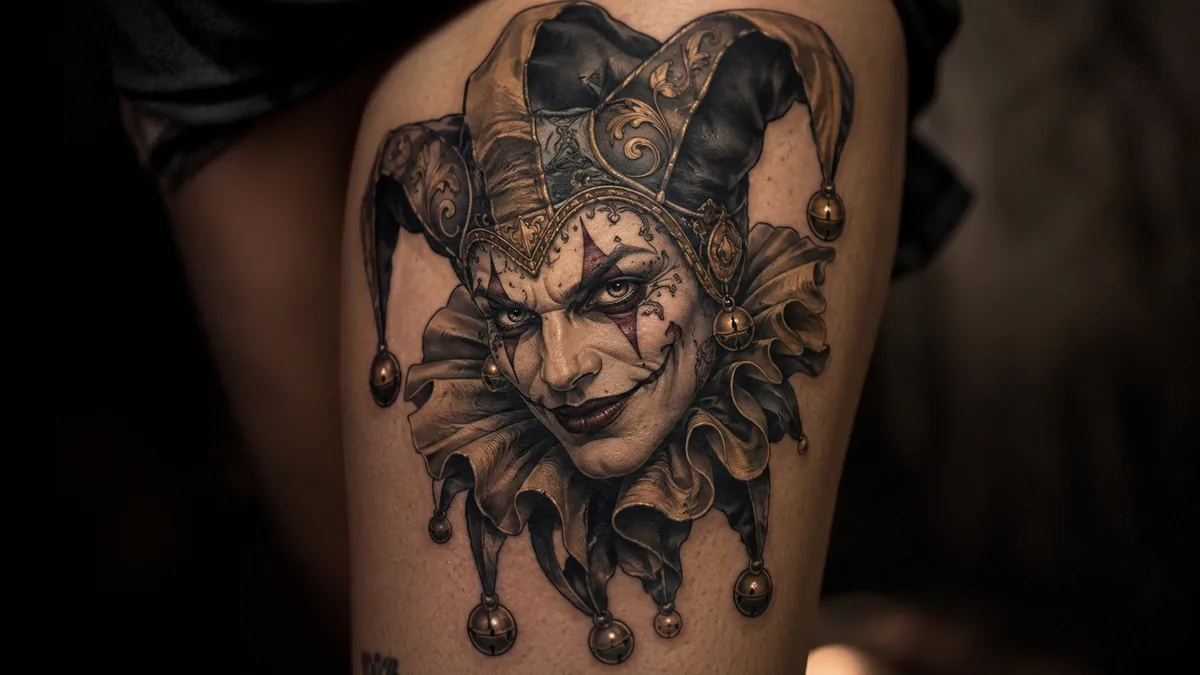
The jester tattoo is one of those pieces that carries a lot more weight than its smiling face suggests. it’s about duality. The jester laughs, sure, but that laugh has always been a mask over something sharper.
If you’re drawn to the classic court fool, a laughing-crying split face, or a more sinister interpretation, the meaning runs deep. This isn’t a novelty piece. It’s a tattoo with real symbolism that’s been around long enough to earn its place in the tradition.
Core Meaning: Duality and the Mask We Wear
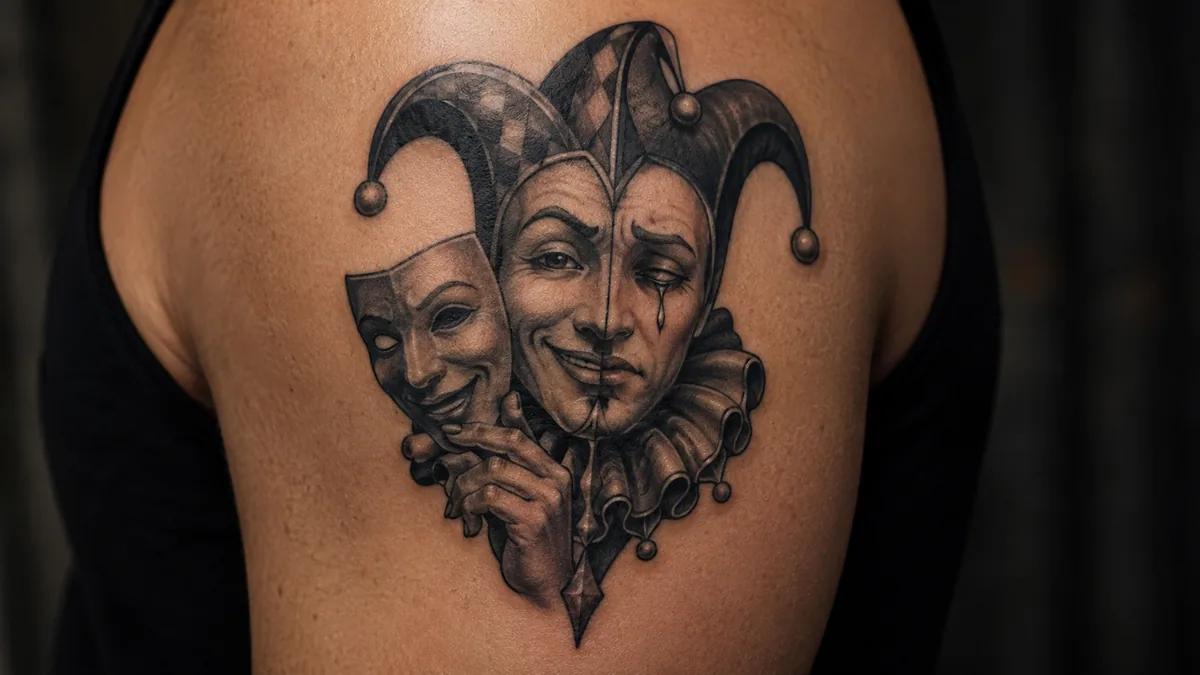
The most recognized meaning of the jester tattoo is duality. Happy on one side, sad on the other. Laughing in public, hurting in private. That split-face design has become a shorthand for the gap between what people show the world and what they actually feel. It’s honest in a way that a lot of tattoos aren’t.
A lot of clients who get this piece have been through something. They’ve learned to perform normalcy while carrying real weight underneath. The jester doesn’t pretend that conflict doesn’t exist. It wears both faces at once. That’s the pull. It’s not weakness. It’s awareness.
Historical Roots: The Court Jester’s Real Role
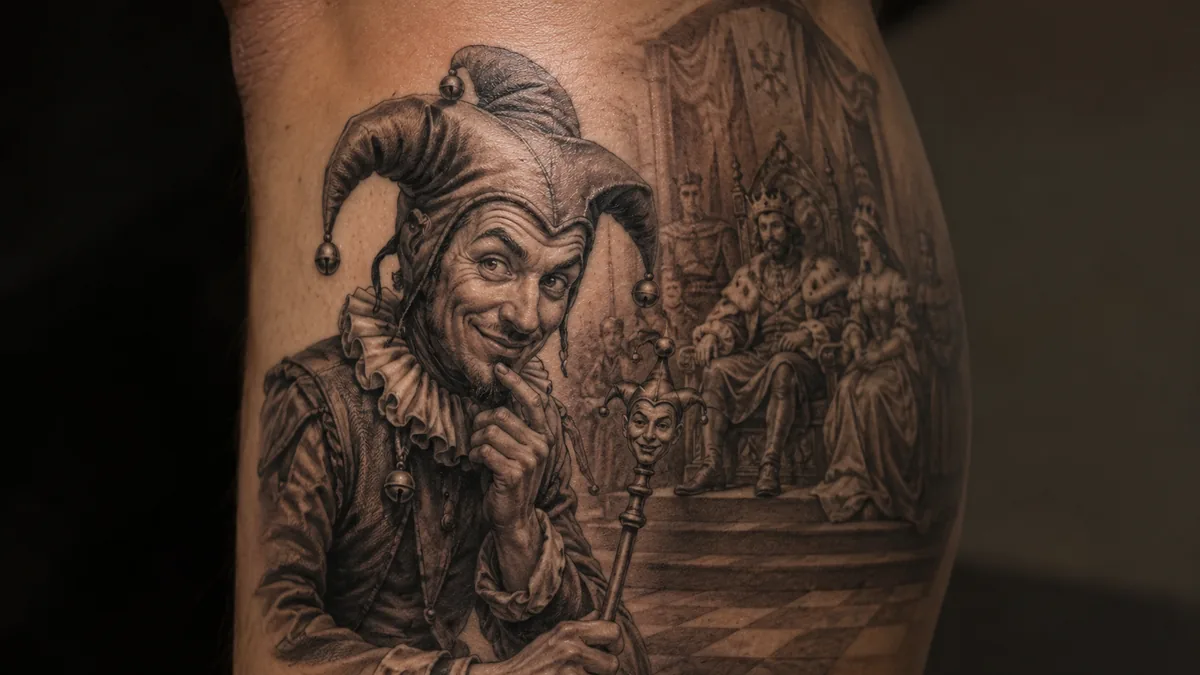
The fool laughs loudest at the truths no one else dares say.
The court jester was a real figure in medieval European culture, employed by royalty from roughly the 11th century onward. The job looked like entertainment, but the actual role was more subversive. Jesters were often the only people permitted to mock the king openly without losing their heads. That gave the figure a unique position: simultaneously powerless and untouchable.
That history matters for the tattoo. A jester piece can represent the person who speaks uncomfortable truths under cover of humor. The fool who isn’t foolish at all. This is a historically accurate reading, not something invented by tattoo culture. It gives the piece a legitimate backbone beyond just aesthetics.
Chaos, Trickery, and Living by Your Own Rules
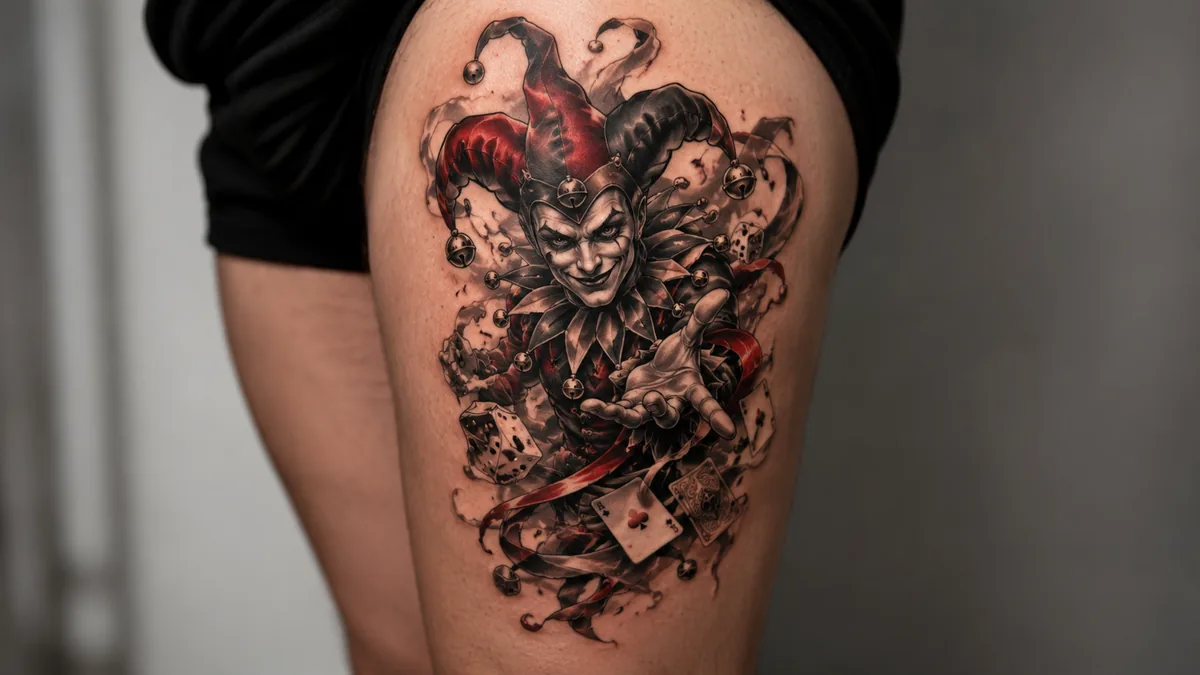
Beyond duality, the jester represents chaos and the rejection of rigid social order. The jester breaks rules, bends expectations, and operates outside the normal hierarchy. For someone who identifies as a free spirit, a rebel, or someone who has always colored outside the lines, this is a strong symbol to carry permanently.
This reading connects to figures like the Joker in a traditional card deck, the Trickster archetype found across world mythologies, and characters like Loki in Norse tradition. None of these are purely evil or purely good. They’re agents of disruption. If that resonates, the jester translates that energy into ink.
Design Variations: From Traditional to Neo-Trad to Dark
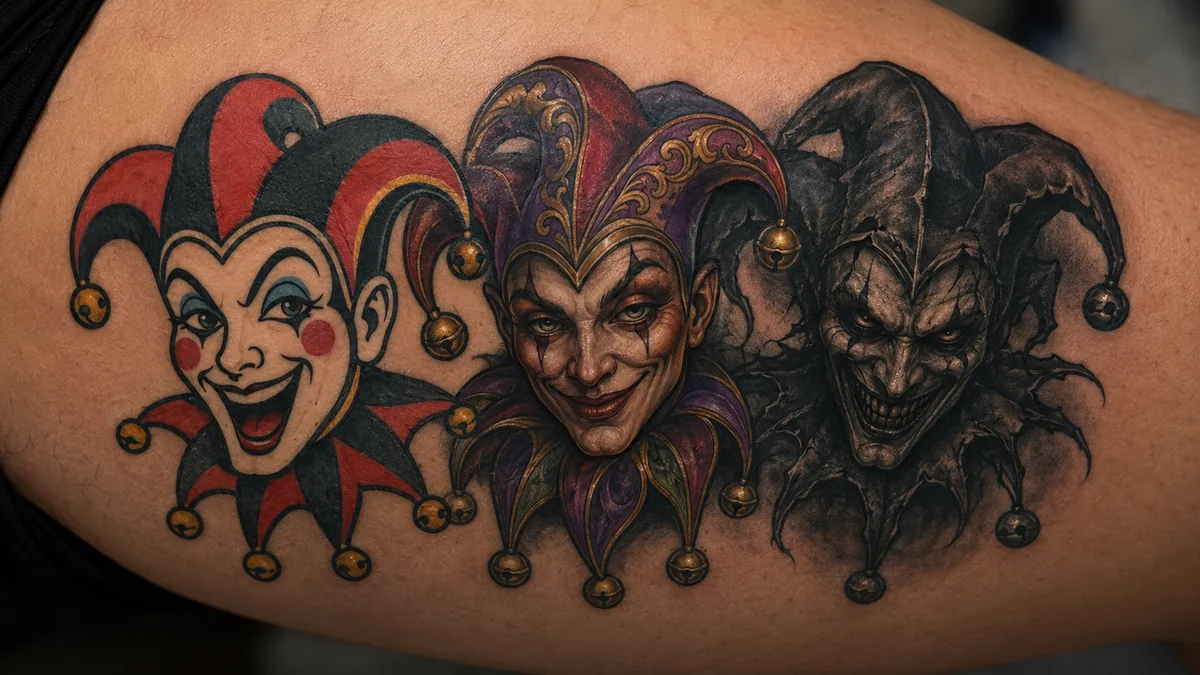
The range on jester tattoos is wide. American traditional jesters are bold, clean, and graphic. Thick outlines, flat color fields, solid black. They read from across the room and they hold up for decades. Neo-traditional versions add more linework detail, texture in the hat bells, and richer color gradients while keeping that readable quality. Both styles are strong long-term bets.
On the darker end, black and grey realism jesters lean sinister. Hollow eyes, sharp teeth, shadowed faces. Fine line versions can capture a delicate, almost vintage playing-card quality. Geometric or illustrative styles have gained ground too. The design variation you choose shifts the tone significantly, so it’s worth being honest with yourself and your artist about what emotional register you actually want.
Color vs. Black and Grey
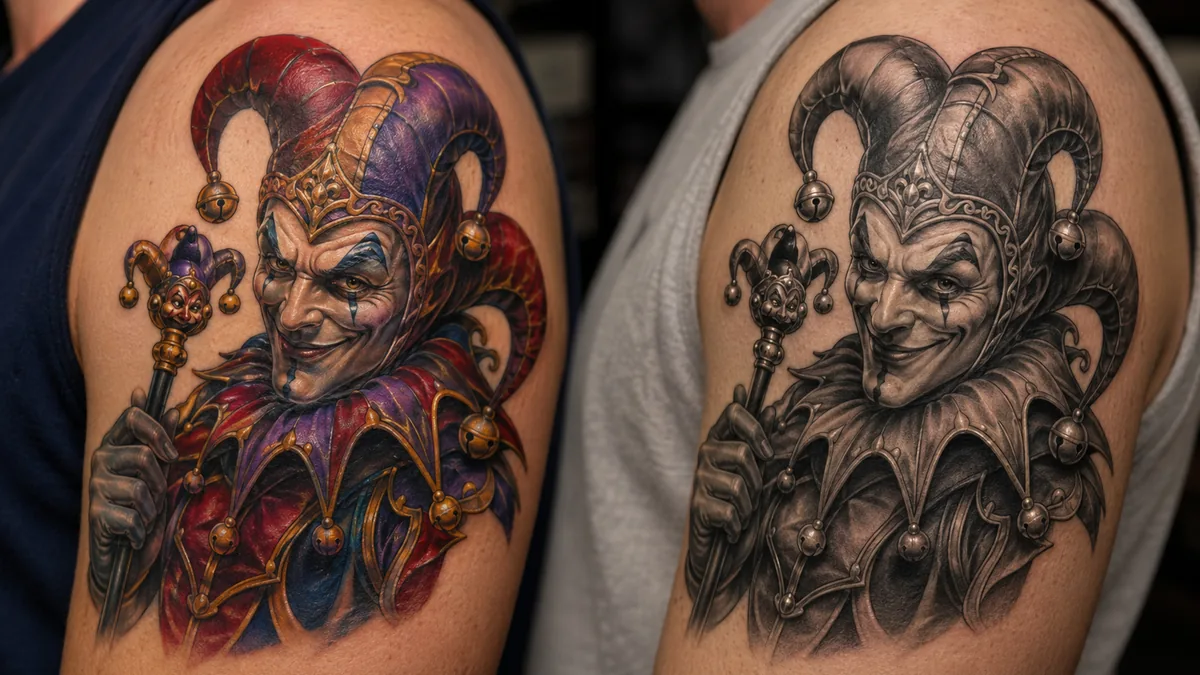
Color jesters, especially in traditional or neo-trad, pop hard. Saturated reds, purples, and yellows against bold black outlines give the piece a timeless quality. Color shows the theatrical side of the symbol, the showmanship, the performance. It reads festive even when the underlying meaning is heavy.
Black and grey pulls the piece toward shadow and introspection. A well-executed black and grey jester with smooth whip shading and clean transitions reads quieter but hits just as hard emotionally. It tends to suit clients who identify more with the melancholy reading than the theatrical one. Both hold well over time when done correctly. Neither is the wrong call.
Placement and How It Ages
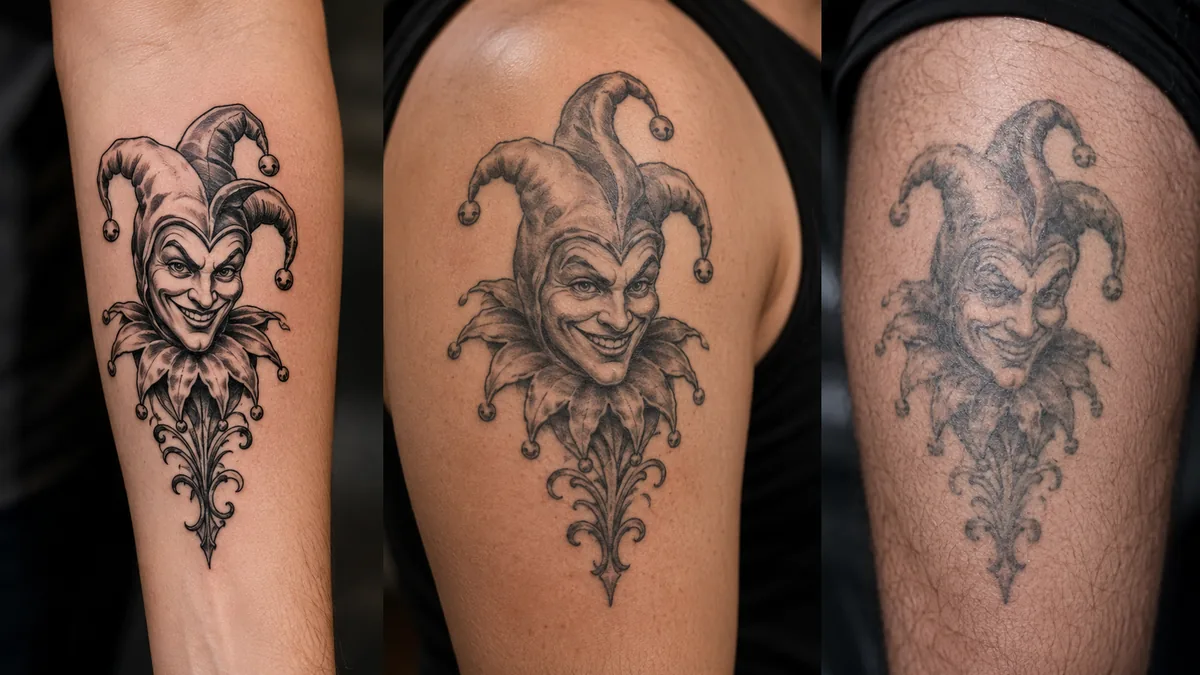
The upper arm, thigh, and calf are all solid placements for a jester. These are lower-wear zones, and the jester’s detail work, especially the face, hat, and bells, survives well on relatively flat skin with good surface area. A jester designed for the thigh can go large, which gives your artist room to get precise on the face without cramming the linework. Faces done small on high-wear zones blur faster.
Ribcage and sternum placements are popular and look great fresh, but fair warning, those zones are spicy and the skin moves a lot over time. Hand, finger, and foot placements are risky for fine-line jester detail. Blowout and fading hit harder in those spots. If you want a jester that stays crispy ten years from now, pick a stable zone and let your artist size it appropriately.
Who Gets This Tattoo and How to Make It Personal
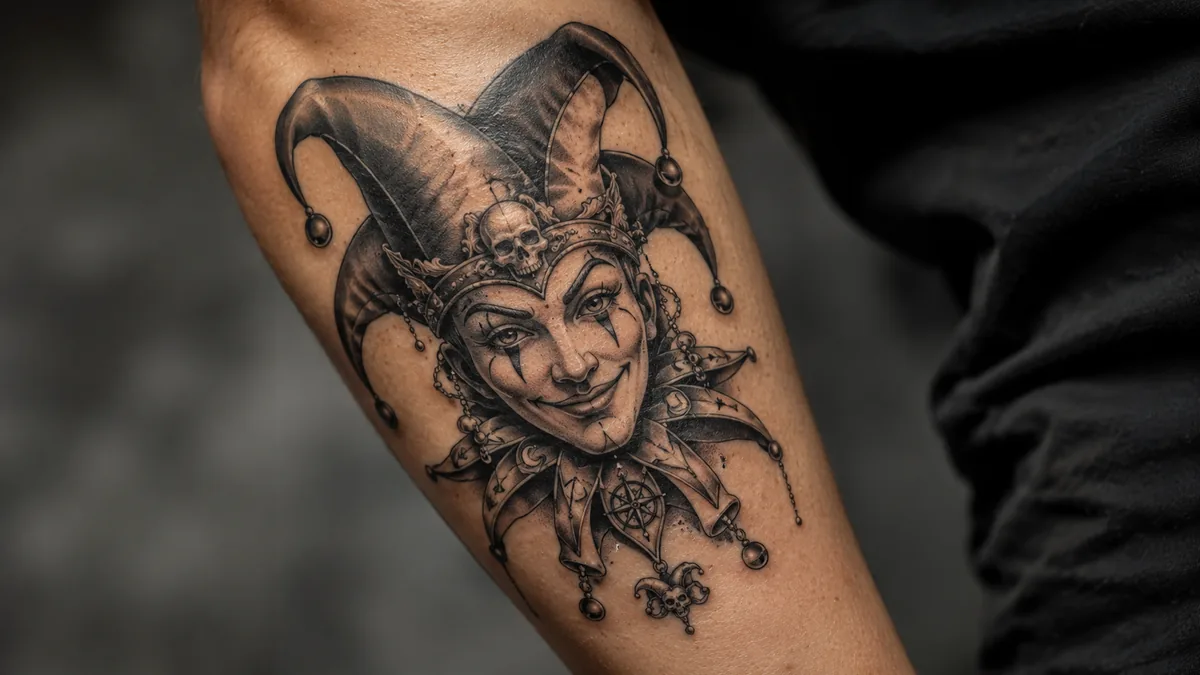
Jester tattoos attract people who have lived some complexity. Performers, comedians, artists. People who have been told they’re too much or not enough. People who cope with dark periods through humor. People who have worn a mask long enough that they want the truth of that on their skin permanently. It’s also popular in the tattoo collector community just for its deep roots in classic iconography.
Making it personal comes down to specifics. What face does your jester have? Is it your face? A loved one’s? Does the hat have initials in the bells? Do the expressions split evenly or tip toward one emotion? Adding a specific date, name, or symbol inside the design ties the broader meaning to your actual story. A good artist will help you build that in without cluttering the read of the piece.









