
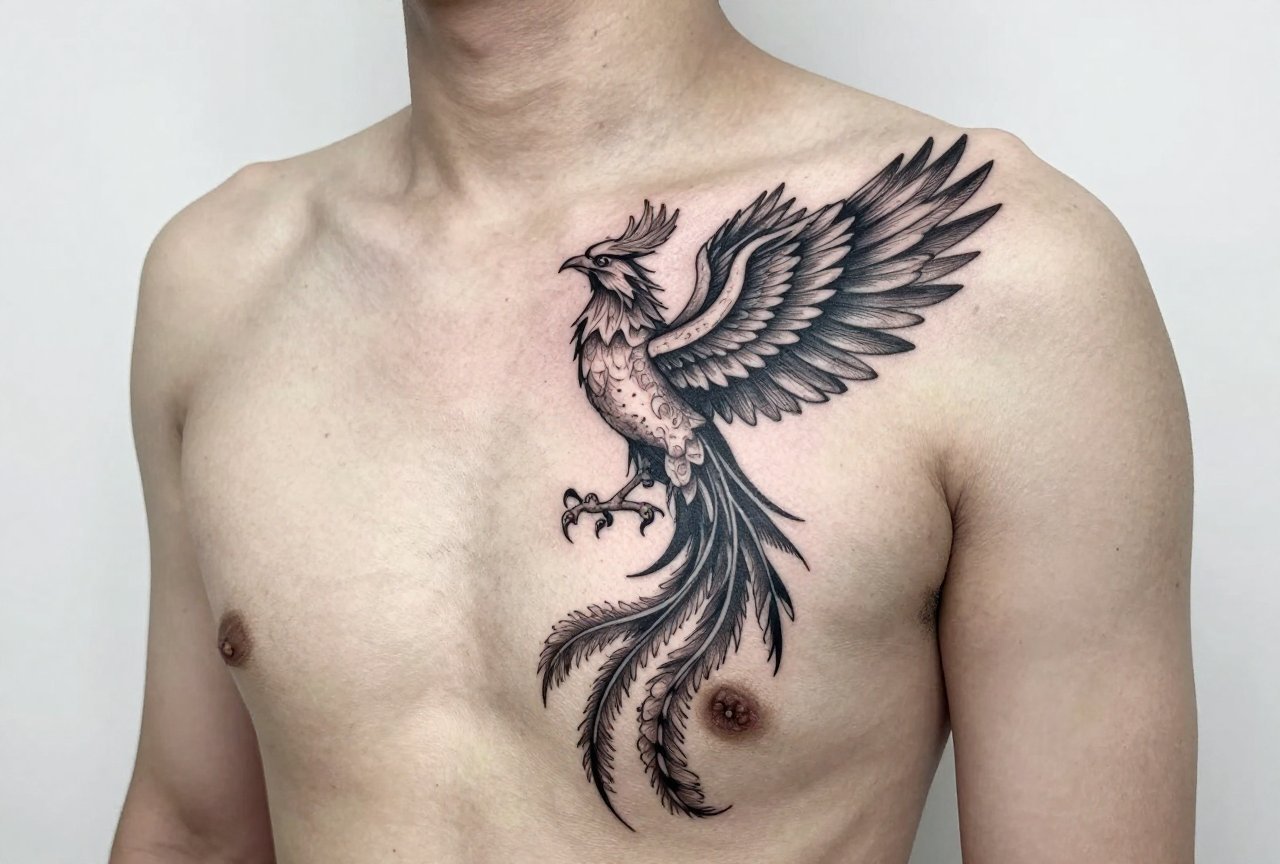
I’ve tattooed phoenixes on construction workers, software engineers, and a guy who swore his bird had to be rising from a Ford Mustang. The phoenix hits different for men, it’s not just rebirth, it’s the kind of rebirth that leaves scars. In my chair, I see this design requested by guys going through divorce, career pivots, or just that restless feeling at 3 AM. Here’s what actually works, what ages well, and where artists roll their eyes behind your back.
Popular Styles That Hold Up
Not every phoenix ages like the legend itself. I’ve watched fine-line birds blur into chicken soup in five years. Here’s what we actually execute in shops that still looks intentional a decade out.
Neo-Traditional
Heavy black outlines, saturated reds and oranges, stylized feathers that read clearly from ten feet. This is my go-to recommendation for guys who want something bold without going full Japanese sleeve. The line weight carries the design as skin changes, I’ve seen neo-trad phoenixes on dudes in their fifties that still pop. The drawback? It eats skin real estate. A proper neo-trad chest piece needs serious space to breathe.
Black and Grey Realism
Feather texture that looks like you could pluck it. Smoke rendered in soft grey wash. This style demands a specialist, I’ve referred clients out when they want photoreal birds and I’m not the guy that day. The healing is trickier too. Those subtle grey tones can heal patchy if you don’t stay out of the gym for two weeks. I tell clients: this is a Rolls Royce, not a daily driver. High maintenance, high reward.
- Japanese/Irezumi: Flowing composition, wind bars, often paired with cherry blossoms or waves. Lives best on arms and legs where the body movement sells the motion.
- Tribal/Blackwork Fusion: The “tribal phoenix” of the 90s evolved. Modern versions use negative space and geometric patterns inside the silhouette. Good for guys who want the symbol without the cartoon.
- Sketch/Etching Style: Crosshatching, raw lines, looks like a Da Vinci study. Trendy now, but I’ve warned clients, this style has a five-year expiration date on skin before it looks like a smudged pencil drawing.
Design Ideas That Mean Something
“I want a phoenix” is where the conversation starts, not ends. The guys who sit longest and happiest in my chair arrive with a story, not a Pinterest board.
The Asymmetrical Rise
Most phoenix designs show the bird centered, wings spread like a mugshot. I love the off-center composition, bird emerging from the lower left, flames trailing to upper right, negative space doing half the work. It feels less “tattoo parlor flash” and more personal narrative. One client, a firefighter who got burned on the job, wanted the bird leaving the fire behind, not centered in it. That asymmetry told his story.
Deconstructed Elements
Not every phoenix needs the full bird. I’ve done just the wing span across a shoulder blade, the tail feathers wrapping a forearm like a sleeve anchor, the eye alone on a sternum. These fragment designs work for guys who want the symbolism without the billboard. A single burning feather can reference the whole myth. Subtle reads confident.
- Phoenix with clock/compass: Time and direction, the “where I’m going” narrative. Common but effective when the artist integrates rather than stacks elements.
- Phoenix and serpent: The cyclical opposition, life and death entwined. Heavy symbolism, needs an artist who understands composition weight.
- Minimalist silhouette: Just the profile, clean black fill. Surprisingly versatile for smaller placements, though I warn: tiny silhouettes can blob over time.
Best Placements for Male Builds
Where you put it changes what the design can do. I’ve had to talk guys down from full back pieces when a chest or thigh would serve the story better.
Chest/pec: The classic. Wings spread across both pecs, heart center as the fire source. Works with muscle movement, when you flex, the bird seems to breathe. I’ve done this on gym rats and skinny guys alike; the design adapts to the canvas. One caveat: chest hair. If you’re furry, expect to trim or lose detail in the flames.
Upper arm/shoulder cap: The “starter” placement that doesn’t look like a starter. Wraps well, extends to full sleeve later. The shoulder cap specifically lets the bird face forward while the tail trails down the deltoid. I place a lot of phoenixes here for guys in corporate jobs, coverable, but personal.
Thigh: Underrated. Massive canvas, less bone pain, heals cleaner than lower leg. The muscle movement is different though, walking doesn’t animate the design like a chest piece. Good for detailed realism where you need flat, stable skin during the session and healing.
Forearm: Visible, vulnerable, committed. I ask forearm clients: “You ready to explain this at every job interview?” The phoenix works here when it’s confident, not apologetic. Sleeve-style wrapping with the tail coiling toward the wrist reads strongest.
Back: Full canvas, but I see too many centered, symmetrical back pieces that look like target practice. The best back phoenixes use the spine as a flame column, asymmetrical wings using the scapula movement. Takes 20+ hours, multiple sessions, serious commitment.
Color Choices: What Fades and What Stays
Red is the phoenix color, but red is also the first to leave the party. In my experience, after five years of sun and skin turnover, that fiery crimson goes pink, then peach, then weird skin-tone.
The Warm Palette Reality
Orange holds better than red. Yellow disappears fastest unless it’s packed dense. I steer clients toward deeper crimsons bordering burgundy, orange-amber cores, and heavy black contrast to define the shapes as color mutes. The black outline is your insurance policy, when the red goes soft, the structure still reads.
Black and Grey Endurance
Zero color maintenance, ages like a black and white photograph. The tradeoff is emotional impact, fire reads differently in grey wash. I tell clients: if your story is about the burning, consider color. If it’s about what came after, black and grey carries that quieter weight.
- White ink highlights: I use these sparingly. Heals to skin-tone or yellowish, never that bright pop you see in fresh photos. Good for feather texture accents, not core elements.
- Blue/purple flames: Trending on Instagram, rare in real shops. The cool palette against warm bird creates visual tension, but purple fades to muddy grey. Commit to touch-ups or skip it.
Tips for Choosing Your Artist
The phoenix is a test of an artist’s fundamentals, feather flow, flame movement, dynamic composition. I’ve fixed too many birds that looked like turkeys on fire.
Look at their healed work, not just fresh photos. Ask to see a piece from two years ago. If they can’t show you, they either don’t follow up or don’t have repeat clients. Both are red flags. I keep a photo log of my healed pieces specifically for this conversation.
Ask how they handle the “awkward spots”, armpit attachment, wing joint at the shoulder, tail wrapping around anatomy. A confident artist has solutions. A hesitant one will give you a flat design that fights your body.
Budget honestly. A solid chest phoenix from an experienced artist runs $800-1500 in most US cities, more in high-cost areas. The guy offering $300 for a full back piece is either desperate, inexperienced, or planning to trace clip art. I’ve seen all three.
Bring references, not blueprints. I love when clients show me three birds they like and say “the energy of this one, the wings of that one, the flame style of the third.” That gives me room to design for your specific body. The guys who bring one image and say “exactly this”, those sessions are harder, and the result is rarely better.
Final Thoughts
The phoenix works for men because it’s active, not decorative. It’s doing something, rising, burning, becoming. In my chair, the guys who sit best with this design are the ones processing something real. Not every tattoo needs that weight, but the phoenix invites it. Choose your style for the long haul, your placement for your life, and your artist for their healed portfolio. The bird will rise. Make sure it’s worth the ashes.
Frequently Asked Questions
Will a phoenix tattoo look good on skinny arms or does it need muscle?
I’ve placed phoenixes on all body types. The design adapts, feather flow follows your natural lines, not forced muscle contours. A skilled artist adjusts wing spread and flame density to your build. Skinny arms often read cleaner for detailed work since there’s less movement distortion.
How many sessions does a full chest phoenix usually take?
Typically 2-3 sessions of 3-4 hours each, depending on complexity and your pain tolerance. We stop when the skin says stop, pushing through swelling just damages the work. Color packing adds a session compared to black and grey.
Can I add a phoenix to an existing sleeve or does it need to be planned from the start?
It can work either way, but planned integration looks intentional. I’ve woven phoenix tails into existing Japanese sleeves and used bird wings to bridge gaps between unrelated pieces. The challenge is matching the established style, mixing realism with traditional rarely ages well.
Why do some phoenix tattoos look like eagles or chickens after healing?
Usually it’s beak shape and eye placement. A phoenix needs a longer, more curved beak and a fierce, forward eye. Artists who don’t study bird anatomy default to generic bird shapes. Also, overly detailed feathering in small spaces blurs together, losing the distinctive silhouette. I always rough-sketch the bird at distance to check the read.
More Tattoo Ideas
- Authentic Japanese Tattoos: A Working Artist s Guide
- Japanese Tattoo Artists: Complete Style Guide
- Unique Tattoo Ideas for Females
- Explore more









