Traditional marine tattoos are the backbone of American tattooing. Sailor Jerry, Bert Grimm, the whole Honolulu hotel scene, these guys built the visual language we still speak in shops every day. When someone walks in asking for a ship, a mermaid, a swallow, they’re asking for something that connects to a hundred years of working-class art made on skin. I’ve tattooed hundreds of these pieces over the years, and I still get excited when someone wants the real deal. This guide is what I tell clients who sit in my chair: how to get a marine traditional tattoo that looks good fresh, heals clean, and still reads clear in twenty years.
Origins & History
Marine tattoos started with sailors who had time, money from shore leave, and skin that needed marking. Captain Cook’s crew came back from Polynesia with tattoos in the 1770s, but the style we call “traditional” solidified in the early 1900s around port cities, San Diego, Honolulu, Norfolk. These weren’t gallery artists. They were guys working out of hotel rooms and storefronts, cranking out flash off the wall for sailors who wanted to remember a voyage, mark a milestone, or just kill time before shipping out again.
The Sailor Jerry Legacy
Norman Collins, Sailor Jerry, ran his shop on Smith Street in Honolulu from the 1940s until his death in 1973. I’ve studied his flash sheets until the paper went soft. What made his work last was simplicity and boldness. He wasn’t trying to be subtle. A Jerry ship has maybe five colors, heavy black outlines, and enough negative space that the skin breathes. I’ve seen his originals on old timers who got them in the 60s, still readable, still proud. That’s the standard.
Shop Culture Then vs. Now
Back then, you picked off the wall. Custom work existed but wasn’t the default. Today, clients want their grandfather’s destroyer rendered exactly, or a specific lighthouse from their hometown. The best traditional artists I know can do both, respect the flash tradition while making it personal. In my shop, we keep a binder of vintage marine flash for people who want that authentic feel, but we also draw custom ships, compasses, whatever tells their story.
Key Characteristics & Motifs
Traditional marine tattoos have rules. Break them and you lose the style. I explain this to clients who bring in Pinterest boards of delicate watercolor ships, those are fine tattoos, but they’re not traditional.
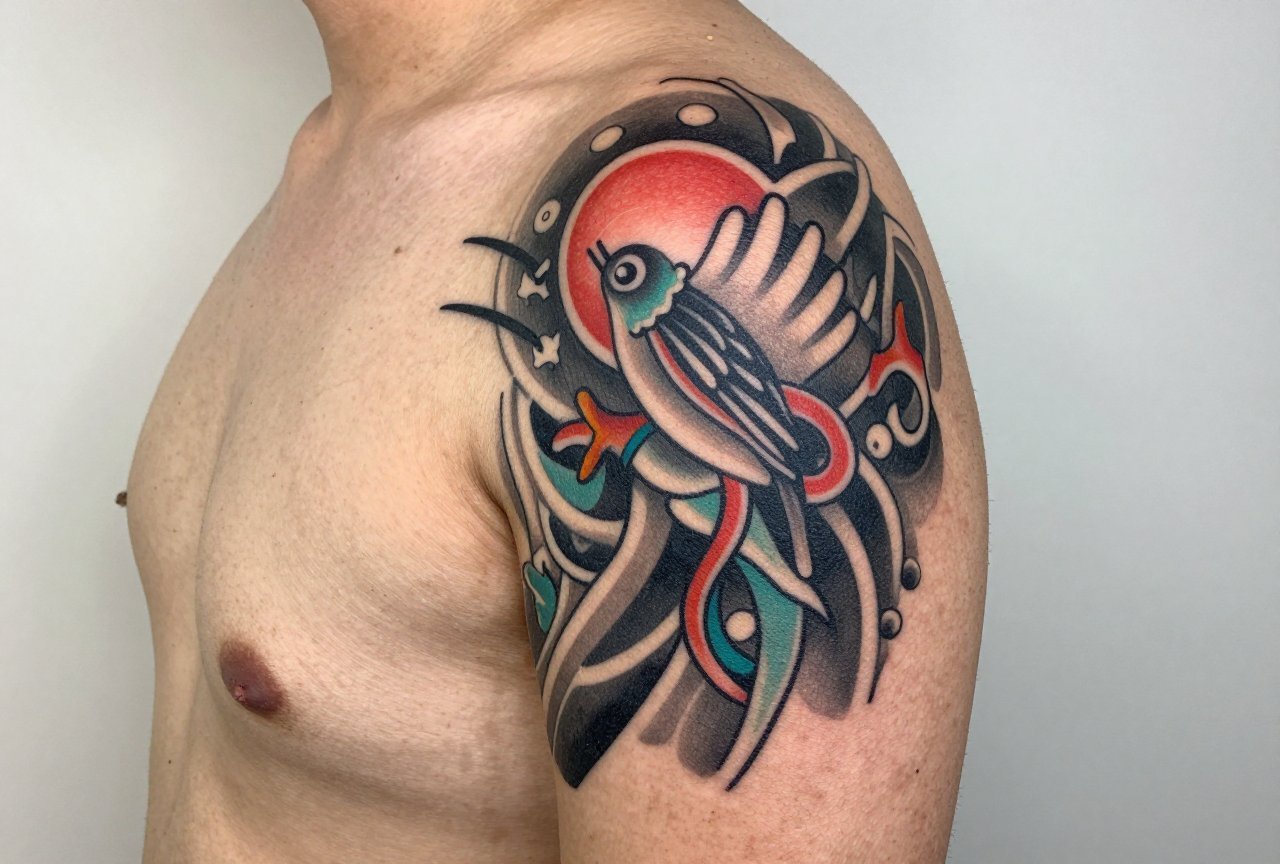
- Bold black outlines: The line weight varies, but every shape is defined. No floating color without a border holding it.
- Limited color palette: Red, yellow, green, blue, black. Maybe purple for a grape bunch on a lucky piece. That’s it.
- Flat shading: We use whip shading or sparse black fill, not smooth gradients. The skin does the blending over time.
- Readable at distance: A traditional ship on your forearm should look like a ship from across the room. Period.
Common motifs include clipper ships, anchors, swallows, mermaids, compasses, sharks, and nautical stars. Each carried meaning: swallows for miles sailed, anchors for stability or Navy service, ships for voyages survived. I still have clients ask for specific combinations their grandfathers wore.
Color vs Black and Grey
This debate happens in my chair at least once a month. Here’s my honest take after watching both age.
Color Traditional
Red holds. Yellow fades to a soft peach. Green goes muddy blue on some skin tones. Blue stays decent. The key is saturation, pack it in, don’t leave streaks. I tell clients: color traditional looks amazing for the first ten years, then the red and black carry the piece. I’ve got a client with a full-color ship on his calf from 2008 that still pops because we went heavy on the pigment and he kept it out of the sun.
Black and Grey
Black and grey traditional ages like iron. It doesn’t shock people across the beach, but it stays legible forever. The limitation is that you lose some of the style’s identity, traditional marine work was built on color. A black anchor with a red rose reads traditional. A black anchor alone reads more neo-traditional or just bold blackwork. I do both, but I ask clients what they want the tattoo to say in thirty years, not three.
Best Placements
Traditional marine tattoos were designed for specific body parts. The flash was drawn for arms, legs, chests, areas that sailors could reach and artists could access in cramped conditions.
- Forearms: Classic. Ships, anchors, swallows all read perfectly here. The cylinder shape suits the vertical compositions of masts and rigging.
- Upper arms: Bigger pieces, fuller ships. The deltoid curve frames a clipper ship beautifully. I’ve done dozens of “ship in a bottle” variations here.
- Chest: The full naval tradition. Eagles, ships, banners across the chest. Needs commitment, this is visible, permanent, and hurts.
- Thighs and calves: Great for larger compositions. The flat planes let ships sail straight. Healing’s easier than joints.
- Hands and knuckles: HOLD and FAST still get done. I warn everyone: these spots blur, they fade, they hurt like hell. But they’re part of the culture.
Ribs and stomachs? We see this a lot now, but it’s not traditional placement. The old designs warp on soft, shifting skin. I won’t refuse, but I have the conversation.
Who It Suits
Not everyone. Traditional marine tattoos are bold, graphic, and committed. They look best on people who carry themselves with some presence. The style doesn’t hide. It doesn’t apologize.
I’ve tattooed Navy veterans who finally got the piece they couldn’t get under regs. I’ve tattooed sailors’ grandchildren who never set foot on a boat but want the connection. I’ve tattooed punk kids who just love the graphic punch. The common thread: they want something that lasts, something with weight.
Skin tone matters for color choices, not for whether you can wear the style. Darker skin needs heavier black, brighter reds, more contrast. Lighter skin can carry subtlety that doesn’t exist in traditional anyway. A good artist adjusts the palette, not the design.
Modern Variations
The style’s alive, not museum-bound. I see great work coming out of shops that push the boundaries while keeping the bones.
Neo-Traditional Marine
Bigger color range, more complex compositions, sometimes softer edges. Still readable, still bold, but with more room for personal symbolism. I’ve done neo-traditional pieces where the ship’s sails are actually filled with someone’s handwriting, their grandfather’s log entries. The line weight stays heavy, the black holds it together.
Japanese Fusion
Water backgrounds from irezumi tradition, ships from American traditional. This works better than it should. The waves and wind bars give motion, the ship stays graphic and central. Takes a confident artist. I’ve collaborated on a few, sending clients to specialists for the background after I lay the ship.
Choosing an Artist
This matters more than design. A bad traditional tattoo is worse than a bad realism piece, at least realism can hide in detail. Bad traditional is just muddy shapes with no excuse.
- Look at healed work: Fresh photos lie. Ask for one-year-healed shots. The black should still be black, the lines clean.
- Check their flash: Do they paint their own? Do they collect vintage? An artist who lives in the tradition produces better work than one dabbling.
- Ask about their machines: Most traditional artists I respect run coil machines for the bold lines. Some rotary users get there. The tool matters less than the hand, but it’s worth asking.
- Shop vibe: Traditional shops should feel like shops. Flash on walls, maybe some taxidermy, definitely not sterile corporate minimalism. You want an artist who breathes this.
I tell clients to travel for the right artist. A traditional marine piece is for life. A few hours’ drive or a flight to a convention is cheap insurance.
Final Thoughts
Traditional marine tattoos aren’t nostalgia. They’re a living language that still communicates courage, distance, return, and belonging. I’ve watched clients cry getting their grandfather’s anchor redrawn. I’ve watched sailors get their first ship before deployment, not knowing if they’ll add the “returned” banner later. The style carries weight because it earned it.
Get it bold. Get it clean. Get it from someone who knows why the ropes on a ship tattoo are drawn that specific way, who can tell you which shop in Honolulu first put a hula girl on a bicep. The history is part of the tattoo. Wear it with the respect it deserves, and it’ll treat you right for decades.
Frequently Asked Questions
How long does a traditional marine tattoo take to heal?
Two to three weeks for the surface, two to three months for the full settle. I tell clients to keep it clean, keep it moisturized, and keep it out of the sun. The black lines will look cloudy for a while, that’s normal, not blown out.
Can I get a traditional ship tattoo if I’ve never been on a boat?
Absolutely. The style belongs to anyone who connects with it. I’ve tattooed ships on landlocked mechanics, teachers, artists. The imagery speaks to journey and endurance, not just literal sailing.
Why do some traditional tattoos look blurry after a few years?
Usually the lines were too thin or the black wasn’t saturated enough. Traditional should be bold. I see this a lot with artists trying to make the style “delicate.” That’s not how it works. Heavy black, clean lines, proper aftercare, that’s the formula.
What’s the difference between sailor tattoos and Navy tattoos?
Sailor tattoos are the broader tradition, merchant, civilian, anyone who worked the water. Navy tattoos are specific military markings: unit insignia, deployment dates, sometimes regulation violations rendered as jokes. The style overlaps, but the meaning differs. I ask clients which story they’re telling.
Related Style Guides
- Traditional Portrait Tattoos: A Working Artist s Guide
- Traditional Religious Tattoos: Complete Style Guide
- Traditional Tattoo Artwork: A Working Artist s Guide
- Explore more