Chicano traditional tattoos aren’t a trend that showed up on Instagram last week. They’re rooted in decades of Mexican-American culture, prison artistry, and Catholic imagery that got filtered through barrio life and refined in neighborhood shops from East LA to San Diego. When someone sits in my chair asking for this style, I know we’re probably talking black and grey, probably talking religious figures or fine-line lettering, and definitely talking about work that needs to respect where it came from. This style carries weight. It tells stories about family, struggle, faith, and identity that cheap knockoffs can’t touch.
Origins & History
The story starts in the 1940s and 50s, when Mexican-American youth in Southern California developed a distinct cultural identity, pachuco culture, lowriders, zoot suits. Tattooing happened underground, often in garages and prisons, using handmade machines and whatever ink was available. I’ve talked to old-timers who learned with guitar strings and cassette motors. The aesthetic that emerged was spare, resourceful, and deeply symbolic.
From Prison to Parlor
Prison constraints shaped the style fundamentally. No color ink available? You learned to make black sing. No time for elaborate sessions? You developed efficient, readable designs. Religious imagery served multiple purposes, protection, penance, connection to family and faith on the outside. The Virgin Mary, praying hands, rosaries: these weren’t decorative choices. They were survival and meaning compressed into skin.
By the 1970s and 80s, artists like Freddy Negrete and Jack Rudy were bringing these techniques into legitimate shops, refining the single-needle black and grey work that would become legendary. Freddy’s “smile now, cry later” masks, his refined lettering, these became touchstones. I’ve studied their flash sheets until the paper went soft. The precision they achieved with such limited tools still humbles me.
Shop Culture and Respect
Here’s something I tell clients: walking into a shop asking for Chicano work without understanding its roots is like wearing a military patch you didn’t earn. The style has been appropriated heavily, especially as black and grey realism blew up globally. Real Chicano artists guard this tradition. In my shop, we see this a lot, kids wanting the aesthetic without the context. A good artist will educate, not just take your money.
Key Characteristics & Motifs
Chicano traditional has visual signatures that separate it from generic black and grey. The line work tends toward fine and precise, often single-needle for detail. Shading is smooth, almost airbrushed, with subtle gradations rather than heavy contrast. The overall feel is illustrative, sometimes photographic, but always controlled.
- Religious iconography: Virgin of Guadalupe, crucifixes, praying hands, rosary beads, sacred hearts
- Clown faces and masks: the classic “smile now, cry later” duality, theatrical expressions of life’s contradictions
- Fine-line lettering: Old English, script, or custom lettering for names, neighborhoods, prayers, or memorial dates
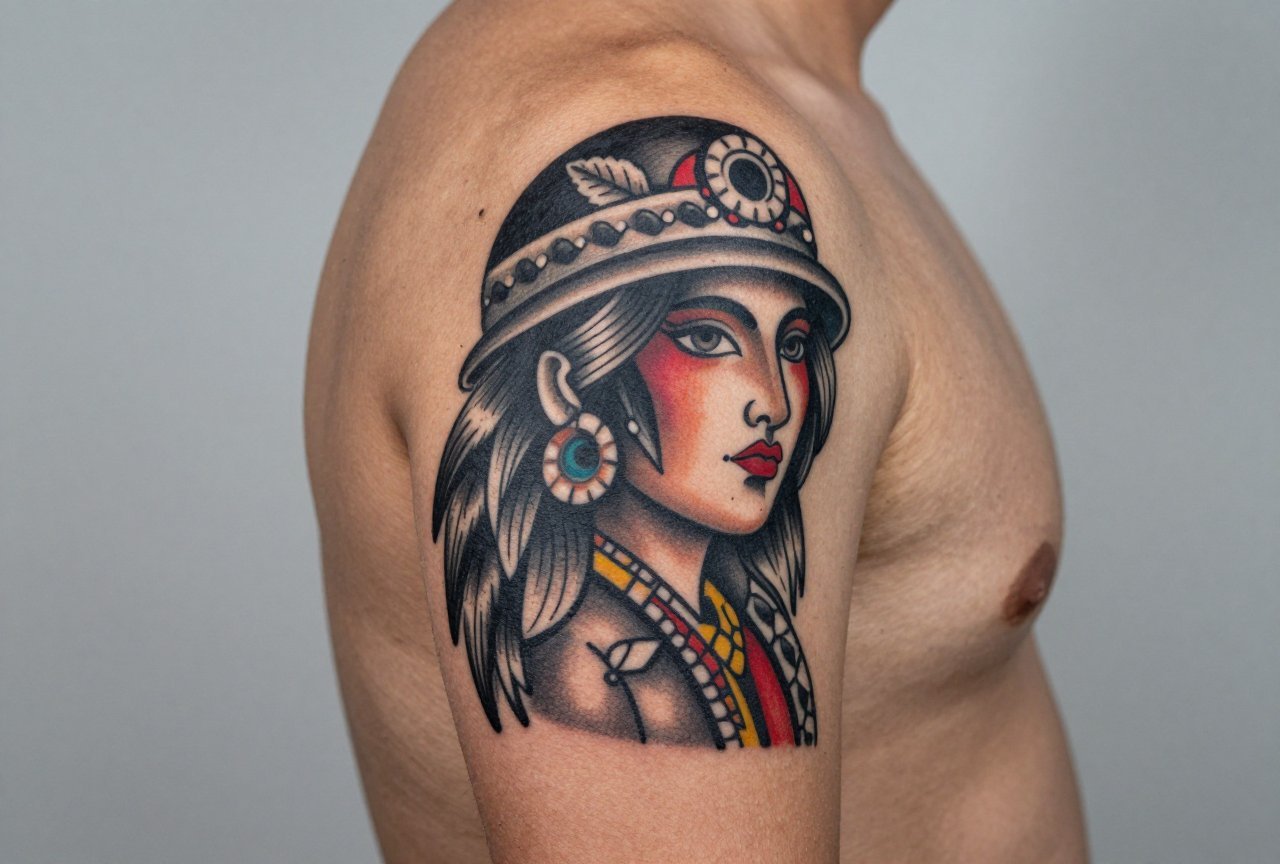
- Women’s faces: stylized portraits, often representing mothers, lovers, or the Virgin herself
- Lowrider and street culture: cars, dice, money, guns rendered with cultural specificity rather than generic gangster imagery
- Aztec and pre-Columbian references: pyramids, warriors, calendar stones connecting to indigenous heritage
The women’s faces deserve special mention. Done well, they have a particular softness around the eyes, a specific lip shape, a styling that references 1940s Mexican cinema and family portraits. I’ve seen bad versions that look like generic pinups with brown skin. That’s not it. The good ones carry a particular dignity, a specific cultural beauty standard.
Color vs Black and Grey
Purists will tell you Chicano traditional is black and grey, period. And mostly, they’re right. The style’s origins in prison ink scarcity made monochrome its native language. But I’ve been tattooing long enough to see evolution happen in real time.
Contemporary artists sometimes incorporate limited color, deep reds for sacred hearts, subtle blues for Mary’s mantle, earth tones for Aztec imagery. This isn’t wrong, but it changes the register. Black and grey carries a certain gravity, a timelessness that color can dilute. When clients ask me about adding color, I ask them why. Sometimes there’s a genuine personal reason. Sometimes they’re just afraid black and grey will look “unfinished.” I show them healed photos from five, ten years back. The best black and grey ages like a photograph that only gets more interesting.
Best Placements
Chicano work flows with the body in specific ways. The style developed on arms, chests, backs, areas visible in short sleeves, areas that could be covered for work or shown for pride.
Arms and Hands
Full sleeves or half-sleeves are classic territory. The forearm gives space for detailed religious figures, for lettering that reads at conversation distance. Hands carry praying hands, small crosses, or lettered knuckles, though I warn clients, hand tattoos are job-stoppers in most professional contexts, and they blur faster than almost anywhere else. The skin there is thin, constantly moving, constantly sun-exposed. I’ve touched up hand work more than any other placement.
Chest and Back
The chest plate, pectorals, upper sternum, is sacred ground for Virgin portraits, for “smile now, cry later” masks facing each other across the collarbone. The full back allows for narrative compositions: calavera processions, lowrider scenes, elaborate Aztec temples. These large pieces take dozens of hours, multiple sessions, real commitment. The healing is rough. Sleeping on your back, wearing shirts that don’t stick, clients learn patience they didn’t know they had.
Who It Suits
I’ll be direct: this style carries cultural weight that matters. I’ve tattooed Chicano traditional on Mexican-American clients reconnecting with family history, on white clients who grew up in these neighborhoods and earned their place in the culture, on people who simply appreciate the aesthetic but are willing to do the learning. The difference is respect and homework.
Skin tone matters technically, not as a gatekeeping device. Very dark skin can make fine-line black and grey disappear; we adjust with bolder lines, higher contrast, maybe selective use of white highlight. Very fair skin takes the subtle gradations beautifully but can wash out if the artist doesn’t build enough density. I’ve adjusted my approach session by session for fifteen years.
Modern Variations
The style has splintered and hybridized. Some artists push toward photorealistic black and grey portraiture, technically impressive but sometimes losing the illustrative quality that defines tradition. Others incorporate Chicano lettering and imagery into neo-traditional or even Japanese compositions. I’ve seen beautiful work and I’ve seen disrespectful grab-bags.
The “Chicano style” tattoo tourism in Europe and Asia is its own phenomenon. Some foreign artists study seriously, travel to LA, apprentice under masters. Others copy Instagram posts and miss the soul entirely. When clients bring me reference from overseas artists, I look at the line quality, the cultural accuracy of the imagery, whether the figures look like real people or cartoon stereotypes.
Choosing an Artist
This matters more than almost any other style. A bad Chicano traditional tattoo isn’t just ugly, it’s culturally tone-deaf, permanently.
- Look at healed work, not just fresh photos. Black and grey looks dramatically different at six weeks versus six years. Ask for long-term photos.
- Check their lettering specifically. Bad script is the fastest giveaway of an artist who hasn’t put in the study. Lettering should flow, not just be readable.
- Ask about their training and influences. Artists with genuine connection to this tradition will talk about it openly, name their teachers, reference the pioneers.
- Be wary of artists who do “everything” including Chicano. Specialization shows respect. Jack of all trades usually means master of none in this style.
- Discuss cultural context directly. A good artist will ask why you want this style, will want to know your connection, will steer you away from imagery that doesn’t fit your story.
I’ve turned down work when the client’s reasons didn’t align with what they’d be wearing. That’s part of the job in this style. Not every artist will, but the best ones do.
Final Thoughts
Chicano traditional tattoos represent one of American tattooing’s most significant contributions to global art. Born from constraint, refined through generations of neighborhood shops, carried forward by artists who treat the tradition as living culture rather than visual catalog. When it heals on your skin, it should carry that weight properly, technically flawless, culturally grounded, personally meaningful. Take your time finding the right artist. Ask uncomfortable questions. The good ones will respect you for it. I’ve been in this trade long enough to know that the best tattoos come from conversations that start with honesty and end with something that lasts.
Frequently Asked Questions
How long does a full Chicano traditional sleeve typically take?
A detailed black and grey sleeve usually runs 25-40 hours across multiple sessions, depending on complexity. Fine-line religious portraits take longer than bold lettering or simpler imagery. I schedule sleeves in 3-4 hour sessions to let skin recover and keep line quality consistent.
Does Chicano traditional tattooing hurt more than other styles?
Pain depends on placement, not style. However, the long sessions common for detailed black and grey work can be more wearing overall. Single-needle detail in sensitive areas like ribs or inner arm definitely gets clients gripping the chair harder.
Can I get Chicano traditional tattoos if I’m not Mexican-American?
Respect and connection matter more than ethnicity itself. I’ve tattooed this style on people who grew up in these communities, who married into families, who genuinely studied the history. What doesn’t work is treating it as a cool aesthetic you found online without understanding its origins.
Why does my healed black and grey look lighter than when it was fresh?
All tattoos lighten as they heal, fresh ink sits in plasma and inflammation that makes it look darker and more saturated. Black and grey shows this dramatically because the subtle graduations are more visible. Good artists account for this, building slightly darker than the final desired tone.
Related Style Guides
- Traditional Duck Tattoos: A Working Artist s Guide
- Traditional Portrait Tattoos: A Working Artist s Guide
- American Traditional Western Tattoos: A Working Artist s Guide
- Explore more