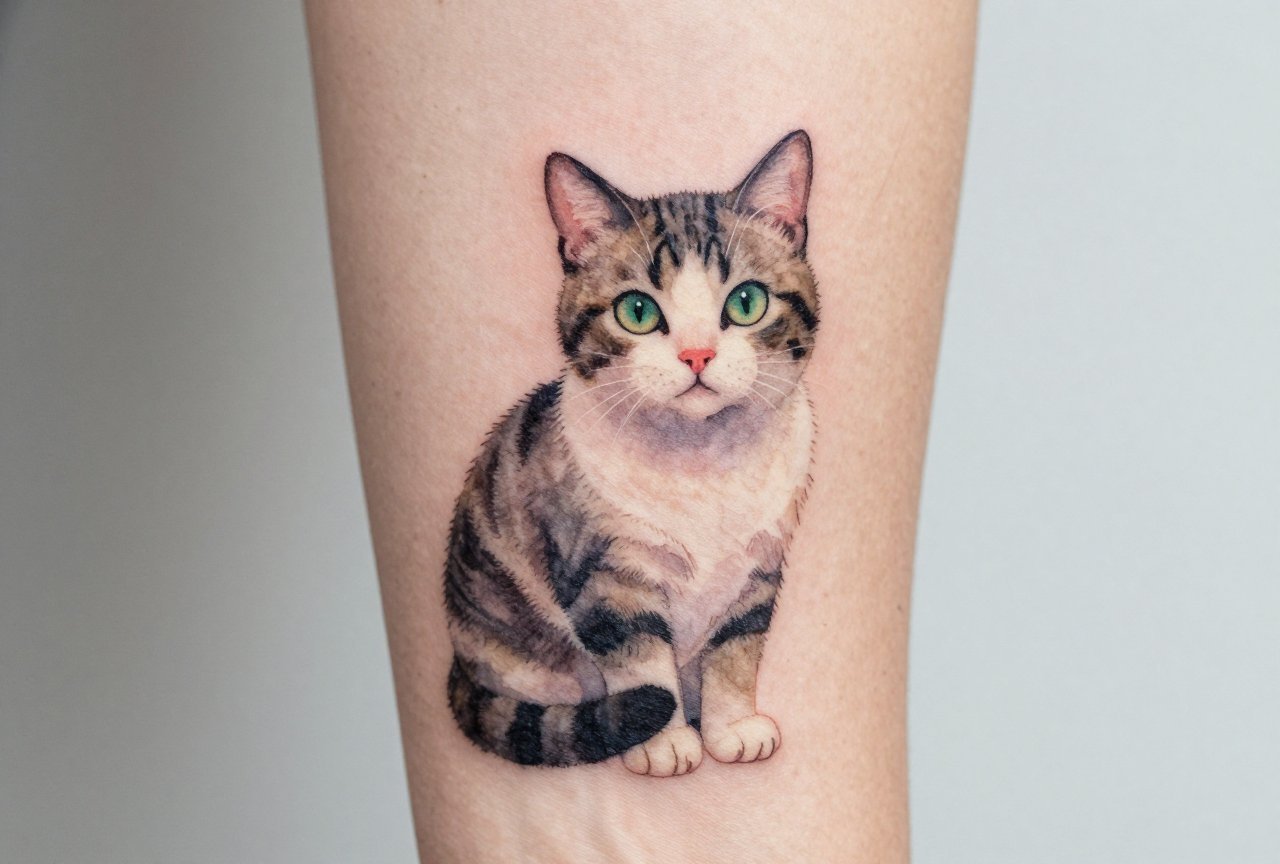
Watercolor cat tattoos are exactly what they sound like, feline imagery rendered with the bleeding, pooling, and splashing qualities of watercolor paint. I’ve tattooed dozens of these over the years, and they’re a specific beast. The style relies on deliberate color bleeding outside traditional linework, soft gradients that look like they were dragged by a wet brush, and negative space that lets your skin tone become part of the composition. Done right, they look like someone spilled their paint palette onto a cat sketch in the best possible way. Done wrong, they look like a bruise with whiskers.
Origins & History
Where the Style Actually Came From
Watercolor tattooing didn’t crawl out of some ancient tradition. It’s a genuinely modern development, maybe fifteen or twenty years old in any recognizable form. I remember first seeing it around 2010 in European work, particularly from artists who had fine art backgrounds and got tired of the thick black outlines that dominated the 2000s. They started asking: what if we tattooed like we paint?
The cat motif came naturally. Cats already carry that artistic baggage, Egyptian reverence, Japanese neko-e paintings, Art Nouveau posters. Pairing feline imagery with watercolor technique made sense because both share that quality of suggestion over declaration. A cat’s silhouette is instantly readable. You don’t need to render every whisker for the brain to say cat.
How It Entered Mainstream Shop Culture
By the mid-2010s, every shop had someone trying watercolor. I watched apprentices attempt it with cheap inks and blowouts galore. The style got a reputation for fading fast because so many early practitioners didn’t understand saturation. They’d use too much watery dilution, too little pigment packed into the dermis. The Instagram era loved it, bright colors photograph beautifully fresh. But we learned quickly that fresh and healed are different countries.
Key Characteristics & Motifs
When I say “watercolor cat tattoo” to another artist, here’s what we both picture:
- Soft or absent black outlines: Traditional linework gets minimized or replaced with color boundaries. Sometimes there’s a single delicate line defining the cat’s form, sometimes nothing at all.
- Color bleeds and splatters: The “drip” effect, those running streaks down the skin, is usually intentional. I build them with a whip shader, letting the needle dance at the edge of a color field.
- Negative space as highlight: Your skin becomes the white paper. We leave gaps, sometimes large ones, where light would hit in a watercolor painting.
- Gradient transitions: Colors that shift from saturated to transparent in a single pass, mimicking wet paint on wet paper.
Motifs vary. I’ve done sleeping cats curled into color puddles, cat eyes floating in abstract washes, full silhouettes with galaxies bleeding from their edges. The most successful designs anchor the watercolor chaos to a recognizable feline form. Without that anchor, you get pretty colors that might be anything.
Color vs Black and Grey
The Case for Color
Color is the obvious choice. Watercolor means color to most people, those magentas dropping into teals, those yellows bleeding into oranges. In my chair, I tell clients that color watercolor cats demand maintenance. The pigments that make those jewel tones possible are also the ones that scatter fastest under UV exposure. Reds and purples hold better than yellows and pastels. I pack color more densely in watercolor pieces than I would in traditional work because I know what’s coming.
Black and Grey Watercolor
This surprises people, but black and grey watercolor cats can be stunning. You lose the literal watercolor association, but you gain longevity and a certain sophistication. I use grey washes at different dilutions, my own mixes of black ink and distilled water, to create those soft gradients. The “splatter” effect reads as ink or charcoal rather than paint. These pieces age with more dignity. I’ve got a black and grey watercolor cat on my own leg from seven years back that still reads clearly, while some color pieces from the same era have softened to pastel ghosts.
Best Placements
Not every spot works for this style. Watercolor needs room to breathe. The splatter effects require space to resolve, or they look like mistakes rather than intention.
- Upper arm/shoulder: Classic canvas. The deltoid’s curve catches the eye, and the meat there holds saturation well. I’ve done probably thirty watercolor cats in this zone.
- Thigh: My favorite for larger pieces. The skin’s stable, the area’s flat enough for clean color fields, and clients can hide or show at will.
- Forearm: Risky for employment reasons, but the visibility suits the style’s showiness. Inner forearm ages faster, constant sun, constant friction from desks and arms.
- Ribs/side: The pain is real. I warn everyone. But the vertical space lets you do that classic drip-down effect beautifully. Skin here stretches and breathes, so healing demands discipline.
- Back of calf: Underrated. The gastrocnemius gives a nice rounded surface, and pants cover it easily. Watch for sock lines and boot friction though.
I steer people away from hands, feet, and fingers for watercolor cats. The style’s subtlety dies on those high-movement, high-fade zones. You’d be touching up every year.
Who It Suits
Personality-wise, watercolor cat people tend to be specific. They’re usually not getting their first tattoo, there’s a confidence to choosing something this stylistically bold. They often have art backgrounds themselves, or they at least think visually. I’ve had clients bring in their own watercolor paintings of their cats and ask me to translate them.
Skin tone matters practically, not aesthetically. Lighter skin shows the full color range. Medium to darker skin can absolutely carry watercolor, but I adjust my palette, deeper magentas, true blues, strong teals rather than soft pastels that will disappear. I have honest conversations about this. An artist who won’t is doing you a disservice.
Your existing collection matters too. Watercolor cats sit awkwardly next to heavy traditional work. They love company from other contemporary styles, geometric, illustrative, fine line. I once had a client with a full Japanese sleeve who wanted a watercolor cat on the same arm. We talked for an hour. Ended up doing it on the other arm.
Modern Variations
Watercolor Meets Line Work
The most common evolution I’m seeing: a single, elegant continuous line forming the cat, with watercolor bursts behind or beneath it. This solves the aging problem. Even if the color fades, you’ve still got a legible tattoo. I’ve been doing more of these, especially for clients who want the aesthetic but worry about longevity.
Double Exposure and Embedded Imagery
Cat silhouettes filled with watercolor landscapes, starfields, floral arrangements. The cat becomes a window. Technically tricky, getting the embedded image to read at small scale takes planning. I draw these twice full-size before touching skin.
Abstract Feline Forms
Pushing further toward pure abstraction. Maybe just cat eyes in a color wash, or a tail’s curve suggested by a single flowing stroke. These are for collectors who’ve moved past literal representation. I love doing them, but they’re not for everyone.
Choosing an Artist
This is where I get serious with you. Watercolor tattooing is not a skill every artist develops. Traditional apprenticeship teaches bold lines and solid saturation. Watercolor asks for opposite instincts, restraint, negative space thinking, color theory that painting classes teach, not tattoo seminars.
- Look at healed work, not just fresh: Any tattoo looks good at day three. Ask to see photos at six months, a year, two years. Good artists keep these.
- Ask about their pigment choices: Do they use straight pigments or pre-mixed washes? How do they handle the dilution? Vague answers are red flags.
- Check their fine art background: Not mandatory, but helpful. Artists who paint with actual watercolors understand why the style works, not just how to mimic it.
- Discuss their touch-up policy: Watercolor often needs refinement. I include one touch-up in my pricing because I expect it. Artists who don’t may be planning to blame your aftercare.
I tell clients to expect a longer session than comparable traditional work. Building those soft gradients takes time. Rushing it creates muddy transitions. I’ve spent four hours on a watercolor cat that a traditional version would take two.
Final Thoughts
Watercolor cat tattoos occupy this interesting space between fine art and body art. They’re beautiful, they’re expressive, and they demand more from both artist and wearer than most people expect going in. I’ve watched the style mature from Instagram novelty to legitimate technique. The best pieces I’ve done are the ones where client and artist both understood the trade-offs, vibrancy against longevity, spontaneity against structure, the painting against the skin it lives in.
If you’re drawn to this style, sit with a portfolio, have the hard conversations about how it’ll look in ten years, and commit to the aftercare. A watercolor cat isn’t a set-it-and-forget-it tattoo. It’s a living thing on a living thing. That interplay is exactly what makes it worth doing.
Frequently Asked Questions
Do watercolor cat tattoos fade faster than traditional tattoos?
They can, especially the lighter colors and pastel tones. I pack pigment more densely in watercolor work to compensate, but yellows and soft pinks will always fade before bold black lines. Plan for a touch-up in a few years if you want to maintain that fresh vibrancy.
Can you add watercolor effects to an existing cat tattoo?
Sometimes, but it depends on the existing work. Heavy black lines limit what watercolor can do around them. I’ve had success softening older pieces with color washes, but it’s a case-by-case conversation. Bring it to an artist and be open to their honest assessment.
How much should I expect to pay for a quality watercolor cat tattoo?
You’re paying for the artist’s specialized skill and the extra time these take. In most US shops, a medium-sized watercolor cat runs $400-$800, with larger or more complex pieces going higher. Anyone charging traditional prices for watercolor work is probably rushing it.
What’s the hardest part of healing a watercolor tattoo?
Resisting the urge to over-moisturize. Because watercolor uses softer color fields without bold outlines to hide behind, scabbing and peeling can make it look terrifying at two weeks. Stick to thin layers of unscented lotion, keep it clean, and trust the process. The soft gradients return as the skin settles.
Related Style Guides
- Common Tattoo Designs That Actually Work
- Popular Tattoo Designs That Actually Work
- Amazing Tattoo Designs That Actually Work
- Explore more