
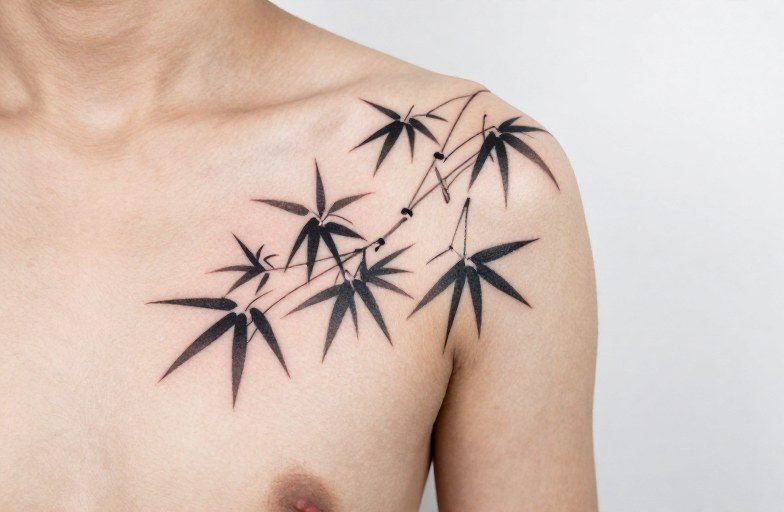
A bamboo tattoo carries layered meaning rooted in its natural behavior: the plant bends without breaking, grows faster than nearly any woody species, and thrives in conditions that kill less adaptable life. For most people who choose it, the design represents personal resilience, steady progress, or the ability to stay upright through pressure without becoming rigid.
Symbolism & History
The symbolism draws directly from observable plant biology. Hollow stems make bamboo lightweight yet structurally sound. Root systems spread horizontally before shooting upward, suggesting patience followed by sudden growth. These physical traits translate into human virtues across several cultures, though the specific associations vary.
East Asian Associations
In Chinese tradition, bamboo ranks among the “Three Friends of Winter” alongside pine and plum blossom, valued specifically for staying green through cold months. This endurance quality made it a scholar’s motif, representing integrity that persists despite hardship. Japanese usage often links bamboo to prosperity and protection, with the plant’s rapid growth pattern suggesting business success or family expansion. Vietnamese and Korean traditions similarly emphasize uprightness, the straight stem as moral rectitude.
Southeast Asian Tattoo Practice
Thailand’s sak yant tradition sometimes incorporates bamboo imagery, though the famous “bamboo tattoo” technique refers to the hand-tapping method using sharpened bamboo rods rather than the design itself. The tool and the image occasionally overlap: a practitioner might tattoo bamboo using actual bamboo. This creates meaningful confusion in search results. The hand-poked method produces distinct aesthetic results, slightly less uniform lines, more organic texture, faster healing for some skin types, but the meaning of the image remains separate from how it was applied.
- Resilience under pressure: the bending-not-breaking metaphor
- Steady growth: root expansion before visible shoots
- Simplicity and utility: hollow stem, multiple uses
- Longevity: some species flower only once per century
- Adaptability: thriving across diverse climates and soils
Common Variations & Styles
The basic bamboo stalk adapts to nearly every tattoo style, though some approaches suit the subject better than others.
Single Stalk vs. Grove Compositions
A solitary vertical stalk reads as personal strength, individual endurance. The composition demands clean line work, any wobble in the stem’s edge destroys the upright effect. Groves or clusters suggest community, family, or collective resilience. These compositions work well wrapping around limbs, with stalks at varying angles creating depth.
Leaf placement matters significantly. Sparse leaves high on the stalk feel minimalist and modern, sometimes approaching Japanese sumi-e brush painting aesthetics. Dense foliage lower down creates weight and visual anchoring. Leaves pointing upward suggest aspiration; downward-angled leaves read as maturity or the weight of experience.
Style-Specific Treatments
- Black and grey realism: Captures the segmented stem texture, the slight powdery coating on mature bamboo, the way light catches the nodes. Requires an artist comfortable with smooth gradient work.
- Traditional Japanese (irezumi):strong> Bamboo often appears as background filler in larger compositions, rarely as standalone subject. The wind-barred leaf treatment (sasa) creates movement within static designs.
- Line work / single needle: Emphasizes the plant’s architectural quality. Clean, uniform lines reward precise execution; mistakes show clearly.
- Watercolor / abstract: Green splashes suggest foliage without defining it; the stem grounds the composition. Risk of muddy color if the artist lacks control.
Color choices carry subtle signals. Natural greens and warm browns read as grounded, traditional. Black and grey feel contemporary, sometimes melancholic. Gold or yellow tones suggest prosperity and harvest associations.
Best Placements
Bamboo’s vertical emphasis makes certain placements natural and others challenging.
The forearm, calf, and rib cage suit single-stalk designs perfectly, the long, relatively flat surfaces let the stem run true without excessive curving. A rib placement following the natural body line can work if the artist accounts for how the stem appears when the person stands straight versus breathes deeply.
Wraparound compositions suit the upper arm and thigh. Bamboo stalks can spiral with the limb’s cylinder, leaves extending toward the shoulder or knee. This creates movement impossible in strictly vertical placements.
Smaller designs behind the ear, along the collarbone, or on the wrist require simplification. A single segment with one leaf pair reads as bamboo without demanding much space. Finger placements rarely work, the stem’s length gets lost, and the nodes become unreadable at small scale.
Back pieces allow grove compositions with atmospheric perspective: detailed foreground stalks, lighter and smaller background growth. This suits the symbol’s communal associations.
Who Chooses This Tattoo / Personal Meanings
People gravitate toward bamboo after specific life transitions rather than as spontaneous decoration. Common contexts include recovery from illness or injury, career changes requiring patience, parenthood, or immigration, themes involving sustained effort before visible results.
The meaning often shifts with life stage. Someone might choose bamboo during a difficult period, then later appreciate its growth aspect more than its resilience. The tattoo accommodates this evolution without requiring reinterpretation of the image itself.
Some choose it for cultural connection, heritage, study abroad, martial arts practice. Others respond purely to the visual qualities: the clean vertical line, the mathematical regularity of nodes, the contrast between rigid stem and soft leaves. Both motivations produce valid, lasting tattoos.
Age considerations matter. Bamboo ages relatively well as a tattoo subject because the design relies on structural clarity rather than fine detail. A slightly blurred node still reads as a node. However, very thin single-needle lines on the stem can spread over decades, turning precise segments into vague stripes. Planning for aging means erring slightly bolder on line weight than current fashion might suggest.
Similar Symbols
People considering bamboo often compare it to related imagery.
Willow: Similar flexibility symbolism, but associated with grief and loss in Western traditions, feminine grace in East Asian contexts. The drooping form creates different energy.
Pine: Shares the winter endurance quality, but suggests steadfastness rather than adaptability. More masculine-coded in traditional usage. The needle clusters demand different technical approach.
Lotus: Growth-through-adversity narrative, but with explicit spiritual dimension often absent in bamboo. The flower’s blooming sequence allows narrative progression in ways a stem cannot.
Oak: Western strength symbol, but emphasizes rigidity and longevity rather than flexibility. The “strong oak” breaks in storms where bamboo bends.
Japanese pine-bamboo-plum (sho-chiku-bai) combination: Triple motif representing the full year and complete character. Some choose all three; others isolate bamboo for personal focus.
Final Thoughts
Bamboo endures as tattoo subject because its meaning sits in observable reality, not abstract philosophy. The plant actually behaves as the symbol claims. This grounded quality makes it forgiving of interpretation, you need not share the wearer’s specific story to recognize the underlying values. For placement, prioritize the vertical line’s integrity; for style, match the visual weight to your body’s scale and your tolerance for visibility. The best bamboo tattoos look like they grew there, not like they were applied.
Frequently Asked Questions
Does a bamboo tattoo have to include green ink?
No. Black and grey bamboo tattoos are common and often preferred for longevity. Green ink can fade faster and shift toward blue or grey depending on the specific pigment and your skin chemistry.
What’s the difference between a bamboo tattoo and a sak yant tattoo?
A bamboo tattoo typically refers to the image of bamboo. Sak yant is a Thai spiritual tattoo tradition that sometimes uses bamboo as a hand-poking tool. The terms get confused because both involve bamboo, but one is a design and the other is a technique and spiritual practice.
Can bamboo tattoos work well in small sizes?
They can, but with limitations. A single stem segment with minimal leaves works at 3-4 inches. Full stalks with multiple nodes need more vertical space to read clearly, typically 6+ inches for the stem alone.
Do bamboo tattoos age better than floral designs?
Generally yes. Bamboo relies on structural elements, straight lines, regular nodes, that remain recognizable even with slight spreading. Dense floral detail can blur into indistinct shapes over time, while bamboo’s simplicity preserves its identity.
Related Tattoo Meanings
- Angelina Jolie Cambodian Tattoo Meaning: Sak Yant Blessing Ink
- Mambabatok Tattoo Meaning: History, Symbolism Design Guide
- Philippines Tribal Meanings Tattoo Meaning: Heritage Inked in Skin
- Explore more









