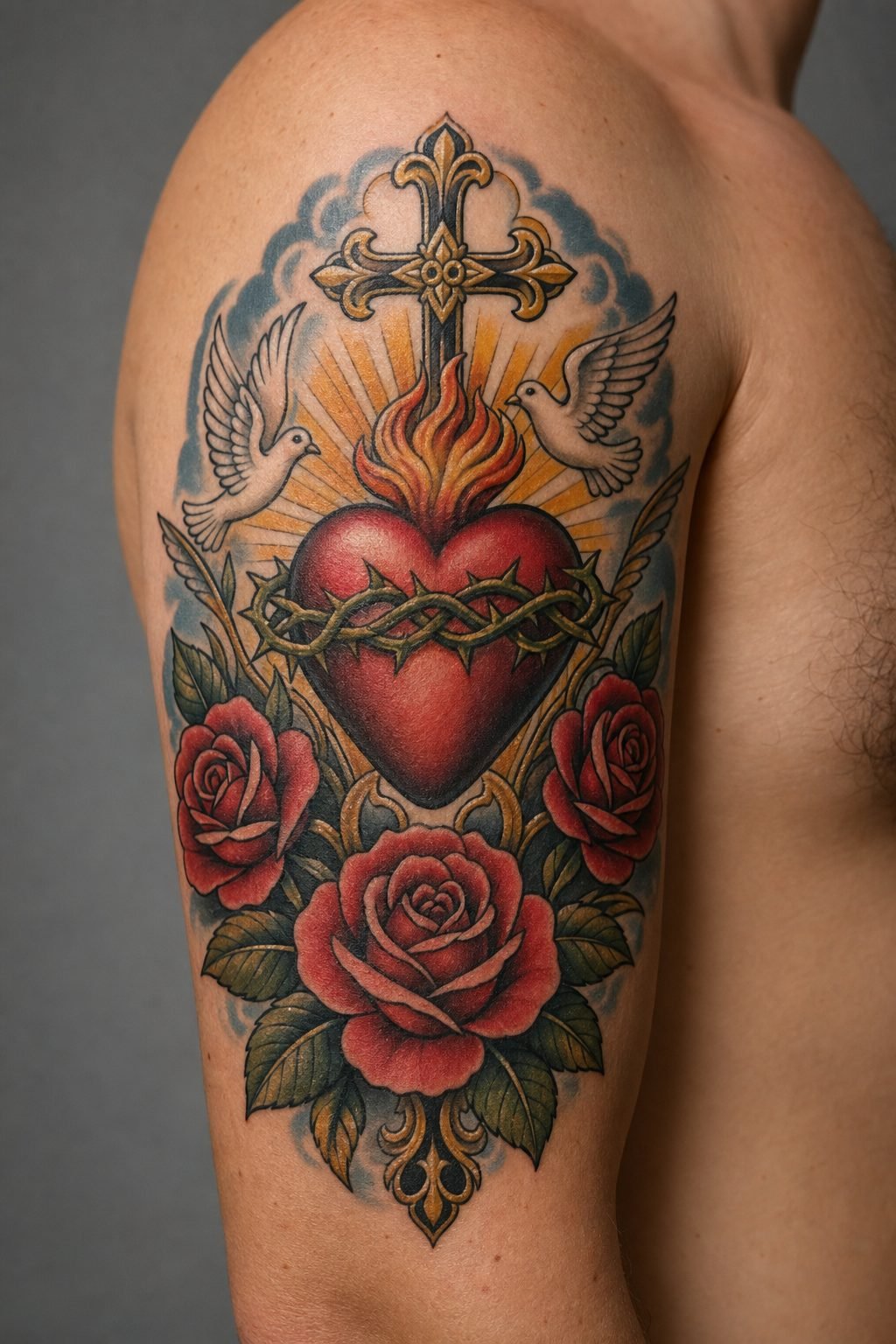
American traditional religious tattoos occupy a distinctive corner of tattoo history, where Christian iconography, sailor culture, and working-class flash art merged into something immediately recognizable. Think thick black outlines, limited but saturated color palettes, and imagery that reads clearly from across a room. Crosses, sacred hearts, praying hands, and the Virgin Mary all became staples of shop flash sheets by the mid-20th century, rendered with the same bold constraints that defined the broader style: simplicity for longevity, clarity for impact, and enough symbolism to carry weight without needing explanation.
Origins & History
From Sailor Culture to Street Shops
The roots of American traditional tattooing are often linked to maritime culture, where sailors collected marks as records of travel and talismans against harm. Religious imagery served a practical purpose at sea, crosses and Jesus faces functioned as protection, or at least the promise of it. When these designs migrated from ports to inland street shops, they kept their bold construction but accumulated new meanings. A cross on a forearm in 1940s Los Angeles might signal faith, mourning, or neighborhood affiliation depending on context.
Some trace specific religious motifs to individual artists. Bert Grimm’s sacred hearts and Norman Collins’s (Sailor Jerry) praying hands became templates that other shops replicated and modified. The imagery spread through flash sheets, pre-drawn designs sold between shops, rather than originating from any single source. This diffusion means “traditional” religious tattoos carry a collective authorship, with regional variations emerging in different cities.
The Working-Class Archive
Religious tattoos in this style also functioned as accessible commemoration. Before custom work became standard, a working person could walk into a shop, point to a flash design, and walk out with a permanent marker of loss, devotion, or identity. The standardized imagery created a shared visual language, praying hands meant grief or hope; a cross with a banner meant a named memorial. The style’s constraints (bold lines, limited shading) kept costs down and ensured the tattoo would hold up over decades of labor.
Key Characteristics & Motifs
American traditional religious tattoos follow the same technical rules as the broader style, but with specific recurring imagery that carries distinct connotations.
- Crosses: Latin crosses with flared ends, often wrapped with banners or roses. The three-dimensional shading is minimal, usually a single drop shadow or none at all. Crucifixes with corpus figures appear but are less common than bare crosses.
- Sacred Hearts: Anatomically approximate hearts (not Valentine’s shapes) crowned with thorns, sometimes topped with flames or a cross. The crown of thorns is rendered as a separate black line element, not blended into the heart.
- Praying Hands: Usually shown in three-quarter view, knuckles prominent, often with a rosary draped over or between them. The hands are typically white with heavy black outlines, the rosary beads simple circles with minimal highlight.
- The Virgin Mary: Shown as bust portraits or full figures, often with a halo of simple radiating lines. Blue mantles (when color is used) are typically a specific cobalt or navy, not sky blue.
- Angels: More common in memorial pieces, with simplified wings spread in a characteristic V-shape. Faces are generic rather than portrait-realistic.
Lettering accompanies most of these designs, banners with names, dates, or short phrases. The typography is part of the design, not an afterthought, and follows traditional conventions: heavy serifs, slight arching, and consistent letter spacing.
Color vs Black and Grey
The classic approach uses a restricted palette: black, red, green, yellow, and sometimes blue or brown. Religious tattoos often emphasize red for sacred hearts and blood imagery, with green reserved for leaves or limited background elements. The Virgin Mary’s mantle provides one of the few contexts where blue appears prominently.
Black and grey traditional religious work exists but is less common historically. When done, it relies on whip-shading and limited greywash rather than the smooth gradients of photorealistic black and grey. The effect is starker, more graphic, and often reads as older or more severe. For crosses and memorial pieces, black and grey can feel appropriately somber; for sacred hearts, the loss of red diminishes some of the design’s immediate recognition.
Over time, color traditional tattoos settle into predictable patterns. Reds soften toward orange or pink depending on ink brand and skin tone. Greens sometimes shift blueish. Blacks remain stable but expand slightly as the surrounding skin ages. The bold outlines are what preserve the design’s integrity, color fade matters less when the structure stays legible.
Best Placements
American traditional religious tattoos were designed for visibility and longevity, which shaped their typical placements.
- Forearms: The classic location for crosses and praying hands. The flat surface preserves detail, and the outward-facing position keeps the imagery visible. Inner forearm works for more personal pieces but sees more flexing and friction.
- Chest: Large sacred hearts and Virgin Mary portraits suit the broad canvas. The sternum’s relative stability (less stretching than stomach, less movement than limbs) helps preserve detail. Centered placement creates a devotional symmetry.
- Upper arms: Traditional bicep and outer arm placements allow for medium-sized designs that age well. The muscle’s movement adds life to praying hands or angel wings without distorting the image.
- Hands and knuckles: Crosses and small sacred hearts appear here, though the skin’s rapid turnover means significant fading within a few years. Bold black lines are essential; color is rarely advisable.
- Back: Larger compositions, crucifixion scenes, full-figure Madonnas, work across the upper back. The flat expanse suits the style’s graphic quality, though lower back placement risks distortion with weight fluctuation.
Areas to approach cautiously: sides of the torso (stretching and distortion), feet (poor ink retention, high fade), and anywhere with significant hair growth that might obscure fine detail.
Who It Suits
This style suits people who want immediate readability and cultural weight over customization. The imagery carries established associations, there’s no ambiguity in a traditional sacred heart or praying hands. That can be desirable or limiting depending on intent.
The bold construction works well on most skin tones; the heavy black outlines provide contrast that lighter, more delicate styles sometimes lack. However, the limited color palette means some hues (particularly lighter greens and yellows) may appear muted on darker skin, requiring adjustment to saturation or substitution with higher-contrast alternatives.
People with existing traditional work find religious motifs integrate naturally. The style’s consistency means a cross on one arm and a ship on the other share a visual language. For those with mixed styles, a traditional religious piece can serve as an anchor or contrast, though it may read as visually heavier than surrounding work.
Modern Variations
Contemporary artists working in this idiom have developed several approaches that respect the tradition while introducing variation.
Neo-traditional religious tattoos maintain the bold outlines but expand the color palette and introduce more complex shading. Sacred hearts might include jewel tones, anatomical detail, or decorative backgrounds impossible in classic flash. The Virgin Mary’s face becomes more individualized, sometimes approaching portraiture.
Remixed iconography combines traditional religious motifs with unexpected elements, sacred hearts with daggers through them, praying hands clutching objects other than rosaries. These retain the graphic construction but alter the symbolism, often toward personal or subversive ends.
Historical revival work deliberately mimics the limitations of early electric tattooing: slightly shaky lines, restricted color, the aesthetic of a 1950s street shop. This requires genuine technical skill, the looseness is controlled, not accidental.
Some artists also work at the intersection of traditional religious imagery and Chicano black and grey, particularly in West Coast scenes. The result blends the bold construction of traditional with the softer shading and religious intensity of Chicano portraiture, Madonnas with more dimensional faces, crosses with realistic wood grain.
Choosing an Artist
Not every artist who does American traditional work handles religious imagery with equal comfort. The motifs have specific conventions, how a sacred heart’s flames are constructed, the proper proportion of praying hands, that differ from general subject matter.
Look for portfolios showing healed work, not just fresh photos. Religious traditional tattoos rely on line stability over time; a crisp cross at one year should still read clearly at ten. Ask to see examples of the specific motif you want. An artist strong in eagles and pin-ups may not have developed the same fluency with crosses or Virgin Mary portraits.
Consultation matters for banner lettering and any customization. The best artists will advise on text length relative to design size, flagging when a requested phrase won’t fit cleanly within traditional conventions. They should also discuss placement realistically, some designs that work on paper compress poorly onto fingers or curve awkwardly around elbows.
Style purists exist, and their value depends on your goals. Someone committed to historical accuracy will constrain your options; someone working in a broader neo-traditional approach offers more flexibility. Either can produce excellent work, but mismatching expectations creates disappointment.
Final Thoughts
American traditional religious tattoos persist because they solve specific problems well. They’re legible from distance, hold up for decades, and carry meaning without requiring explanation. The imagery operates in a register between personal devotion and cultural shorthand, praying hands might commemorate a specific loss or express general spiritual orientation, and the design works either way.
The style’s constraints are also its protection against trends. A well-executed traditional cross will outlast adjacent styles that looked current five years ago and dated now. That longevity comes with trade-offs: limited customization, established conventions that restrict innovation, and an aesthetic some find too blunt or too anchored in specific historical contexts. For those drawn to it, though, the directness is the point. The tattoo doesn’t whisper. It states.
Frequently Asked Questions
Do American traditional religious tattoos have to include color?
No. Black and grey versions exist and can be striking, though they sacrifice some of the style’s immediate recognition. Red is particularly tied to sacred hearts and blood imagery, so removing color changes the emotional temperature. Bold black lines remain essential either way.
How well do praying hands tattoos age on forearms?
Reasonably well if done with heavy outlines and minimal fine detail. The fingers and rosary beads are vulnerable to blur over time. Simpler versions with thicker bead shapes and less inter-bead shading hold their structure longer. Expect some softening at ten to fifteen years.
Can I combine traditional religious imagery with other styles in a sleeve?
Possible, but challenging. Traditional pieces read as visually dense and graphically flat; they can overwhelm adjacent realism or watercolor work. Some artists bridge the gap with neo-traditional approaches. Plan the full composition before starting, not piece by piece.
Are there placement restrictions for religious tattoos in American traditional style?
No formal restrictions, but historical conventions exist. Crosses on hands and knuckles carry specific associations from particular subcultures. Chest and forearm placements are most common for visibility. Consider whether you want the imagery publicly readable or personally private.
Related Style Guides
- American Traditional Tattoo Outlines: Complete Style Guide
- Classic Traditional Tattoos: Complete Style Guide
- Geo Realism Tattoos: Style Guide
- Explore more