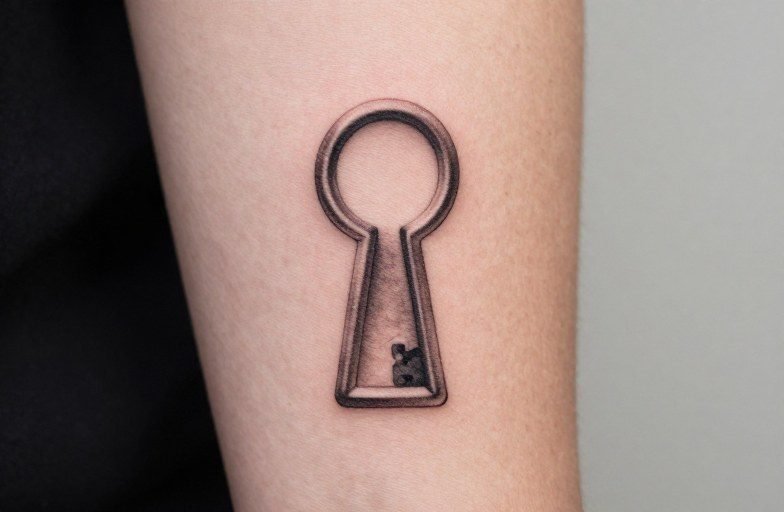
A keyhole tattoo most commonly represents mystery, the unknown, and the threshold between what is hidden and what is revealed. It can symbolize holding a secret, seeking hidden knowledge, or the perspective of someone looking in, or being locked out. The meaning shifts depending on what appears through the opening: an eye, a landscape, a skull, or nothing at all.
Symbolism & Core Meaning
The keyhole is fundamentally an aperture. It frames a view, limits it, and makes whatever lies beyond feel precious or forbidden. This shape carries weight even without imagery inside it.
The Threshold & The Secret
Architecturally, a keyhole is the point of access. In tattoo form, that translates to personal symbolism: something you protect, something you are working to unlock, or something you have finally opened. A bare keyhole with darkness inside suggests a secret held. A keyhole with light streaming through reads as discovery or hope. The empty keyhole is the most versatile, it becomes whatever the viewer projects into it.
The Voyeur’s Eye
When an eye appears looking through the keyhole, the meaning inverts. Now the wearer is the observer, or the observed. This variation plays with surveillance, intimacy, and the tension between public and private selves. It can feel playful or unsettling depending on rendering style, cartoonish linework reads cheeky; photorealistic shading reads more ominous.
Personal & Modern Meanings
Contemporary wearers often choose keyholes for reasons that have little to do with literal locks.
Mental Health & Interior Life
A keyhole can represent the difficulty of letting others see your inner state. For some, it marks a period of isolation or the slow process of opening up. The small scale of the keyhole mirrors how much of yourself you actually show at any given moment.
Transition & Locked Doors
Closed doors, literal and metaphorical, shape lives. A keyhole tattoo sometimes commemorates a door that finally opened: citizenship, sobriety, gender affirmation, escape from a bad situation. The keyhole becomes a scar of passage, not the key itself but the evidence that something was once secured.
Best Placements
Keyhole tattoos work best where the body naturally suggests a surface to peer through. The vertical oval shape also needs real estate that won’t distort it.
- Upper arm / outer bicep: Classic canvas. The flat plane keeps the keyhole symmetrical, and the shape follows the arm’s natural verticality.
- Forearm: Highly visible, which suits the “peephole” concept, others literally see you looking through it. Best for designs with interior imagery.
- Side of the calf: The muscle’s flat outer face holds the shape well. A keyhole here can frame a larger scene inside with good visibility.
- Ribcage: Intimate placement that literalizes the “hidden” aspect. Pain is significant; the tattoo becomes truly private.
- Behind the ear / neck nape: Small, peeking-out keyholes work here. The placement itself becomes part of the concept, something you have to position yourself to see.
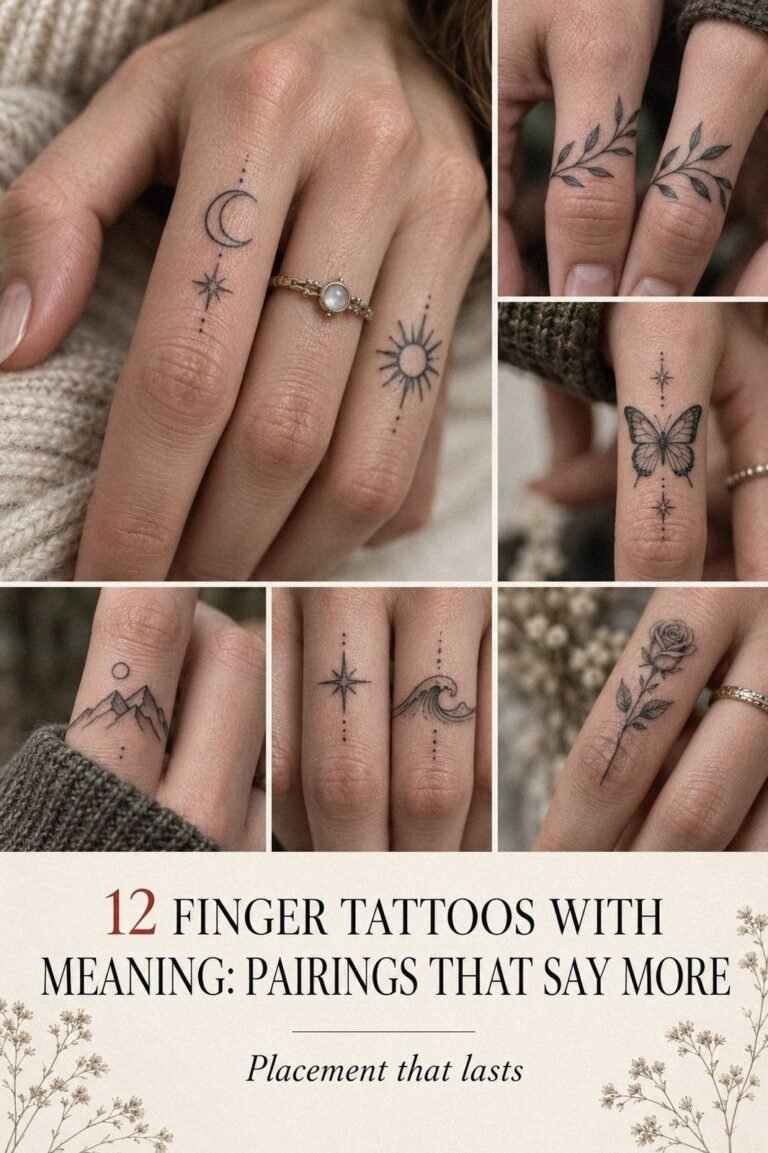
- Fingers / hands: Risky for longevity but conceptually sharp. A keyhole on the knuckle or between thumb and forefinger turns the hand into a door.
Avoid areas with heavy flexion or distortion: the inner elbow, the wrist’s underside, the stomach. The keyhole’s precise geometry warps easily and looks sloppy when stretched.
How It Ages on Skin
Keyhole tattoos face specific aging challenges because of their defining feature: the border.
The Outline Problem
Most keyholes rely on a crisp perimeter to read as a keyhole at all. Over time, all lines spread slightly, more on areas with movement, sun exposure, or weight fluctuation. A line that started at 3mm might double. The interior negative space shrinks. The keyhole can become a blob if the original border was too thin or too close to the interior image.
Interior Detail Fading
When the keyhole frames a scene, an eye, a galaxy, a room, the interior work typically uses finer lines and softer shading than the border. That interior detail fades faster. Within five to ten years, you may have a solid dark outline with a ghosted interior. Plan for this: either accept the fade as part of the aesthetic, or design the interior with bolder elements that hold.
Black and grey ages more predictably than color for this motif. If you want color inside the keyhole, restrict it to saturated, simple shapes rather than subtle gradients.
Common Variations & Styles
The keyhole’s simplicity makes it adaptable across tattoo genres, though some approaches suit it better than others.
- Traditional / neo-traditional: Heavy black outline, limited interior palette, often paired with a banner or key. Reads immediately, lasts well.
- Blackwork: Solid black keyhole with negative-space interior. Stark, graphic, ages excellently because there’s minimal fine detail to lose.
- Single needle / fine line: Delicate, often with photorealistic interiors. High risk for aging; requires touch-ups and sun protection. Best for collectors who understand the trade-off.
- Illustrative / etching style: Crosshatched shading inside the keyhole, woodcut textures. The interior detail holds better than smooth gradients because the texture disguises minor blur.
- 3D / trompe l’oeil: Rendered to look like actual metal sunk into skin. Effective for a few years, but the dimensional illusion breaks down as the tattoo settles and the skin texture changes.
Popular interior images include: an eye (watching or being watched), a heart (romantic or anatomical), a skull (memento mori), a landscape (escape, longing), and pure black void (the unknown).
Design Tips & Pairings
Building a strong keyhole tattoo requires thinking about the relationship between container and content.
Scale & Detail Matching
The keyhole’s size determines what can live inside it. A two-inch keyhole cannot hold a readable portrait. Either enlarge the whole piece or simplify the interior to iconic shapes: a crescent moon, a single flower, a silhouette. If you need complex interior detail, the keyhole itself should be four inches or larger, or placed on a flat area like the thigh or upper back.
Complementary Motifs
Keys are the obvious pairing, but consider the relationship. A key and keyhole on the same body can feel literal; separate them (key on one arm, keyhole on the other) for a more dynamic concept. Locks, chains, and doors extend the vocabulary. A keyhole with a broken lock suggests liberation. A keyhole with a spiderweb suggests long abandonment.
Text banners work if kept minimal, a single word, a date. The keyhole already communicates so much conceptually that verbose text over-explains and weakens the image.
Before You Decide
The keyhole tattoo tempts because it seems simple: a small shape, big meaning. But its very simplicity exposes technical flaws. A crooked keyhole reads as a mistake, not style. A faded keyhole reads as a stain. Before committing, look at healed photos, not just fresh work. Ask your artist how they plan to handle the border weight relative to the interior, and whether the design accounts for ten years of spread.
Consider also the social readability. The keyhole’s voyeuristic connotation lands differently in professional contexts than, say, a floral motif. Its strength, immediate symbolic charge, is also its limitation. You cannot easily explain it away as purely decorative. Make sure that charge aligns with what you actually want to carry.
Frequently Asked Questions
Does a keyhole tattoo always mean something secretive?
Not necessarily. While secrecy is common, many wearers use it to symbolize discovery, perspective, or a threshold they’ve crossed. The interior image usually clarifies the specific meaning.
What’s the best size for a keyhole tattoo to stay readable?
At least two inches in height for a simple outline keyhole, and four or more if you want detailed interior imagery. Smaller than that, and the shape blurs into an unrecognizable oval within a few years.
Can a keyhole tattoo be covered up easily if I change my mind?
The dark outline makes it challenging. Solid black borders are harder to mask than softer, shaded designs. If cover-up potential matters, ask your artist to keep the border lighter or incorporate more surrounding elements from the start.
Why do so many keyhole tattoos include an eye inside?
The eye creates a recursive effect: someone looking through a hole that someone else might look through. It plays with watching and being watched, which amplifies the keyhole’s themes of privacy, access, and perspective.
Related Tattoo Meanings
- Ankh Tattoo Meaning: Life, Eternal Life and Balance
- King Chess Piece Tattoo Meaning: Power, Strategy Self-Rule
- Larkspur Tattoo Meaning: July Birth Flower Symbolism
- Explore more