
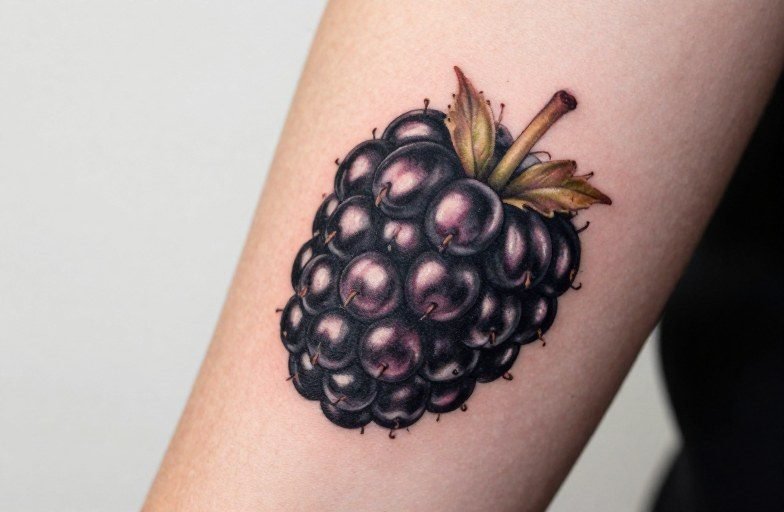
A blackberry tattoo carries layered symbolism rooted in the plant’s dual nature: lush, edible fruit protected by fierce thorns. It speaks to resilience, the sweetness earned through struggle, and abundance that doesn’t come without cost. The meaning centers on protective growth, thriving despite, or because of, the defenses you’ve had to build.
Symbolism & Core Meaning
The Thorn-Fruit Paradox
Blackberries embody contradiction in a way few plants do. The same cane that offers juicy fruit will draw blood if you grab carelessly. This makes the tattoo resonant for people who’ve learned that openness requires boundaries, that generosity and self-protection aren’t opposites but partners. The thorns aren’t obstacles to the fruit; they’re the reason the fruit survives to ripen.
Unlike roses, where thorns guard a largely decorative bloom, blackberry thorns protect something nourishing and perishable. The symbolism tilts toward practical resilience rather than romantic defense. Someone drawn to this image often identifies with having had to become tough to preserve something tender inside.
Seasonal Cycles & Patience
Blackberries don’t rush. The canes overwinter bare, leaf out in spring, flower in early summer, and fruit ripens gradually through late summer into fall. A tattoo can emphasize this timeline, buds, white flowers, green fruit, and dark ripe berries all on the same cane, to represent patience, maturation, or the value of waiting for the right moment. The plant’s biennial rhythm (canes fruit in their second year, then die back) also carries natural symbolism of legacy: the fruit comes from growth you didn’t see planted.
Design Tips & Pairings
Working with the Plant’s Architecture
Blackberry canes arc and loop in distinctive ways, creating natural movement for tattoo composition. The compound leaves with serrated edges offer fine detail work that holds up well at small sizes, though the berry clusters themselves need adequate space to read as fruit rather than ambiguous dots. Line weight matters: delicate thorns on thin canes suit fine-line styles, while bolder traditional work benefits from heavier outlines and saturated purple-black berry fills.
- Color vs. black and grey: Ripe berries read as deep purple-black; unripe red fruit adds narrative contrast. Black and grey can emphasize form over ripeness, suggesting memory or endurance rather than harvest.
- Pairing with fauna: Bees and butterflies have genuine ecological relationships with blackberry flowers. Avoid random additions, stick to species that actually interact with the plant.
- Complementary flora: Wild roses, honeysuckle, or elderberry share habitats and blooming seasons, creating coherent meadow compositions without feeling like a grocery list of symbols.
Negative Space & Background
The dense, messy growth habit of blackberry brambles translates poorly to tattoo if rendered literally. Skilled design simplifies the tangle into readable layers: foreground canes with berries, midground leaves, and suggested depth behind. Too much overlapping reads as mud on skin, especially as aging blurs fine detail. Some of the strongest blackberry tattoos use the plant’s natural arching form to frame another element, a quote, a date, or a small animal, without crowding.
Best Placements
Forearms and calves offer the length to show cane curvature and leaf progression. The outer upper arm accommodates clustered berry compositions with surrounding leaves. Ribs and sides follow the body’s natural lines well but require the client to tolerate longer sessions for the fine detail berries demand.
Smaller placements, behind the ear, on the wrist, or ankle, work best with single berry clusters or simplified cane sections rather than full botanical accuracy. Finger tattoos of single berries are possible but fade quickly; the small size forces extreme simplification that loses the plant’s character.
Thigh and hip placements suit larger, more sprawling designs that incorporate multiple growth stages. The skin’s relative stability there preserves fine detail longer than high-movement areas like the inner bicep or sternum.
History & Cultural Roots
European & North American Contexts
Blackberry brambles colonized disturbed ground across temperate regions so aggressively that they became associated with abandonment and the reclamation of human spaces. In parts of Appalachia and the rural South, blackberry picking remains a living seasonal practice, giving the tattoo genuine regional resonance for people with those roots. The plant’s spread through English hedgerows and Irish boreens connects it to working landscapes rather than cultivated gardens, useful, slightly wild, and common.
Indigenous food traditions across the Pacific Northwest and California incorporated native trailing blackberries and related Rubus species, though specific symbolic associations vary by nation and shouldn’t be generalized. The commercial blackberry is largely a European-derived cultivar, so cultural claims need care.
Agricultural & Domestic Associations
Before industrial agriculture, blackberry picking was children’s work in many rural communities, accessible, seasonal, slightly dangerous. This gives the tattoo potential resonance with childhood independence, rural identity, or the specific texture of summer memory. The scratches and stained fingers were part of the cost, not accidents to avoid.
Mythology & Folklore
European Folk Beliefs
Multiple traditions held that blackberries shouldn’t be picked after Michaelmas (September 29), often linked to the legend that the devil spat or stepped on them. This folk prohibition reflects actual late-season fruit quality decline and wasp infestation, but gathered supernatural weight. A tattoo referencing this might use overripe, slightly ruined fruit to suggest liminal timing, harvesting at the edge of propriety or safety.
Some English folklore associated brambles with protection. Cane arches were sometimes planted at cottage doors, and in some accounts, branches were used in folk practice. The plant’s practical usefulness, food, medicine, barrier hedge, supported its magical reputation rather than replacing it.
Christian Symbolism
The crown of thorns in some medieval and folk art was occasionally depicted using blackberry or other bramble species rather than specifically acacia. This association remains marginal and contested, use it only if you have specific personal or denominational connection, not as general “deep meaning.” The berry’s blood-dark juice and the thorns’ pain make the visual connection obvious enough to resonate without requiring doctrinal endorsement.
Common Variations & Styles
Traditional American tattoo renders blackberries with bold black outlines, limited purple and green color palette, and simplified leaf shapes. The style sacrifices botanical accuracy for immediate readability and aging resilience. Neo-traditional allows more naturalistic color gradation in berries while keeping the graphic structure.
Botanical illustration style pursues accuracy: serrated leaf edges, correct berry clustering (the aggregate fruit structure), and proper cane architecture with its characteristic powdery bloom. This demands skilled color packing to achieve the berry’s dusty deep purple. Watercolor techniques can suggest the juice’s staining quality but risk becoming unrecognizable abstraction without enough structural line.
Single-needle and fine-line work suits the thorn’s delicacy and the leaf’s veining but struggles with the berry’s dark value, solid black fills on tiny needles blur faster than traditional approaches. Some artists solve this by using slightly larger scale than typical fine-line botanicals or by accepting that the berries will soften to dark blobs over decades.
Abstract and geometric interpretations exist but rarely succeed; the blackberry’s meaning depends on recognizing the specific plant. Without thorns and berry structure, it becomes generic fruit or meaningless shape.
Key Takeaways
A blackberry tattoo works when the design respects the plant’s actual character: protective, productive, slightly untidy, and seasonally specific. The symbolism of resilience-through-defense resonates most when the visual includes both thorns and fruit, not one sanitized away. Placement and style choices should account for how fine detail ages, berries need enough size and solid value to remain readable, and the natural cane curvature should flow with the body’s movement rather than fight it.
The meaning isn’t imposed from outside but emerges from the plant’s biological reality: you don’t get the sweetness without navigating the defense. That’s not metaphor, that’s how blackberries grow.
Frequently Asked Questions
Do blackberry tattoos work well in black and grey, or do they need color?
Black and grey works beautifully, especially for emphasizing thorn structure and the plant’s architectural qualities. Color adds the specific ripeness narrative, green to red to deep purple, but isn’t required for the symbolism to read clearly.
How well do the fine details in blackberry leaves and thorns hold up over time?
Leaf serration and thin thorns blur faster than bold outlines. Solid berry fills and strong cane lines age best; plan for touch-ups if you want fine detail preserved, or design with slightly heavier line weight from the start.
Can a blackberry tattoo reference a specific person or memory without adding portraits or names?
Yes, through specific seasonal stages (the flower they loved, the ripeness when you picked together), companion plants from a shared place, or placement that maps to a meaningful body location. The plant itself carries memory without needing literal text.
What’s the difference between a blackberry and a raspberry tattoo symbolically?
Raspberries share the Rubus genus and thorn-fruit structure, but blackberries carry stronger associations with wildness, hedgerow foraging, and late-summer endurance. Raspberries read more cultivated and delicate; the choice depends on which quality you identify with.
Related Tattoo Meanings
- Blueberry Tattoo Meaning: Symbolism, Folklore Style
- Blackbird Tattoo Meaning: Symbolism, Styles What to Know
- Blessing Thai Tattoo Meaning: Sacred Ink and Its Significance
- Explore more









