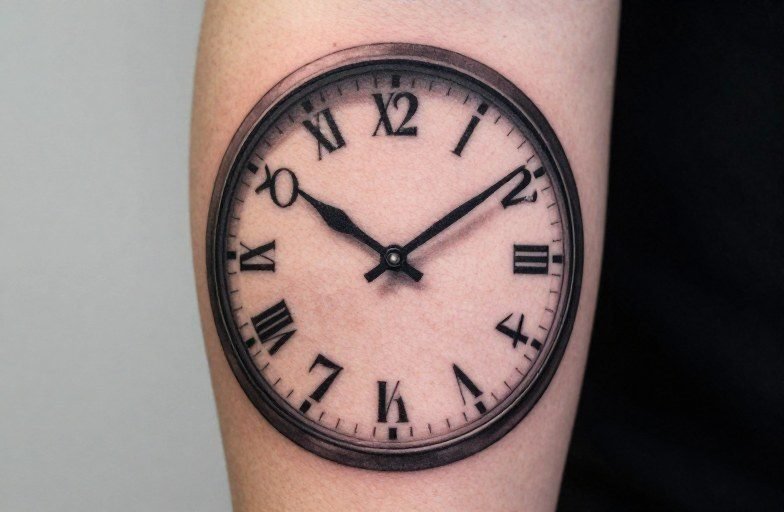
A realistic clock tattoo reproduces the look of an actual timepiece, complete with numbered or Roman numeral faces, functioning hands, visible gears, and metallic reflections, rendered with the shading, perspective, and detail you’d expect from a photograph. Unlike traditional or neo-traditional clock designs that flatten and stylize, this approach demands technical precision: correct ellipses for tilted faces, consistent light sources, and convincing depth that makes the mechanism appear three-dimensional on curved skin.
Linework & Technique
Clock faces are merciless. A slightly uneven circle reads as amateur; a Roman numeral set at the wrong angle breaks the illusion instantly. The foundation starts with geometrically perfect linework, usually mapped with a stencil that accounts for the body’s natural curves. From there, the artist builds tone through layered greywash and selective black saturation.
Face and Hands
The dial presents specific challenges. Numbers must shrink correctly with perspective if the clock tilts. Minute and hour hands need crisp edges but subtle gradients to suggest thickness, not cardboard flatness. Many artists use a single-needle setup for the thinnest elements, the pinion where hands meet, the hairline marks between numerals. White ink, applied sparingly at the end, creates glass reflections or the glint on polished metal.
Gears and Interior Mechanics
Exposed movement pieces add complexity. Each gear tooth catches light differently; the spacing between cogs must read as functional, not decorative. Artists typically work from reference photos of actual watch calibers, simplifying only where detail would muddy at tattoo scale. Depth comes from cast shadows, soft greys behind each gear plate, darker tones where mechanisms overlap.
Modern Variations
Contemporary realistic clock work rarely stands alone. Common pairings include:
- Roses or botanicals: Soft organic forms against hard mechanical precision, with petals overlapping the clock edge for depth
- Skulls: Often positioned behind or integrated into the clock face, with bone texture rendered in the same tonal range as aged metal
- Maps or coordinates: Faded parchment tones behind a pocket watch, suggesting specific times and places
- Smoke or abstract dissolution: Clock elements fragmenting into particles, requiring smooth greywash transitions
Some collectors opt for hyperrealism, extreme close-ups of a single watch component, like a balance wheel at actual size, filling an entire forearm. Others prefer double exposure effects, where a landscape or portrait occupies the negative space within the clock hands. These hybrids demand artists equally comfortable with photorealism and conceptual composition.
Who It Suits
Realistic clock tattoos favor specific placements and body types. The style’s fine detail requires relatively flat, stable skin that won’t distort significantly with movement or weight change.
Best Placements
- Outer forearm: Flat plane, visible for appreciation, large enough for a pocket watch with chain
- Upper arm/shoulder cap: Natural curve suits a tilted clock face; surrounding muscle provides framing
- Thigh: Ample space for complex mechanisms with gears; less sun exposure aids longevity
- Side of torso: Challenging but effective for elongated grandfather clock faces, following the rib line
- Hands and fingers: Only for simplified watch faces; full realism fails at this scale due to ink migration
People with significant freckling or moles in the planned area should discuss coverage strategy, realism depends on uninterrupted skin tone for shading gradients. Very dark skin presents additional challenges: without white highlight capability, metallic effects require careful negative space planning and higher contrast blacks.
Collector Mindset
This style attracts people patient with process. Multiple sessions, higher costs, and longer healing for dense black areas aren’t negotiable. The subject matter, time, mortality, memory, resonates broadly, but the style choice signals someone who values technical execution over symbolic shorthand.
How It Ages
Clock tattoos age predictably, which is both strength and vulnerability. The fine linework that makes Roman numerals legible at year one blurs by year ten. Single-needle details in the movement become indistinct mush. White highlights, which oxidize and fade fastest, may disappear entirely within five years.
What Holds
Bold black outlines around the clock perimeter remain visible longest. The overall silhouette, round face, hanging hands, gear clusters, survives even when interior detail degrades. Solid black backgrounds, increasingly popular for contrast, age more gracefully than stippled or greywash alternatives.
What Degrades
- Thin minute marks between numerals
- Individual gear teeth
- Subtle metallic gradients on clock hands
- Reflected light spots (white ink)
- Fine chain links on pocket watch variants
Long-term maintenance means accepting softening or budgeting for touch-ups every 7-10 years. Some collectors intentionally design with aging in mind, larger numerals, simplified movements, heavier black anchors, trading initial delicacy for longevity.
Cost & Sessions
Realistic clock work sits in the upper price tier. The geometric precision, extensive reference consultation, and slow shading application reward artists who work methodically, not quickly.
Session Breakdown
A straightforward pocket watch with minimal background runs 4-6 hours for a competent artist. Add exposed gears, a rose with detailed petal work, or a custom-designed face, and you’re looking at 10-15 hours across multiple appointments. Large compositions, full sleeves incorporating multiple timepieces, or chest pieces with melting clock elements, can exceed 30 hours.
Pricing structures vary: hourly rates ($150-400 depending on region and artist reputation), day rates for extended sittings, or flat project quotes. Highly sought-after realism specialists often book months ahead and may require deposits. The investment reflects not just time but the specialized skill, wrong-angle clock faces are permanent, and cover-ups of botched realism are notoriously difficult.
Aftercare Notes
Clock tattoos typically carry heavy black saturation, especially in backgrounds and gear shadows. This means more plasma and ink discharge during initial healing, and a higher scab burden than lighter styles.
Healing Specifics
Keep the area clean and lightly moisturized, but don’t overdo it, thick ointment layers can pull out fine detail as scabs soften and detach. Sleep positions matter: forearm clocks suffer if you roll onto them night one; torso pieces stick to sheets. Loose, breathable clothing prevents friction on healing surfaces.
Sun protection is non-negotiable. UV exposure degrades black ink fastest where it’s most concentrated, and clock tattoos rely on black contrast. A healed piece left unprotected fades from crisp mechanism to grey smear within a few summers. Plan for lifelong SPF application or clothing coverage.
Touch-up timing: wait at least two months after final healing. Rushing back in damages already-settled skin and wastes ink. When you do return, focus on the elements that faded most, usually highlights and thinnest lines, rather than reworking the entire piece.
Final Word
Realistic clock tattoos occupy a demanding niche: they require artists with geometric discipline, tonal control, and the patience to build mechanical complexity layer by layer. For collectors, they offer a style that reads immediately as skilled craftsmanship, though that same precision makes them vulnerable to time’s own effects. Choose an artist whose healed work you’ve examined in person, not just fresh photos. Ask about their reference process, their stencil approach for circular elements, and how they’ve handled aged pieces. The best clock tattoos result from collaboration between someone who knows watches and someone who knows skin, two kinds of timekeepers, both essential.
Frequently Asked Questions
Do clock hands need to point to a specific time?
Many people choose meaningful times, birth hours, memorial moments, though the hands can also sit at 10:10, the retail display position that frames the brand logo symmetrically. Just ensure your artist understands the significance before committing to placement.
Can a realistic clock tattoo be done small?
Not successfully. Below three inches in diameter, numerals blur together and gear details become indistinguishable within a few years. If you need something compact, consider a stylized or traditional approach rather than forcing realism into inadequate space.
Why do some realistic clocks look distorted after healing?
The artist likely failed to account for body curvature during stencil application. A perfect circle drawn flat distorts when wrapped around a cylinder like an arm. Proper artists map ellipses that appear correct from the viewing angle, not geometrically perfect from above.
Is black and grey the only option for realistic clocks?
While most collectors choose black and grey for its classic association with photography and metalwork, color realism works for specific effects, gold pocket watch cases, verdigris on aged copper, or the blue glow of radium dial paint. These require artists experienced in color saturation and its different aging behavior.
Related Style Guides
- Realistic Eyeball Tattoos: Complete Style Guide
- Realistic Fire Tattoos: A Complete Style Guide
- Realistic Galaxy Tattoos: Complete Style Guide
- Explore more