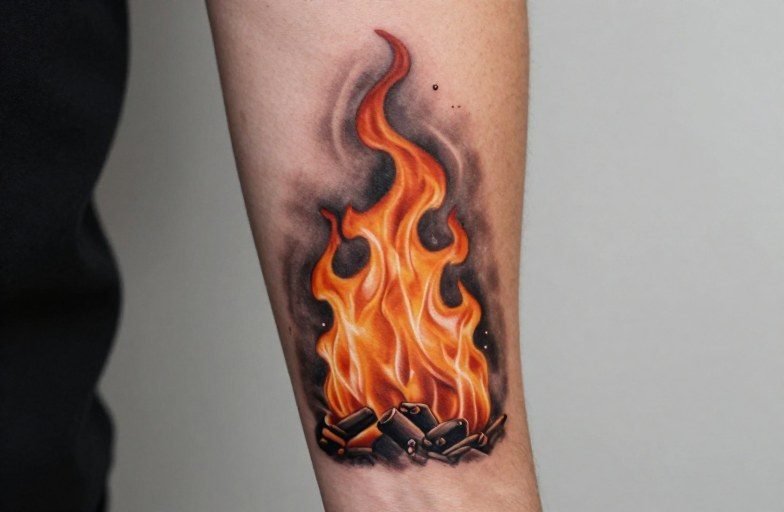
Realistic fire tattoos aim to replicate the volatile, luminous quality of actual flame rather than the flat, stylized orange-and-yellow symbols common in traditional Americana. The goal is convincing heat: light that seems to emanate from the skin, edges that dissolve into smoke, coals that glow with residual warmth. This demands a specific technical approach, one that borrows from photorealism but adapts it to a subject that has no fixed form.
Linework & Technique
Building Flame Structure
Fire has no outline in nature, so heavy black contour lines kill the illusion immediately. Instead, artists map the flame’s movement with soft gray washes or extremely fine single-needle passes that establish shape without boxing it in. The core technique relies on whip shading and smooth color transitions, often called “color packing” in softer tones, to create the temperature gradient from white-hot center to cooler outer edges.
White ink plays a critical role, but not the way beginners assume. Packed white highlights sit on top of healed yellows and pale oranges to suggest the hottest points where combustion is most intense. This only works if the white is applied with enough density; sparse white heals to a chalky gray that reads as ash, not light. Many artists lay white twice: once during the initial session, again after healing when the surrounding colors have settled.
Negative Space as a Tool
Skin tone itself becomes part of the palette. The brightest “white” in a flame is often un-inked skin, particularly at the tips where fire becomes translucent. Strategic negative space prevents the tattoo from becoming a muddy orange blob. This requires planning during the stencil phase, mapping exactly where skin will show through, where it will carry a whisper of pale yellow, and where it needs saturated red-orange density.
- Single-needle or tight 3-round liner for wispy smoke tendrils
- Color packing with 7-11 mag for smooth orange-red gradients
- Gray wash (20-40% black dilution) for charred wood or coal bases
- White ink applied last, with a second pass at 6-8 weeks healed
Aftercare Notes
Fire tattoos with heavy color saturation and white ink are prone to patchy healing. The pale tones, yellows, light oranges, white highlights, are the first to fall out if scabs are disturbed or if the client works out aggressively during the first two weeks. Moisture management matters more than with black-and-gray pieces; color fire needs to stay slightly hydrated but never soggy, since oversaturated skin leaches pigment.
White ink specifically can yellow during healing as plasma and lymphatic fluid mix with the pigment. This usually resolves by week three, but panicked clients often over-moisturize, trapping bacteria. The rule is thin layers, frequent washing, and no picking at the inevitable milky film that forms over bright colors.
Sun exposure is the long-term enemy. UV degrades the red and orange pigments fastest, turning bold flame into dull rust. A healed fire tattoo needs SPF 50+ whenever it’s exposed, or the color investment degrades within a few summers.
Modern Variations
Biomechanical and Organic Fusion
One prevalent direction integrates flame with mechanical or biological elements, engines with exhaust fire, skulls with ignited craniums, phoenixes rendered with anatomical feather texture rather than stylized curves. These hybrids demand that the artist understand both the realistic fire technique and the contrasting structure it’s attached to. Metal catching fire, for instance, needs reflected orange light on its surfaces, not just flame behind it.
Monochrome and Limited Palette
Not all realistic fire relies on full color. Black-and-gray fire, using only value shifts to suggest heat, has gained traction for clients who want the dynamic movement without the maintenance burden of saturated pigment. The limitation forces stronger composition, without color temperature to do the work, the flow and negative space must be impeccable. Some artists restrict themselves to red-only palettes, letting a single hue carry the entire temperature narrative through density variation.
- Full color: white, yellow, orange, red, deep burgundy, black smoke
- Black and gray: 10-15% black for hottest points, 80%+ for cooled edges
- Single-color red: demands extreme precision in value separation
How It Ages
Realistic fire tattoos age unevenly by design. The pale, airy tips, the parts that read as hottest and most ethereal, are also the least saturated with pigment. Over five to ten years, these areas fade toward invisibility, while the dense orange-red cores remain visible. This isn’t necessarily failure; it can mimic the natural behavior of fire itself, where outer edges are always dissipating. However, clients expecting the original photograph to hold indefinitely will be disappointed.
White ink is the first to vanish or discolor, often within three to five years depending on sun exposure and skin type. The smart approach is designing with aging in mind: ensuring that even with white loss, the flame structure still reads through color value and shape. A tattoo that depends entirely on white highlights for its structure will look collapsed within a decade.
Blurred edges, once a flaw in other styles, can actually benefit fire pieces. Slight diffusion mimics the atmospheric distortion of real heat. The danger is uncontrolled blowout in the dense color zones, where orange and red merge into a single brownish mass. Proper needle depth and consistent hand speed prevent this, rushing color packing is the most common technical error.
Who It Suits
Skin tone significantly affects how realistic fire reads. On very light skin, the negative space technique shines, skin tone genuinely contributes to the brightest values. On darker skin, the same approach can look like incomplete tattooing unless the artist shifts strategy, using pale yellow and dense white as the light source rather than relying on skin contribution. The most successful fire tattoos on deep skin tones use higher contrast and more saturated cores, accepting that the outer wispy edges will be suggested through darker surrounding values rather than pale ones.
Commitment level matters. This style requires touch-ups more predictably than bold traditional work. Clients who want low-maintenance ink should consider black-and-gray variants or accept that color refresh sessions every several years are part of owning this aesthetic.
Best Placements
Flow and Movement
Fire tattoos need space to breathe. The subject is inherently directional, flame rises, spreads, consumes. Compressing it into a rigid geometric shape fights the natural form. Forearms, calves, and ribs offer the elongated canvas where flame can move vertically or horizontally without distortion. Wraparound designs on the upper arm or thigh work well when the flame appears to spiral with the limb’s curvature.
Problem Areas
Hands and feet present difficulties. The dense color packing required for fire’s core saturation doesn’t hold well in high-wear zones, and the fine negative-space tips blur quickly with constant skin regeneration. Finger flame tattoos almost always age to orange smudges. Similarly, the center of the chest, while offering flat workspace, often stretches and compresses with breathing and movement, distorting the delicate value gradients that make fire convincing.
- Strong: outer forearm, calf, side rib, outer thigh, shoulder cap
- Moderate: inner bicep, upper back, sternum (with design adaptation)
- Weak: fingers, tops of feet, center chest, behind knee
Key Takeaways
Realistic fire tattoos succeed when they prioritize light behavior over literal color reference. The technique demands soft edges, strategic negative space, and careful white ink application, not the bold outlines and flat fills of traditional fire imagery. Color saturation in the core values must be dense enough to survive healing and aging, while the palest areas are accepted as temporary by design. Placement should follow the body’s natural flow rather than fighting it, and clients need to understand that maintenance, including sun protection and eventual touch-ups, is built into owning this style. The reward is a tattoo that genuinely seems to generate heat, a difficult illusion that separates accomplished color work from mere decoration.
Frequently Asked Questions
How long does a realistic fire tattoo take compared to other color pieces?
Expect longer sessions. The smooth gradients and multiple color passes, often including a dedicated white-ink stage, mean a palm-sized fire piece can take 4-5 hours where a simpler color design might take 2-3. Large compositions with smoke and surrounding elements frequently require multiple sessions.
Can realistic fire be covered up if I change my mind?
Difficult but not impossible. The dense dark areas (black smoke, deep red cores) provide cover-up potential, but the pale, airy tips with minimal pigment are hard to mask. A skilled cover-up artist would need to design something that incorporates or obscures those light zones specifically.
Why do some fire tattoos look like orange blobs after healing?
Usually two reasons: insufficient negative space planning, so colors merge without value separation, or poor healing with scab damage that pulls out the pale defining tones. The orange core survives while the structural highlights and edges are lost, leaving undifferentiated color.
Is black-and-gray fire easier to maintain than full color?
Slightly. Without red and orange pigments, you avoid the fastest-fading colors and the yellowing tendency of white ink. However, black-and-gray fire demands exceptional value control, any muddiness in the gray wash reads as failed technique rather than natural color variation.
Related Style Guides
- Realistic Galaxy Tattoos: Complete Style Guide
- Realistic Goat Tattoos: Complete Style Guide
- Realistic Graveyard Tattoos: Complete Style Guide
- Explore more