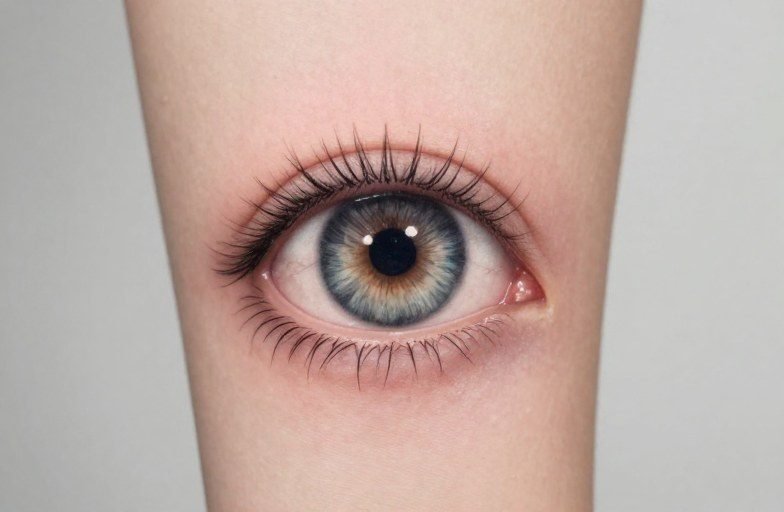
A realistic eyeball tattoo reproduces the human eye with photographic accuracy, the iris’s fibrous detail, the sclera’s subtle veining, the cornea’s wet gleam, the soft fold of the eyelid. Done well, it unsettles because it looks alive. Done poorly, it flattens into a glassy marble. This guide covers what separates the two, where the style works on skin, and how to plan for the long haul.
Key Characteristics & Motifs
The Anatomy That Matters
Realistic eyeball tattoos hinge on specific anatomical landmarks. The iris isn’t a flat color disk; it’s compressed muscle fibers radiating from the pupil, with color variation between the inner and outer rings. The limbal ring, that dark border, grounds the eye in dimension. Scleral veins should be fine, branching, and slightly bluish or reddish, not thick red sharpie lines. The tear duct’s pink flesh and the caruncle’s tiny lobes add authenticity most people can’t name but subconsciously register.
Reflections sell the wetness. A realistic eye needs at least one highlight, usually positioned to suggest a light source, plus secondary softer reflections. Without them, the eye looks dried out. Some designs incorporate the surrounding socket, wrinkled skin, lashes, the orbital bone’s shadow, to frame the eyeball itself.
Common Compositional Variations
- Isolated eyeball: Floating, no context, maximum surreal impact. Demands perfect technical execution since there’s nowhere to hide.
- Eye in hand: The classic “Hand of Fatima” or occult reference, but rendered photoreal rather than symbolic. Skin texture on the palm against the eye’s wet surface creates contrast.
- Socket-integrated: The eye emerging from or set into torn skin, a skull cavity, or mechanical housing. Requires the artist to match the eye’s polish to the surrounding texture.
- Multiple eyes: Clustered, watching different directions, often with slight variation in dilation or reflection to avoid clone-stamp repetition.
Color vs Black and Grey
What Color Actually Adds
Color eyeball tattoos live or die on iris accuracy. Hazel, amber, and green eyes need layered yellows, golds, and desaturated olives. Blue eyes often read flat without violet shadowing near the limbal ring and warm ochre flecks. Brown eyes seem simplest but require black-brown separation to avoid mud. The sclera is never pure white, it’s blue-grey, pink-veined, shadowed where the eyelid would press.
Color saturation in eye tattoos faces a specific problem: the small working area. Blending happens under a magnifying lamp with 3RL and 5RL needles, sometimes single needle for hairline veins. Color packing must be dense enough to hold but not so heavy that healing obliterates detail. Expect longer sessions and higher cost for color work.
Black and Grey Advantages
Black and grey eyeball tattoos rely on value range rather than hue. A properly executed greyscale eye can read as strikingly realistic because value contrast carries form when color is absent. The sclera becomes a study in subtle greys; the iris a push-and-pull of black, charcoal, and near-white. Healing tends to be more forgiving since greywash settles more predictably than color. For large-scale pieces where the eye is one element among many, say, a full face or skull, black and grey maintains cohesion.
Some artists combine approaches: black and grey socket and surrounding skin, color iris only. This draws focus efficiently but requires the color to be absolutely accurate, since it becomes the single chromatic element.
Best Placements
Flat Planes and Visibility
The eyeball’s roundness reads best on relatively flat skin with minimal distortion from movement. The outer upper arm, outer thigh, and calf’s outer face provide stable canvases. The chest works if positioned away from the pectoral’s heavy flex zone; center chest pieces with an eye often see the iris stretch and compress with breath and muscle movement.
Hands and fingers are popular for the “all-seeing” or “Hand of Fatima” concept, but they’re brutal on detail. Finger skin is thin, vascular, and sheds ink rapidly. A realistic eye here becomes a suggestion of an eye within two to three years. If you’re committed to hand placement, scale up, simplify the iris pattern, and accept it as a bold graphic rather than micro-realism.
Scale Constraints
Realistic eyes need minimum size to resolve detail. At under two inches in diameter, the pupil becomes a dot, the iris a smudge, and veins disappear entirely. Three to four inches allows proper fibrous detail. Larger, six inches or more, lets the artist render the cornea’s curvature through subtle greyscale shift, the moist meniscus at the eyelid margin, individual lash follicles. Consider the surrounding design: an eyeball that large needs context or it dominates awkwardly.
Choosing the Right Artist
Portfolio Red Flags and Green Lights
Look for healed photos, not just fresh work. Fresh eye tattoos look deceptively good, blood and plasma create temporary saturation that masks future settling. Healed eyeballs reveal whether the artist understands how much to overpack for hold, how to keep whites from going chalky, whether veins stay fine or bloom into bruise-like patches.
Specifically seek portfolios with:
- Multiple eyeball or eye-region pieces (not one fluke)
- Clear iris detail at close range in healed photos
- Consistent reflection placement that suggests understanding of light source
- Work in your preferred scale, micro-realism specialists differ from large-scale portrait artists
Ask directly about their needle grouping preferences for eye work. Single needle or 3RL for fine detail, 7-9RL for bolder elements, mag shaders for soft scleral tone. An artist who can’t specify likely hasn’t thought through the technical demands.
Consultation Specifics
Bring reference photos of real eyes, not other tattoos. The artist needs to study actual anatomy, not filtered Instagram versions. Discuss whether you want a specific person’s eye, requires extreme precision, or a generic but convincing eye, which allows more artistic interpretation. If you want an unusual iris color (violet, heterochromia, completely black sclera), understand that some effects read as realistic only within certain contexts; an all-black eye with no sclera detail becomes graphic horror, not realism.
How It Ages
The Specific Degradation Pattern
Eyeball tattoos age from the details inward. Fine veins blur first, becoming indistinct reddish haze. The iris’s outer fibrous ring softens, reducing the sharp limbal definition that separates iris from white. Highlights, being un-inked skin or near-white ink, can yellow slightly or be lost to sun exposure. The pupil, if solid black, holds but may expand visually as surrounding greywash settles.
Color eyes face additional challenges: blue and green pigments fade toward grey, warm tones (amber, hazel) tend to hold better but can shift orange. Scleral “white” without enough grey undertone heals to a dingy parchment that reads as infection rather than shadow.
Maintenance and Touch-Up Reality
Plan for a touch-up at 3-5 years, sooner if sun-exposed. The eye’s small scale makes touch-ups technically demanding, adding to existing detail without blowing out previous work requires the original artist or someone equally precise. Moisturize religiously; dry skin makes the sclera look cracked and ancient. Sunscreen is non-negotiable; UV degrades the subtle greys that create roundness faster than it affects bold blackwork.
Long-term, expect the eye to become slightly more “illustrative” and less “photographic.” This isn’t failure; it’s the nature of pigment suspended in living tissue. The goal is maintaining enough information for the viewer’s brain to still read it as a sphere with depth, wetness, and intention.
Common Mistakes to Avoid
Overloading symbolism kills the realism. An eyeball with a pyramid, a clock, and a rose jammed in becomes a collage, not a convincing organ. Pick one contextual element or none. Similarly, adding a literal “cry” with cartoon tears or blood drips undercuts the realism you’ve paid for in technical execution.
Placement without movement consideration ruins the effect. An eye on the inner bicep that distorts when the arm hangs naturally, or on the ribs where breathing shifts the pupil’s position, breaks the illusion every time you move. The stomach and lower abdomen are particularly treacherous, skin stretch and weight fluctuation turn a sphere into an oval permanently.
Color choice based on “favorite color” rather than anatomical plausibility. Neon green doesn’t exist in human irises; it reads as contact lens or fantasy. If you want unnatural color, commit to the surrealism fully rather than straddling realism and symbolism awkwardly.
Finally, underestimating the time investment. A palm-sized realistic eye in color can take 4-6 hours. Rushing the artist, choosing a shop by price, or splitting across too many sessions with different healing stages risks inconsistent saturation. This is not a walk-in flash piece.
The Takeaway
Realistic eyeball tattoos demand technical precision, anatomical knowledge, and honest planning for how they’ll settle and move with your body. The best ones create genuine unease because they trigger recognition, our brains are wired to read eyes intently, and a convincing fake gets processed before we can intellectualize it. That power comes with responsibility: to the reference material, to the artist’s skill, to the placement’s practicality, and to the maintenance required to keep it readable for years. Get the iris detail right, protect the work from sun, and resist the urge to overcomplicate. A single, perfectly rendered eyeball carries more weight than a crowded symbolic mess ever could.
Frequently Asked Questions
How painful is an eyeball tattoo compared to other realistic designs?
The pain level depends entirely on placement, not the subject matter. An eyeball on the outer upper arm feels like any tattoo there, manageable. On ribs, sternum, or near bone, it’s intense regardless of if you’re getting an eye or a flower. The detailed work itself requires longer sessions, which can wear down your pain tolerance by hour four or five.
Can a realistic eyeball tattoo look like a specific person’s actual eye?
Yes, but it requires an artist experienced in portrait-level iris replication and excellent reference photography with clear light source indication. Even then, skin limits the resolution. You’ll get a convincing likeness, not a fingerprint-level match. Bring multiple photos showing the eye in different lighting conditions.
Why do some eyeball tattoos look ‘dead’ or flat after healing?
Usually because the artist missed the moisture cues, reflections, corneal curvature through subtle greyscale, the soft gradient where sclera meets eyelid skin. Or they overworked the whites, making them opaque and chalky rather than translucent. Sometimes the limbal ring blurred during healing, eliminating the sharp edge that defines the iris as a separate structure.
Is there any placement where an eyeball tattoo should absolutely be black and grey?
Not absolutely, but black and grey performs better on areas with thinner skin or higher movement, hands, feet, inner arm, where color tends to fall out faster. It also suits larger compositions where the eye needs to recede visually among other elements. If you want maximum longevity with minimal maintenance, greyscale is the pragmatic choice.
Related Style Guides
- Realistic Fire Tattoos: A Complete Style Guide
- Realistic Galaxy Tattoos: Complete Style Guide
- Realistic Goat Tattoos: Complete Style Guide
- Explore more