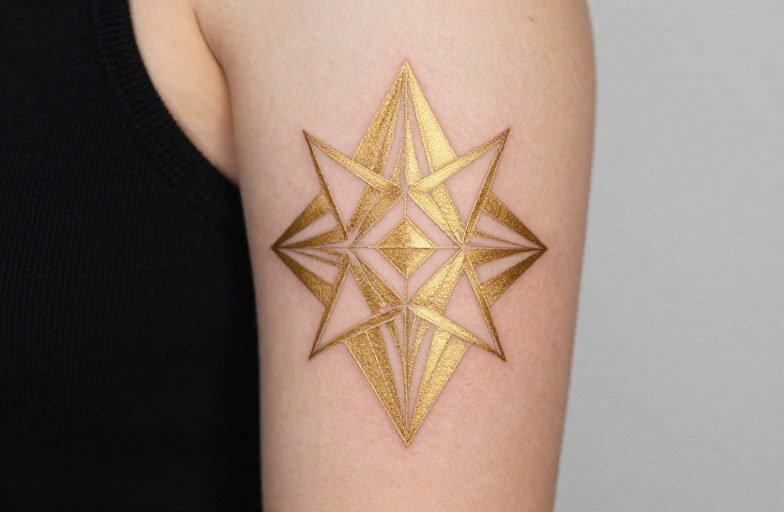
Geometric gold tattoos combine mathematical precision, clean lines, repeating shapes, and sacred ratios, with the warm, luminous quality of gold ink or simulated metallic tones through yellows, ambers, and strategic negative space. The style sits at the intersection of contemporary geometric abstraction and the ancient human impulse to mark skin with patterns that suggest order, value, and light itself.
Key Characteristics & Motifs
The Geometry Behind the Gold
What separates geometric gold from other metallic-leaning styles is the rigor of its underlying structure. Artists typically build compositions from tessellations, the golden ratio (1:1.618), and Platonic solids. Lines must be mathematically exact; a 0.5mm deviation in a mandala’s symmetry destroys the entire effect. Common motifs include:
- Islamic-inspired girih patterns and arabesques
- Sacred geometry: Flower of Life, Metatron’s Cube, Sri Yantra
- Minimalist polygons with gold-fill centers
- Dotwork gradients transitioning into gold-toned regions
- Impossible objects and Penrose triangles with metallic “lighting”
How the “Gold” Achieves Its Effect
True metallic tattoo ink does not exist, no FDA-approved pigment contains actual metal flakes that produce mirror-like reflectivity. Instead, artists create the impression of gold through several techniques. Solid blocks of warm yellow (often ochre, cadmium yellow, or custom-mixed goldenrod) read as metallic when surrounded by black or deep grey. Strategic use of negative space suggests highlights on a reflective surface. Some artists layer white ink over yellow to create “shine” points. The surrounding geometry’s precision is what sells the illusion; loose linework makes gold tones look like flat color, while crisp edges let the eye read them as metal catching light.
Origins & History
The pairing of geometry and gold-toned skin marking has scattered precursors rather than a single lineage. Ancient Egyptian tattooing, often linked to religious and therapeutic practice, included geometric patterns on priestesses; the gold connection is more symbolic than pigment-based, as ochre and yellow pigments were available and associated with solar divinity. Some trace geometric precision in body art to Polynesian tatau, though its palette was traditionally black.
The modern geometric gold tattoo emerged from two converging streams: the 1990s-2000s rise of geometric abstraction in fine-art tattooing (pioneered by artists like Alex Grey-influenced circles and the European technical tattoo scene), and the parallel development of white and yellow ink viability for skin tones beyond very pale. By the early 2010s, artists such as Nazareno Tubaro in Argentina and Peter Walrus Madsen in Denmark were integrating strict geometry with warm tonal fields. The “gold” aspect proliferated through Instagram’s visual economy, where high-contrast black-and-gold compositions photographed dramatically. Today’s practitioners often blend Art Deco revival aesthetics, Islamic geometric tradition, and digital vector-art precision.
Color vs Black and Grey
The Reality of Yellow and Gold Inks
Gold tones present specific technical challenges. Yellow pigments, particularly lighter, more translucent ones, fade faster than black or dark blue. On melanated skin, yellow can heal to a greenish or muddy tone unless the artist selects deeper, more saturated goldenrod bases and builds opacity through multiple passes. White highlights over yellow often disappear entirely on darker skin tones, requiring artists to use negative space or skin-tone “highlights” instead.
Black and grey geometric work with gold accents generally ages better than large gold fields. A solid black mandala with thin gold linework preserves readability for years; a predominantly yellow piece may need significant refreshment within 3-5 years. Some artists now offer “gold effect” using only black, grey, and skin tone, the eye reads the contrast as metallic under good lighting, without the fading liability of yellow pigment.
Skin Tone Considerations
- Fitzpatrick I-II (very fair): Full range of yellows viable; white highlights effective
- Fitzpatrick III-IV (medium): Deeper golds, amber, ochre; avoid pale yellow
- Fitzpatrick V-VI (deeply melanated): Consider black/grey “gold effect” or concentrated small gold elements against dominant blackwork
Best Placements
Flat Planes and Flowing Curves
Geometric gold demands surfaces where lines stay true and where the body doesn’t distort the pattern excessively with movement. The outer forearm’s flat expanse suits medium-sized pieces, mandalas, Platonic solids, or extended tessellations. The upper chest, centered between collarbones, provides a stable canvas for symmetrical work. Thigh fronts and outer calves offer large, relatively flat areas for ambitious compositions.
Curved placements require adaptive geometry. A geometric gold sleeve flowing from shoulder to wrist needs shapes that compress and elongate to follow the arm’s taper. Artists often transition from larger polygons at the shoulder to finer tessellation at the wrist, maintaining visual rhythm while accommodating anatomy. The ribcage and stomach present particular difficulty: breathing and posture shifts distort strict geometry, so artists here often use looser, more organic geometric forms or accept that the piece will “move” with the body.
Small-Scale Precision Spots
Behind the ear, the side of the finger, and the inner wrist can carry small gold-accented geometric marks, tiny triangles, minimal line arrangements, or single sacred geometry symbols. These locations heal poorly (high movement, friction, sun exposure), so black-dominant designs with minimal gold fare better than gold-heavy pieces.
Who It Suits
This style attracts people drawn to visual order and symbolic systems rather than representational imagery. Engineers, architects, and designers often gravitate toward geometric gold’s marriage of technical precision and aesthetic warmth. The gold element specifically appeals to those who want their geometry to feel celebratory or precious rather than stark or clinical.
Commitment level matters. Geometric gold typically requires multiple sessions for complex pieces, and the style’s visibility, often placed on arms, hands, or neck, carries social and professional implications. The aesthetic also demands maintenance; faded gold tones look neglected faster than faded blackwork, which can read as “softened.” People unwilling to plan for touch-ups should consider black-and-grey geometric with minimal gold, or forgo the warm tones entirely.
Pain tolerance factors in. Dense geometric filling, especially with yellow and white inks, requires more passes than equivalent blackwork. The repeated trauma to an area can make long sessions grueling. Those with low pain tolerance should discuss session splitting with their artist rather than pushing through and compromising stillness.
Cost & Sessions
Pricing Structures
Geometric gold commands premium rates due to technical difficulty. Artists proficient in this style typically charge $150-$400 per hour in major US markets, with established names exceeding $500. Flat rates for medium pieces (forearm mandala, thigh tessellation) often run $800-$2,500. Small, simple geometric gold marks might start around $300. The gold/yellow component adds time, color packing requires slower, more deliberate work than black linework, and the precision demands cannot be rushed.
Session Planning
- Small pieces (under 3 hours): Single session, often booked as a flat rate
- Medium work (forearm, calf): 2-3 sessions, 3-4 hours each, spaced 4-6 weeks for healing
- Large compositions (sleeve, back panel): 6-12 sessions over 8-18 months
Healing between sessions affects gold tone retention. Fresh yellow ink can appear deceptively bright; the healed result is typically 20-30% duller. Experienced artists account for this, packing slightly more saturated than the final desired tone. Rushing sessions, returning before full healing, compromises this calibration and risks muddying adjacent colors.
Final Thoughts
Geometric gold tattoos occupy a demanding niche: they require artists who understand both mathematical composition and color behavior across skin types, and they ask collectors to commit to maintenance that simpler styles don’t. The reward is a visual language that reads as both ancient and futuristic, structured and luminous. If you’re drawn to this style, prioritize artists whose healed work you can examine in person, fresh photographs flatter gold tones that may not survive the healing process. Ask specifically about their yellow ink choices, their approach to skin-tone adaptation, and their touch-up policy. The best geometric gold should look intentional a decade in, not merely impressive the day it’s finished.
Frequently Asked Questions
Does gold tattoo ink actually contain real metal?
No. No FDA-approved tattoo pigment contains metallic gold. The effect comes from warm yellow, ochre, and amber pigments combined with strategic black contrast and negative space that tricks the eye into reading metallic shine.
How long does the gold color last before fading?
Yellow and gold tones typically fade faster than black ink. On sun-exposed areas, noticeable dulling can occur within 3-5 years. Proper aftercare, sun protection, and planned touch-ups preserve the effect significantly longer.
Can geometric gold tattoos work on dark skin?
Yes, but the approach changes. Deep goldenrod and amber pigments show better than pale yellow. Many artists recommend black-and-grey geometric work with concentrated gold accents, or “gold effect” using only black, grey, and skin tone contrast.
Why do geometric gold tattoos cost more than regular color work?
The precision required for clean geometry cannot be rushed, and color packing for gold tones demands more passes than equivalent blackwork. Fewer artists master both the technical linework and the color theory needed for convincing metallic effects.
Related Style Guides
- Lizard Tribal Tattoos: Style Guide
- Realistic Clock Tattoos: Style Guide
- Realistic Fire Tattoos: A Complete Style Guide
- Explore more