
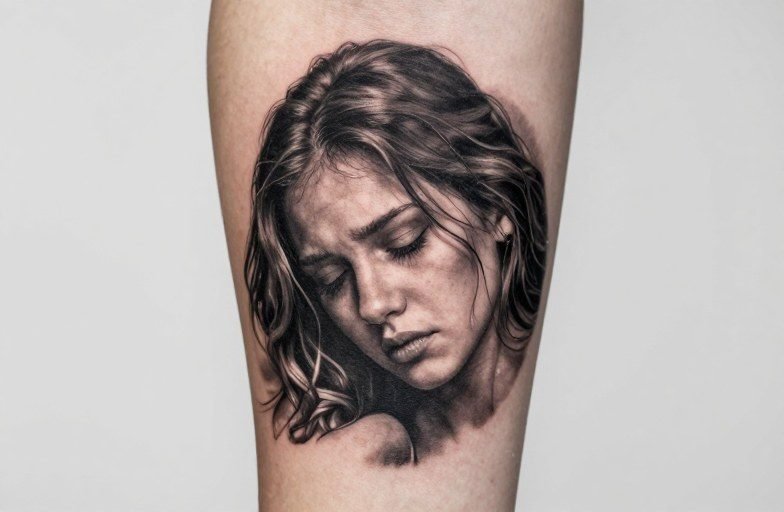
A depressed tattoo typically symbolizes lived experience with depression, mental health struggles, or emotional lows, often serving as acknowledgment, memorial, or quiet signal to others who recognize the reference. Designs range from literal text (the word itself, sometimes struck through or paired with contrasting imagery) to visual metaphors: rain clouds, half-faced masks, wilting flowers, or barren landscapes. The meaning hinges on whether the wearer intends private recognition, public statement, or something between.
How It Ages on Skin
Text-Based Designs
The word “depressed” or related phrases demand careful technical execution. Fine lettering below 10-point equivalent blurs within 5-8 years on high-movement areas, wrists, inner forearms, collarbone. Bold sans-serif fonts hold edges longer than script or thin-line styles. Lettering over joints (wrist flexion points, elbow creases) distorts faster; the skin there stretches and compresses thousands of times daily. For longevity, keep text at least 3/8 inch tall, opt for heavier line weight, and place on flatter surfaces: outer forearm, upper arm, calf, or ribs.
Imagery and Shading
Clouds, rain, or abstract mood pieces with soft grey wash require more maintenance than solid black graphics. Grey wash lightens faster than saturated black; what reads as atmospheric depth at six months can flatten to muddy tones by year ten. High-contrast designs, solid black silhouettes against skin, or stark positive/negative space, age more predictably. If your design includes a “before/after” or “then/now” split (common in this theme), know that the lighter side may need reinforcement sooner. See also: Dogwood Flower Tattoo Meaning: Resilience, Faith & Renewal.
- Flat planes (outer forearm, thigh, back) preserve detail better than curved or high-flex zones
- Single-needle fine lines fade faster; 7-9RL or mag shaders deposit more stable ink
- UV exposure degrades grey wash faster, plan for touch-ups or choose placement under clothing
Color vs Black and Grey
Black and Grey Approaches
This palette dominates depressed tattoo work for practical and symbolic reasons. Monochrome reads as somber, archival, or clinical, tones that match the subject without requiring explanation. Photorealistic black and grey can render tear tracks, pill bottles, or weathered faces with documentary weight. The downside: without color temperature variation, designs risk becoming illegible dark masses as they age. A skilled artist builds value through stippling, whip shading, or smooth gradients rather than uniform grey fill.
Strategic Color Use
When color appears, it usually functions as deliberate contrast: a single yellow sunbeam cutting through grey clouds, a red heart monitor line threading through blackwork, a green shoot emerging from dead earth. These accents draw the eye and create narrative tension. Muted colors, dusty rose, slate blue, desaturated ochre, suit the theme better than bright neons. Saturated color holds longer but can feel tonally wrong, like shouting about whispered subjects. Watercolor-style splashes, popular in 2010s mental health tattooing, have proven particularly fugitive; the soft edges and dilute pigment often heal patchy and fade unevenly. See also: Dollar Sign Tattoo Meaning: Wealth, Hustle & Risk.
Design Tips & Pairings
Composition matters enormously for tattoos carrying emotional weight. A small, isolated word on a wrist reads differently than the same word integrated into a larger scene. Consider these structural choices:
- Strikethrough or overwrite: the word “depressed” with a line through it, or overwritten with “decompressing,” “de-pressed,” or a personal reframe, visually active, suggests process rather than fixed state
- Dual imagery: two panels, one dark and one lighter, sometimes separated by a semicolon (the mental health continuation symbol) or a doorframe
- Object as proxy: an empty chair, an unanswered phone, a stopped clock, avoids literal text while remaining legible to those who know
- Integration with existing tattoos: weaving the theme into a larger sleeve or patchwork collection rather than standalone statement
Pairing with unrelated imagery requires care. A depressed tattoo adjacent to party or celebratory imagery can read as unintentionally ironic unless the juxtaposition is clearly deliberate, some clients intentionally seek that friction, others stumble into it. See also: Dragon Man Tattoo Meaning: Power, Protection & Rebellion.
Common Variations & Styles
Text-Based Variations
Beyond the word itself, phrases circulate: “not okay,” “this too shall pass” (sometimes with the last words smaller or fading), medication names in small type, or dates marking episodes or recoveries. Some use diagnostic language, “MDD,” “dysthymia,” “recurrent”, which functions as private shorthand or clinical reclamation. Typewriter fonts suggest documentation; handwritten scripts imply personal letter or diary entry.
Visual Metaphors
The half-mask, one face smiling and one weeping, has classical roots and remains common. Modern iterations include: the same face at different ages; a mirror reflecting something other than what’s before it; or a figure walking through rain that touches only them. Botanical imagery, dead bouquets, pressed flowers, roots without stems, offers organic vocabulary for emotional states. Geometric or abstract work (fragmented shapes, dissolving grids, negative space tunnels) appeals to those wanting ambiguity without narrative specificity.
Style choice affects reception. Traditional American boldness makes the subject confrontational; fine-line delicacy invites closer inspection; blackout or heavy blackwork creates armored, almost aggressive presentation. The same symbol in different styles communicates different relationships to the experience.
Who Chooses This Tattoo
Demographic Patterns
These tattoos appear across age groups but cluster in two peaks: early twenties (first independent acknowledgment of diagnosed or suspected depression) and mid-thirties to forties (longer perspective, sometimes memorializing survived periods). Gender presentation varies by design type, text-heavy pieces skew slightly more common among women and nonbinary clients in available shop data, though this likely reflects broader tattoo demographics rather than topic-specific patterns. Men more often choose abstract or object-proxy designs over direct text.
Motivation and Timing
Some seek the tattoo during active struggle, wanting external validation or a private anchor. Others mark recovery anniversaries, creating distance from the experience while honoring its reality. A smaller group memorializes lost friends or family, the tattoo functioning as secondary witness. The timing relative to acute episodes matters: artists sometimes gently suggest waiting periods for clients in immediate crisis, not because the subject is inappropriate but because permanent decisions deserve stable ground.
Personal & Modern Meanings
Contemporary interpretation has shifted with broader mental health discourse. Where once such tattoos might have read as shocking confession, they’re increasingly recognized as ordinary self-documentation, akin to medical alert tattoos or memorial work. Social media exposure has both normalized and sometimes trivialized the form; the semicolon tattoo’s viral spread created template pressure that some resist through more individualized design.
Modern meanings often include:
- Neurodivergence framing: depression as brain wiring rather than personal failure, sometimes paired with serotonin molecule diagrams (chemically inaccurate in popular renditions, but symbolically understood)
- Disability rights context: visible marker of an invisible condition, sometimes deliberately placed where medical professionals or intimates might notice
- Creative practice: writers, musicians, and visual artists sometimes reference “the depressed” as artistic identity or historical lineage (caution: this risks romanticizing pathology)
- Irony and reclamation: some Gen Z clients deploy the imagery with detachment, the tattoo itself a comment on overdisclosure culture
The personal meaning often includes contradiction, wanting to be seen and wanting control over how, wanting permanence for something that felt endless but passed, wanting to honor pain without being defined by it.
Before You Decide
Consider placement visibility relative to your professional and social contexts. The tattoo’s meaning to you won’t shield you from others’ interpretations; a wrist piece visible during job interviews or family gatherings carries different weight than rib or thigh work shown only by choice. Think about future you: will this mark a specific period, or does it represent ongoing, evolving relationship with the experience?
Artist selection matters particularly for emotionally loaded content. You need technical skill for the style you choose, but also someone who won’t rush consultation, who can hold space for the subject without either excessive curiosity or awkward avoidance. Bring reference images, but also bring language for what you want to feel when you see it, artists translate emotion to visual structure better with emotional direction, not just visual examples.
Finally, allow for design evolution. The tattoo that felt necessary at 22 may need different context at 40. Some plan for this: leaving space for additions, choosing compositions that accommodate later reframing, or simply accepting that tattoos, like people, accumulate meaning they weren’t born with.
Frequently Asked Questions
Will a depressed tattoo affect job prospects or professional image?
Visible placement matters more than subject. Wrist, hand, or neck tattoos of any content can limit certain fields; covered areas generally don’t. Some corporate environments remain conservative, while creative, tech, and service sectors increasingly accept visible work. Research your specific industry’s norms before committing to exposed placement.
Is it appropriate to get this tattoo if I haven’t been clinically diagnosed?
Your relationship to the experience is yours to define. However, diagnostic language or specific medication references carry different weight when used by those without direct experience. Consider whether your design choices might inadvertently claim lived experience that isn’t yours, and whether that matters to your intent.
How do I explain this tattoo to family members who might worry?
Prepare a brief, boundary-respecting explanation: “It marks something I’ve experienced” or “It reminds me of what I’ve moved through.” You owe no one clinical detail. Some find the tattoo itself reduces future explanation, visible acknowledgment preempts hidden assumption.
Can this tattoo be covered or removed if my feelings about it change?
Cover-up depends on size, density, and placement; black text covers more easily than heavy color or large solid areas. Laser removal works on most black ink but requires multiple sessions and complete removal is rare. Design with potential future modification in mind if you’re uncertain about permanent commitment.
Related Tattoo Meanings
- Bite Mark Tattoo Meaning: Pain, Passion, and Possession
- Born to Die Tattoo Meaning: Mortality, Rebellion Acceptance
- Lonely Wolf Tattoo Meaning: Solitude, Strength, and Self-Reliance
- Explore more









