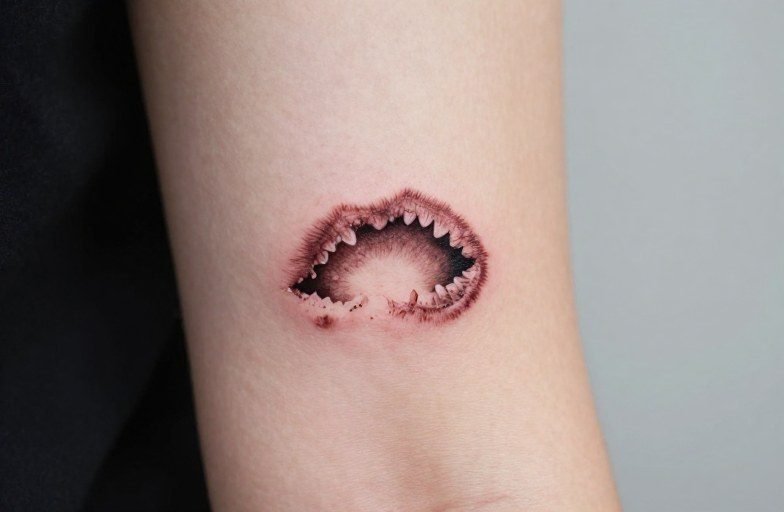
A bite mark tattoo typically signals intensity that borders on the primal: desire, survival, aggression, or darkly playful ownership. The meaning shifts sharply depending on context, a vampire bite on the neck reads romantic and dangerous, while a zombie bite on the forearm leans toward horror fandom or gallows humor about “infection.” Most people choosing this design want something visceral and immediate, not abstract or philosophical.
Symbolism & Core Meaning
Desire and Erotic Tension
The human bite carries loaded sexual connotation. A tattooed bite mark, especially on the neck, inner thigh, or collarbone, often references passion intense enough to bruise. Some trace this to vampire folklore, where the bite doubles as penetration and transformation. Others simply want the visual of being marked by someone or something. The placement matters enormously here: a bite on the wrist reads differently than one on the hip, even with identical artwork.
Survival and Combat
On the forearm, shoulder, or calf, a bite mark can signify surviving attack, literal or metaphorical. Shark bites, dog bites, or monster bites all fall into this category. The design often includes torn skin, blood, or exposed muscle beneath. This isn’t subtle symbolism; it’s a badge that says “something tried to end me and failed.” The visual impact comes from the contrast between ordinary skin and sudden violence.
Dark Humor and Subculture Signaling
Some bite marks are deliberately absurd, a cookie bite, a cartoonish human dental imprint, or a “love bite” rendered in exaggerated purple and yellow. These work as inside jokes or subculture identifiers. Zombie bite tattoos, especially with “infected” or outbreak dates nearby, immediately signal horror fandom without needing explanatory text.
Similar & Related Symbols
Close Visual Cousins
Claw marks and scratch tattoos share the same torn-flesh aesthetic but read more animalistic and less intimate. Bullet wounds and exit wounds carry similar survival narrative but feel more modern and militaristic. Brands and burned-in symbols also suggest forced marking, though without the bodily intimacy of teeth.
Thematic Overlaps
Vampire fang tattoos overlap heavily with bite marks, especially paired with dripping blood. Kiss marks and lipstick prints share the “marked by another” concept but read softer, more glamorous. Hickey-style bruising tattoos exist in the same erotic space but age poorly, purple and yellow ink fades fast and often muddies to brown.
- Claw marks: More animal, less intimate; often paired with tribal or werewolf themes
- Brands: Ownership without the mouth; historically linked to cattle and slavery, so loaded with different weight
- Vampire fangs: The tool before the wound; can be elegant where bite marks are messy
- Lipstick prints: Consensual marking, playful rather than aggressive
Best Placements
Where the Body Reads the Symbol
The neck and collarbone make the vampire/erotic reading almost automatic, too automatic for some, perfect for others. These spots also hurt more than most people expect; the skin is thin, close to bone, and full of nerve endings. Artists often recommend keeping bite marks here relatively small and simple; detailed shading in this area blurs faster than almost anywhere else on the body.
The inner bicep and thigh offer more privacy and softer canvas. A bite here feels secret, discovered rather than displayed. The fat and muscle underneath allow for more dimensional shading, artists can build the illusion of depressed tooth marks and raised swelling more convincingly.
Forearms and calves work best for survival-narrative bites: zombie attacks, animal maulings, combat damage. These placements get more sun exposure, which matters because red ink (common in blood and bruising effects) fades and shifts color fastest under UV. A forearm zombie bite that looks fresh in year one may read as rusty or orange by year five without touch-ups and sunscreen.
Placement Pitfalls
Hands and fingers seem appealing for the “just bitten” shock value, but the near-constant movement and shedding of skin in these areas destroys fine detail within months. Ribs allow large, dramatic work but the stretching and compression of breathing distorts circular shapes like dental impressions. Bite marks on the ribs often look slightly oval within weeks.
Religious & Spiritual Angles
Christian Imagery
The Lamb of God, wounded and marked, carries some distant resonance, though bite marks specifically aren’t traditional Christian iconography. Some trace certain saint martyrdoms to animal attacks, but this is rarely the reference point for modern bite tattoos. More commonly, people drawn to religious themes choose stigmata, crown of thorns, or explicit crucifixion wounds instead.
Occult and Pagan Contexts
Werewolf and shapeshifter bites appear in various folk traditions, often linked to transformation and loss of human control. The bite as vector for becoming-other shows up in Norse berserker lore and in later European witchcraft accusations. Modern pagan practitioners occasionally reference these threads, though most bite mark tattoos in this sphere are more pop-culture than reconstructed tradition.
Demonic possession narratives sometimes use bite marks as evidence of the body being fought over, God and devil both claiming territory. This visual shows up in certain exorcism films and occasionally in tattoo form, though it’s niche enough that most artists will need reference images rather than working from cultural common knowledge.
Design Tips & Pairings
Line Work vs. Shading
Clean black outlines around each tooth mark read as graphic, comic-influenced, or deliberately stylized. This approach ages better and heals more predictably. Full-color bruising and blood, purples, deep reds, yellow-green healing tones, requires more technical skill and more maintenance. The color realism looks striking fresh but demands touch-ups every few years to keep reading as bruise rather than murky discoloration.
Single-needle or fine-line bite marks can look delicate and almost elegant, but the thin lines spread and blur over time. For small placements, slightly bolder linework (3-5 needle groupings) holds crisper tooth impressions longer.
Common and Effective Pairings
- Blood drips: Adds immediate narrative; works best in deep crimson, not bright red
- Torn skin flaps: Increases the 3D illusion; requires experienced shading to avoid looking like gray blobs
- Text: “Infected,” a date, or a name can anchor the meaning; keep lettering simple and readable
- Creature features: Fangs, lips, or partial face emerging from the edge of the bite
- Contrast elements: A pristine bite mark surrounded by floral or geometric patterns creates intentional visual clash
Negative space bites, where the skin shows through as teeth marks against a dark background, offer a different approach entirely. These read more graphic design than horror, and they age exceptionally well since the “teeth” are your natural skin tone rather than ink that might shift.
Who Chooses This Tattoo
Demographics and Motivation
The bite mark attracts people who want visceral reaction over subtle interpretation. Horror fans, especially zombie and vampire enthusiasts, make up a significant portion. So do people in alternative relationship communities where marking and consensual possession carry specific personal meaning. Some choose it after surviving actual violence, reclaiming the image of being bitten on their own terms and timeline.
Age trends are hard to pin down without shop data, but anecdotal observation suggests two peaks: younger clients (early twenties) drawn to pop-culture horror aesthetics, and slightly older clients (thirties to forties) exploring darker or more explicit symbolic territory they’d have hesitated on earlier. The second group often has more existing tattoos and places the bite mark as part of a larger narrative sleeve or collection.
Gender and Presentation
While bite marks carry some traditionally “masculine” aggression and some traditionally “feminine” vampire-romance associations, the design crosses those boundaries constantly in practice. Placement and styling matter more than the symbol itself: a rough, scabbed zombie bite on a calf reads differently than a delicate, slightly bruised neck bite with a single drop of blood. Artists report both designs requested across all genders.
Key Takeaways
A bite mark tattoo succeeds or fails on clarity of intent. The symbol is too loaded to leave ambiguous, viewers will read it as sexual, violent, or humorous, and you want control over which. Placement drives that reading more than almost any other design element. Neck and collarbone signal intimacy and danger; forearm and calf signal survival and horror fandom.
Technically, these tattoos demand decisions about longevity. Color bruising and blood effects look dramatic fresh but require maintenance; black-line tooth impressions hold longer but read more stylized. Neither approach is wrong, but going in unaware leads to disappointment when the vivid purple “hickey” fades to brownish blur.
The best bite mark tattoos commit fully to their tone. Half-measures, realistic teeth with cartoon blood, or delicate linework with aggressive torn skin, confuse the eye and weaken the impact. Know what you’re saying with the mark, place it where the body amplifies that message, and let the artist execute with technical confidence rather than hedging between styles.
Frequently Asked Questions
Do bite mark tattoos hurt more than other designs in the same spot?
The pain depends entirely on placement, not the design itself. A bite mark on your neck will hurt more than one on your thigh because of skin thickness and nerve density. The detailed shading around tooth impressions can mean more needle passes over the same area, which some people find more irritating than simple line work.
How well do the bruise colors in bite mark tattoos hold up over time?
Purples, yellows, and bright reds fade faster than black or dark blue. On areas with sun exposure, color-realistic bruising can shift to muddy browns within three to five years. Touch-ups help, but many people plan for the faded version to read as older, healed scar tissue rather than fresh wound.
Will people constantly ask if my bite mark tattoo is real?
If it’s well-executed and on a visible spot like the neck or forearm, yes, strangers will ask. This is part of the design’s appeal for some and a nuisance for others. Placement on the thigh, hip, or upper arm reduces public commentary while keeping the visual impact for people you choose to show.
Can a bite mark tattoo be covered up or modified later?
Cover-ups are challenging because bite marks are often dark, dense, and irregularly shaped. The negative space within tooth marks can sometimes be incorporated into new designs, but full coverage usually requires something equally bold. Plan carefully; this isn’t a design that easily evolves into something softer.
Related Tattoo Meanings
- Hog Symbolism Tattoo Meaning: Grit, Prosperity Defiance
- Lonely Wolf Tattoo Meaning: Solitude, Strength, and Self-Reliance
- Rubber Duck Tattoo Meaning: Playfulness, Nostalgia Rebellion
- Explore more