
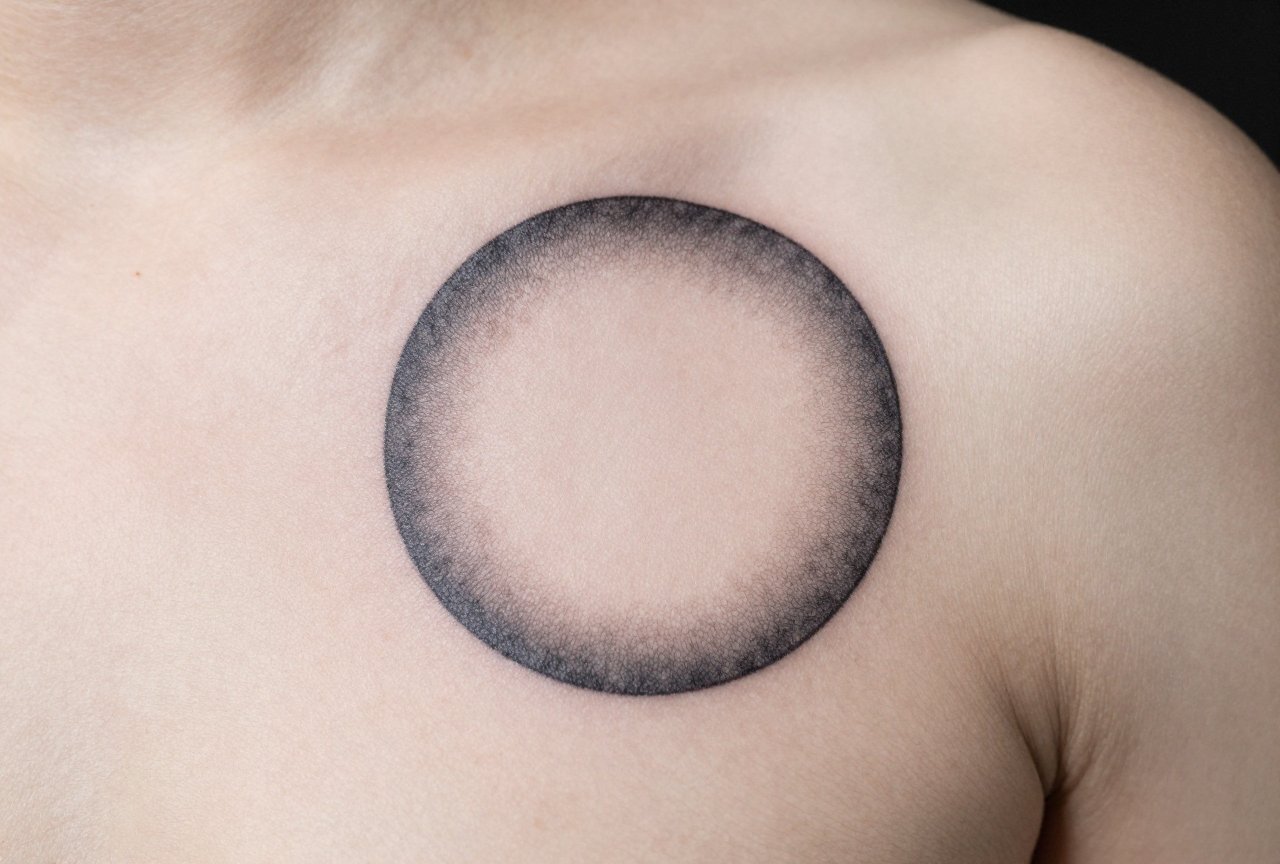
A circular tattoo is one of the oldest and most universal symbols in human culture. It represents wholeness, cycles, eternity, and the natural flow of life, no beginning, no end. I’ve tattooed hundreds of circles over the years, and every single one carries a different story from the person in my chair.
Symbolism & History
The circle predates written language. You see it in every ancient culture, Celtic sun wheels, Buddhist mandalas, Native American medicine wheels, the Ouroboros swallowing its tail. The shape itself holds power because it mirrors what we see in nature: the sun, the moon, eyes, seeds, cells dividing.
I tell clients all the time: a circle isn’t empty. That negative space in the center is the point of focus, the stillness inside motion. It’s the eye of the storm. When someone sits down and says “I want something simple, just a circle,” I know we’re about to dig into something deeper than they initially let on.
Spiritual and Philosophical Meanings
In my experience, people choose circles for three main philosophical reasons:
- Wholeness and self-acceptance. The circle encloses, it doesn’t exclude. It says “this is complete as it is.”
- Cycles and seasons. Life, death, rebirth. The turning wheel. I’ve tattooed circles on people who’ve lost someone, survived something, or started over completely.
- Protection and boundaries. A circle drawn around something creates sacred space. It’s the original magic circle.
Cultural Variations
Japanese ensō circles are painted in a single brushstroke, imperfect by design. They represent the moment of creation and the acceptance of flaw. Celtic knotwork circles weave endlessly, no loose ends. In my shop, we see a lot of people mixing traditions, someone wants the ensō feeling but with their own line quality, or a geometric mandala with personal symbols hidden in the symmetry.
Common Variations & Styles
Not every circle is a simple ring. The style changes everything about what it communicates and how it lives on your skin.
Line Work vs. Shaded Designs
A single clean line circle is brutally unforgiving. Every wobble shows. Every point where the needle overlaps itself is visible forever. I’ve seen artists refuse to do them because the technical pressure is so high, the circle has to be perfect, and human hands aren’t machines. When we do them, we often freehand the final pass or use a stencil only for placement, not for the line itself.
Shaded or stippled circles age softer. The gradient hides small imperfections, and the tattoo settles into skin more gracefully over five, ten, fifteen years. Solid black circles are bold but risky, if the ink spreads at all (and it often does, especially on thinner skin), you end up with a blob rather than a crisp edge.
Popular Motifs Inside the Circle
- Mandala: Geometric patterns radiating from center. Intense sessions, lots of dotwork, stunning when healed.
- Compass rose: Direction, guidance, travel. Often requested by people in transition.
- Floral wreaths: Life, growth, memorial. Roses and peonies age better than fine wildflowers.
- Abstract brushstroke: The ensō influence. Looks effortless, requires enormous control.
- Dotwork gradients: Thousands of individual dots creating tone. Hypnotic to watch, meditative to receive.
Best Placements
Where you put a circle changes how it reads. I’ve tattooed them everywhere, and some spots work better than others.
Forearm and wrist: Classic. Visible, the curve follows the limb naturally. Inner forearm skin is forgiving for line work. Wrists move constantly, so expect some settling and softening over time.
Behind the ear and neck: Small circles here feel intimate, almost secret. The curvature of the skull makes perfect circles tricky, we often adjust the shape slightly so it reads circular even if it isn’t geometrically perfect.
Chest and sternum: Bold statement. The circle sits over the heart, over the breath. I’ve done mandalas here that took six hours, the client lying still while we work inches from their face. The pain is real, but the placement feels ceremonial.
Thigh and calf: Larger canvas, more detail possible. Muscle movement can distort the shape when you flex, so we design with that in mind.
Fingers and hands: I try to talk people out of tiny circles on fingers. They blur. They fade. The skin there sheds fast and holds ink poorly. If someone insists, we go bolder, thicker, simpler.
Who Chooses This Tattoo / Personal Meanings
In my chair, the people who want circles aren’t one type. I’ve tattooed them on a seventy-year-old physicist who studied orbital mechanics his whole life. On a twenty-two-year-old who’d finally left a cult and wanted a symbol of self-contained wholeness. On a couple who got matching ensō circles after a miscarriage, the imperfect circle holding what they couldn’t say in words.
We see this a lot: someone comes in with a Pinterest board of elaborate designs, and by the third consultation they’ve stripped it down to a circle. The reduction is the point. They’re not dumbing down the tattoo, they’re distilling it.
Other times the circle is the starting point that grows. Someone wants a compass, then adds coordinates, then a banner, then their dog’s paw print. The circle contains the expansion. That’s its job.
What Artists Notice
We can tell when a circle is meaningful versus when it’s trendy. The meaningful ones have a specific size, a specific placement, a specific line weight the client has thought about. The trendy ones are vague: “just like, a circle, you know? Minimalist?” Both are fine. But the tattoo sits differently on skin when the person wearing it knows why.
Similar Symbols
People often circle around the circle (pun intended, we make that joke in shops constantly) before deciding. They compare it to:
- The spiral: Growth, evolution, journey inward. Less static than a circle, more dynamic.
- The triangle: Direction, tension, hierarchy. Edges where the circle has none.
- The ouroboros: Technically a circle, but the snake eating its tail adds destruction and renewal to the basic loop.
- The moon phases: Cyclical like a circle, but explicitly about change and passage rather than eternal return.
I usually ask clients: do you want to emphasize the completion or the cycle? Completion points to the circle. Cycle might point to phases, spirals, something with visible movement.
Final Thoughts
A circular tattoo is never just a circle. It’s the shape of the planet you live on, the pupils you see love through, the ring on a finger, the horizon you chase. It’s the simplest possible tattoo and somehow still the hardest to execute well.
If you’re considering one, spend time with the shape before you commit. Draw it. Trace it on your body with a marker. Live with it for a week. The circle isn’t going anywhere, it’s been here since before humans, and it’ll outlast us all. Your version just gets to join that lineage for a little while.
Frequently Asked Questions
Do circular tattoos blur or fade faster than other shapes?
Not inherently, but placement matters. Circles on high-movement areas like fingers or wrists tend to soften at the edges over time. A well-executed circle on stable skin like the forearm or thigh can stay crisp for decades with proper aftercare.
How much does a simple circle tattoo cost?
Don’t expect a discount for simplicity. A perfect circle takes enormous technical skill, and most artists charge their minimum or hourly rate regardless. I’ve spent forty minutes on a single ring that looked effortless but required complete concentration.
Can a circle tattoo be covered up or modified later?
Yes, but with limits. A solid black circle is hard to work with, it’s dense ink with no gradient to hide beneath. Lined or stippled circles offer more flexibility for future additions like floral elements or geometric patterns radiating outward.
What’s the most painful placement for a circular tattoo?
Sternum and ribs, hands down. The bone proximity and thin skin make the vibration intense. That said, I’ve had clients sit perfectly still for three-hour mandalas on their chests because the meaning outweighed the discomfort.
Related Tattoo Meanings
- Double Ambigram Tattoo Meaning: Words That Flip Into New Messages
- Fenrir Tattoo Meaning: Norse Wolf Symbolism Style Guide
- Flame Tattoo Meaning: Symbolism, Styles What Fire Represents
- Explore more









